

The US Attorney’s Office for the Southern District of New York opposed Van Dyke’s motion to dismiss on 19 August in what appears to be the first criminal insider trading prosecution brought over trades on a prediction market.⁴ The indictment against Gannon Ken Van Dyke, a US Army Special Forces master sergeant, alleges that he spent approximately $33,934 across thirteen Polymarket trades between 27 December 2025 and 2 January 2026 while holding classified access to the planning of Operation Absolute Resolve, the operation that apprehended Nicolás Maduro in Caracas on 3 January 2026. His alleged total profit was approximately $409,881.¹
The government has built five counts on two contested definitions. Both are being argued elsewhere while the motion sits before Judge Margaret M. Garnett.
Chronology
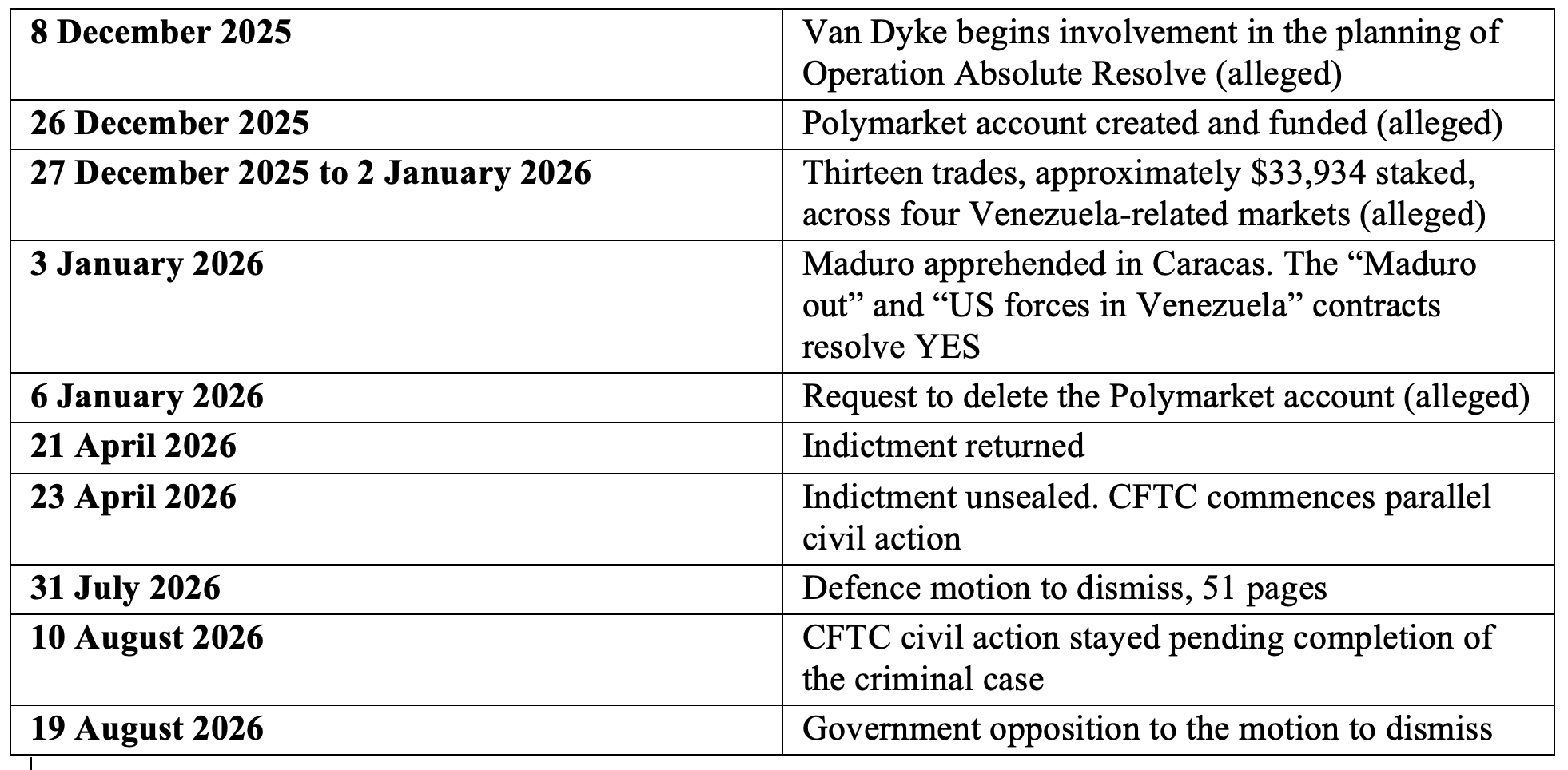
The positions did not all end the same way. The “Maduro out” and “US forces in Venezuela” contracts resolved YES. Van Dyke is alleged to have sold his war powers position at a profit before resolution, and to have sold his invasion position at a profit as well, although that contract ultimately resolved NO. This is important for loss and forfeiture rather than for liability, but it also disposes of the tidy account that the trades were a single winning bet on a single outcome.
The premise beneath counts one to three
Counts one and two arise under the government-information provisions inserted into the Commodity Exchange Act by section 746 of the Dodd-Frank Act, at 7 U.S.C. §§ 6c(a)(3) and 6c(a)(4)(C). The CFTC has described its parallel civil action as its first insider trading case involving event contracts and its first use of what practitioners call the Eddie Murphy Rule.² Count three alleges commodities fraud under 7 U.S.C. §§ 9(1) and 13(a)(5), on a misappropriation theory of the kind familiar from securities insider dealing.
Each of those counts characterises the transactions as swaps. The definition at 7 U.S.C. § 1a(47)(A) reaches agreements providing for payment on the occurrence of an event “associated with a potential financial, economic, or commercial consequence”. The government’s position is that Maduro’s removal carried consequences for crude prices, Venezuelan sovereign bonds and the bolívar, which places the contracts inside the definition. The defence position is that a geopolitical bet remains a bet.
A divided Third Circuit accepted the government’s side of that argument at the preliminary-injunction stage in KalshiEX LLC v Flaherty, 172 F.4th 220 (3d Cir. 2026), holding that sports event contracts were swaps because sporting outcomes carry economic consequences for sponsors, broadcasters, franchises and local economies. The authorities below are divided. The Southern District of Ohio denied Kalshi an injunction on the footing that its contracts were likely not swaps, while the Middle District of Tennessee granted one. A Sixth Circuit panel heard the consolidated merits appeals on 30 July 2026 and has not ruled.³
Neither appeal binds Judge Garnett, and neither concerns these contracts. The Kalshi litigation is about sports event contracts listed on a designated contract market, in a pre-emption dispute with state gaming regulators. Van Dyke concerns Venezuela contracts on the platform the indictment describes as operated by Blockratize, Inc., in a criminal prosecution. A Sixth Circuit judgment against Kalshi would deepen an appellate disagreement about the reach of the swap definition rather than resolve the question in this case. The parallel civil action, CFTC v. Van Dyke, No. 1:26-cv-03369 (S.D.N.Y.), was stayed on 10 August 2026 pending completion of the criminal case, so the definitional question will now be answered first in a criminal court.
Property after Blaszczak and Chastain
Count four charges wire fraud under 18 U.S.C. § 1343. Money or property must be an object of the alleged scheme. The indictment pleads that the classified information carried pecuniary value.
The Second Circuit has been contracting that term. In United States v. Blaszczak, 56 F.4th 230 (2d Cir. 2022), the court held that confidential Centers for Medicare & Medicaid Services information about forthcoming reimbursement rates was regulatory in character rather than proprietary and so fell outside the statute, notwithstanding that the information moved markets and was held in confidence. In United States v. Chastain, 145 F.4th 282 (2d Cir. 2025), decided on 31 July 2025, the court vacated the wire fraud conviction in the first non-fungible token “insider trading” prosecution and held that confidential business information constitutes property only where it carries commercial value to its owner.
Blaszczak preserved United States v. Girard, 601 F.2d 69 (2d Cir. 1979), in which records identifying Drug Enforcement Administration informants were held to be a record or thing of value under 18 U.S.C. § 641 because the information was inherently valuable to the agency’s operations. Judge Richard Sullivan, dissenting in Blaszczak, questioned how Girard could survive the majority’s reasoning. The analogy is therefore imperfect on its face, since Girard turned on the conversion statute rather than on section 1343, and prosecutors must persuade the court that operational military intelligence sits closer to the informant records in Girard than to the regulatory information in Blaszczak or the listing information in Chastain.
The pleading of pecuniary value suggests an alternative argument under Chastain, treating the price the information commanded on Polymarket as evidence of the value it held. That reasoning has an awkward shape. It makes the property status of a national security secret depend on the existence of a market prepared to price it, which is a market the government neither authorised nor controls.
What practitioners should take from this
Three points follow for anyone advising holders of confidential information.
First, most insider trading and MNPI policies are drafted by reference to securities and say nothing about event contracts. Earnings, regulatory approvals, clinical results and deal timing now have a tradable venue that sits outside the securities perimeter as most codes of conduct define it. The gap is a drafting problem rather than a doctrinal one, and it is straightforward to close.
Second, the outcome of the dismissal motion will not settle the swap question. A Sixth Circuit judgment against Kalshi would produce a split with the Third Circuit and a plausible route to the Supreme Court, with the CFTC’s own event contract rulemaking running alongside it.
Third, the property question has consequences well beyond prediction markets. If classified operational information is property under section 1343 because a betting market will pay for it, the same logic reaches any confidential government information for which a market exists. If it is not property, the wire fraud count falls away and the prosecution rests on the Commodity Exchange Act counts, which are the counts exposed to the definitional dispute.
The court has not ruled on the motion.
Notes
1. Indictment, United States v. Van Dyke, No. 1:26-cr-00156 (S.D.N.Y., returned 21 April 2026), at paragraph 10 for the aggregate stake. See also U.S. Attorney’s Office, Southern District of New York, Press Release 26-109, 23 April 2026, which gives a slightly different aggregate figure.
2. Commodity Futures Trading Commission, Release 9217-26, 23 April 2026. The government-information prohibitions were inserted by section 746 of the Dodd-Frank Wall Street Reform and Consumer Protection Act 2010.
3. Oral argument in the consolidated Ohio and Tennessee appeals was heard on 30 July 2026 before Judges Gibbons, Clay and Bloomekatz. An earlier unpublished Sixth Circuit order of 24 April 2026 upheld the Ohio injunction denial while assuming, without deciding, that the contracts were swaps.
4. The DOJ announcement does not itself claim a first. The characterisation rests on specialist commentary, which hedges it, and on the CFTC’s statement that its parallel civil action was its first insider trading case involving event contracts.