

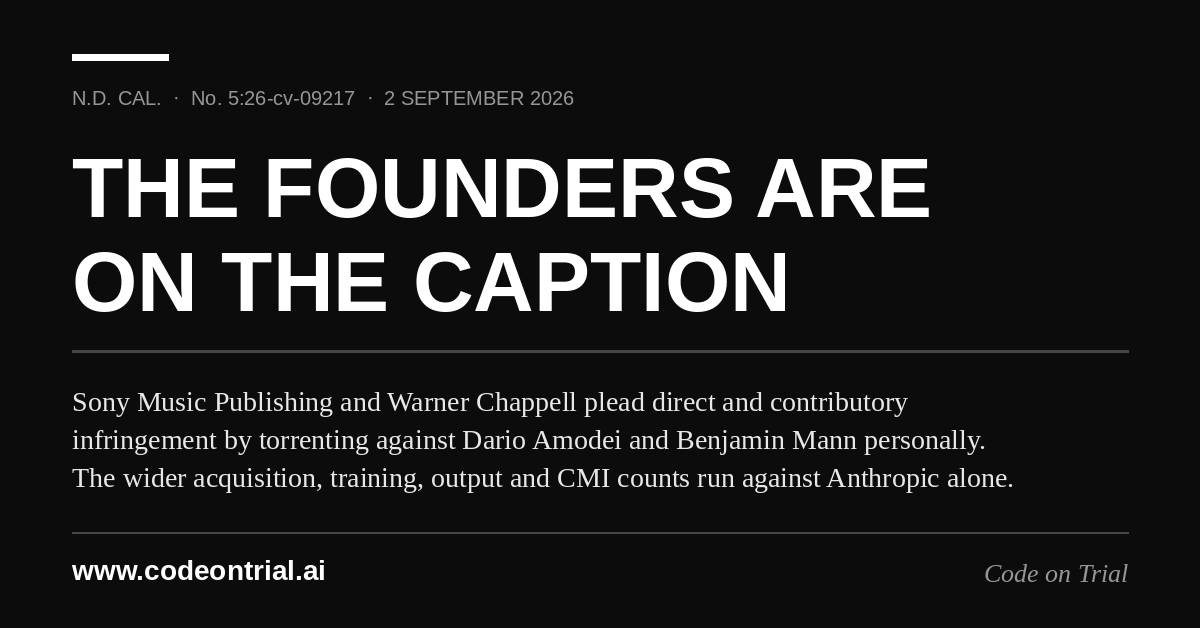
Sony Music Publishing and Warner Chappell have sued Anthropic PBC and named Dario Amodei and Benjamin Mann as individual defendants.1 The corporate defendant is the obvious target. The naming of two individuals is the development that will occupy general counsel this week.
A pleading that travelled
Paragraph 79 of the complaint cites Benjamin Mann’s answer in the second Concord action.2 In that answer Mann pleads that he discussed acquiring LibGen data with Amodei and other Anthropic colleagues, and that “Dr. Amodei approved”. The complaint also alleges that Anthropic’s internal policy required the chief executive’s express approval before a new dataset could be obtained or used in model development.
An answer of that kind is ordinarily protective. It places the employee’s conduct inside a corporate authorisation structure and invites the court to treat the company as the actor. Read across into a fresh complaint, the same paragraph identifies the person who authorised the act. Sony and Warner Chappell have taken an internal approval requirement, which existed to control the company’s data practice, and used it as the evidential route to the officer who operated it.
The complaint pairs that with material unsealed in Bartz: Mann’s description of LibGen as “sketchy AF”, and Anthropic’s own Archive Team recording that the site was a “blatant violation of copyright”.3 The knowledge element for contributory liability is being assembled from the defendants’ own documents.
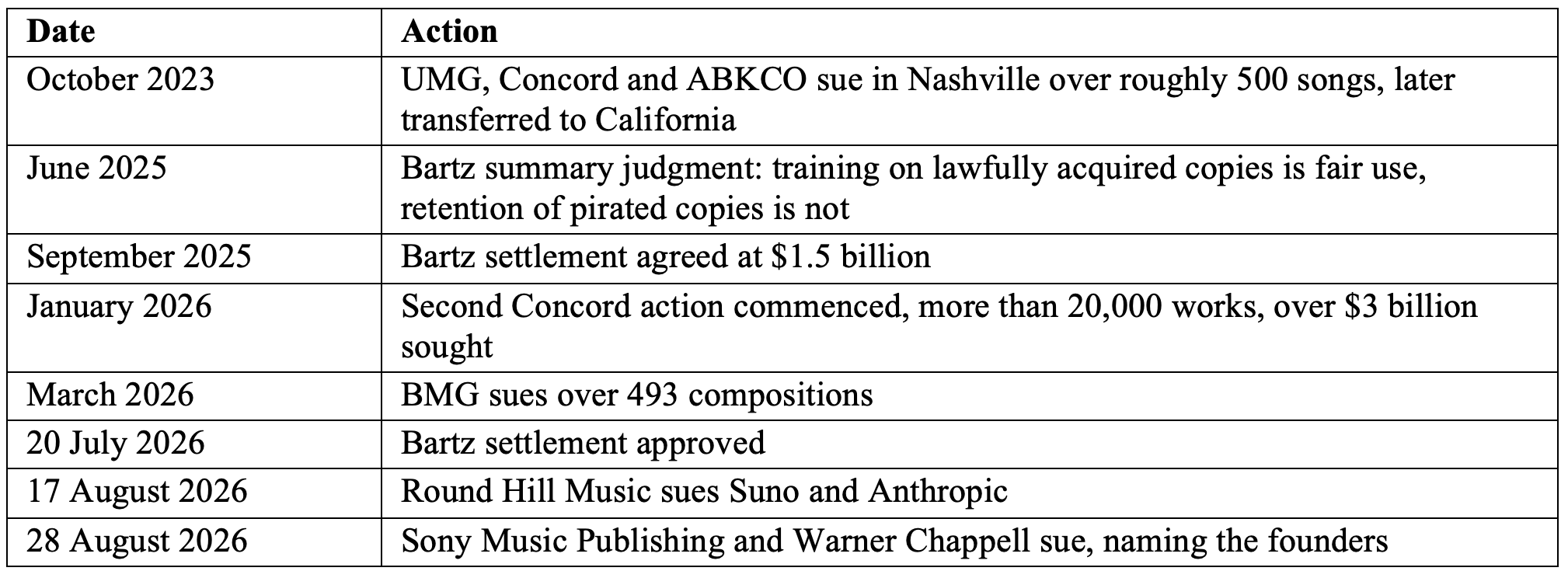
The sequence
The English comparison
An English claimant would face a different structure and, on these facts, might find it easier rather than harder.
Accessory liability against a director tightened considerably in Lifestyle Equities CV v Ahmed.4 The Supreme Court held that a director who procures a company’s tort is liable as an accessory only if he knows the essential facts that make the act wrongful, and that this holds even where the underlying tort is one of strict liability. Trade mark infringement did not become a route to personal liability simply because it required no knowledge as against the company.
Copyright is differently drafted. Section 16(2) of the Copyright, Designs and Patents Act 1988 provides that copyright is infringed by a person who, without the licence of the copyright owner, does or authorises another to do any of the acts restricted by the copyright. Authorisation is infringement in its own terms rather than accessory liability grafted onto the company’s wrong, so the Lifestyle Equities knowledge requirement does not govern it. The constraint comes instead from CBS Songs Ltd v Amstrad Consumer Electronics plc, where the House of Lords held that to authorise means to grant or purport to grant, expressly or by implication, the right to do the act complained of.5
On the facts pleaded, an approval given under a policy that required it before the dataset could be acquired sits close to the centre of that definition. Amstrad escaped because it sold equipment and had no control over what purchasers chose to record. A chief executive whose required approval preceded the download has no comparable distance from the act.
What this changes for the developer
Personal exposure therefore begins to affect the case before liability is determined.
Naming the founders immediately raises questions about indemnification, defence costs and the scope of any directors’ insurance. Much will depend on the policy wording, particularly whether a conduct exclusion operates only after a final adjudication. Their position may therefore complicate a settlement negotiated principally for the company.
The second consequence is evidential discipline. Anthropic is defending several publisher actions arising from the same acquisition conduct. A pleading served in one is available in the next, and an answer drafted to establish corporate authority is a document that names the officer who gave it.
The Bartz litigation showed that the provenance of a training corpus, quite apart from the fact of training, can create ten-figure exposure. This complaint seeks to attach that exposure to named individuals.
Anthropic has said it disagrees with the claims and intends to defend itself robustly. No defendant has yet responded to the complaint.
Notes
1. Sony Music Publishing (US) LLC v. Anthropic PBC, No. 5:26-cv-09217 (N.D. Cal., commenced 28 August 2026). Thirty-five plaintiff entities. Count I is pleaded against all three defendants, Count II against Amodei and Mann, and Counts III and IV against Anthropic alone.
2. Concord Music Group, Inc. v. Anthropic PBC, No. 5:26-cv-00880-EKL (N.D. Cal.), ECF No. 106 (Answer to Amended Complaint by Benjamin Mann), at ¶ 71, cited in the complaint at ¶ 79.
3. Bartz v. Anthropic PBC, 791 F. Supp. 3d 1038, 1064 (N.D. Cal. 2025). The internal material is cited in the complaint at ¶¶ 78 and 79 to the Bartz docket, ECF No. 325 at 8 and ECF No. 337-1 at 144:4-13 and 396:3-13.
4. Lifestyle Equities CV v Ahmed [2024] UKSC 17.
5. CBS Songs Ltd v Amstrad Consumer Electronics plc [1988] AC 1013 (HL).