

Introduction
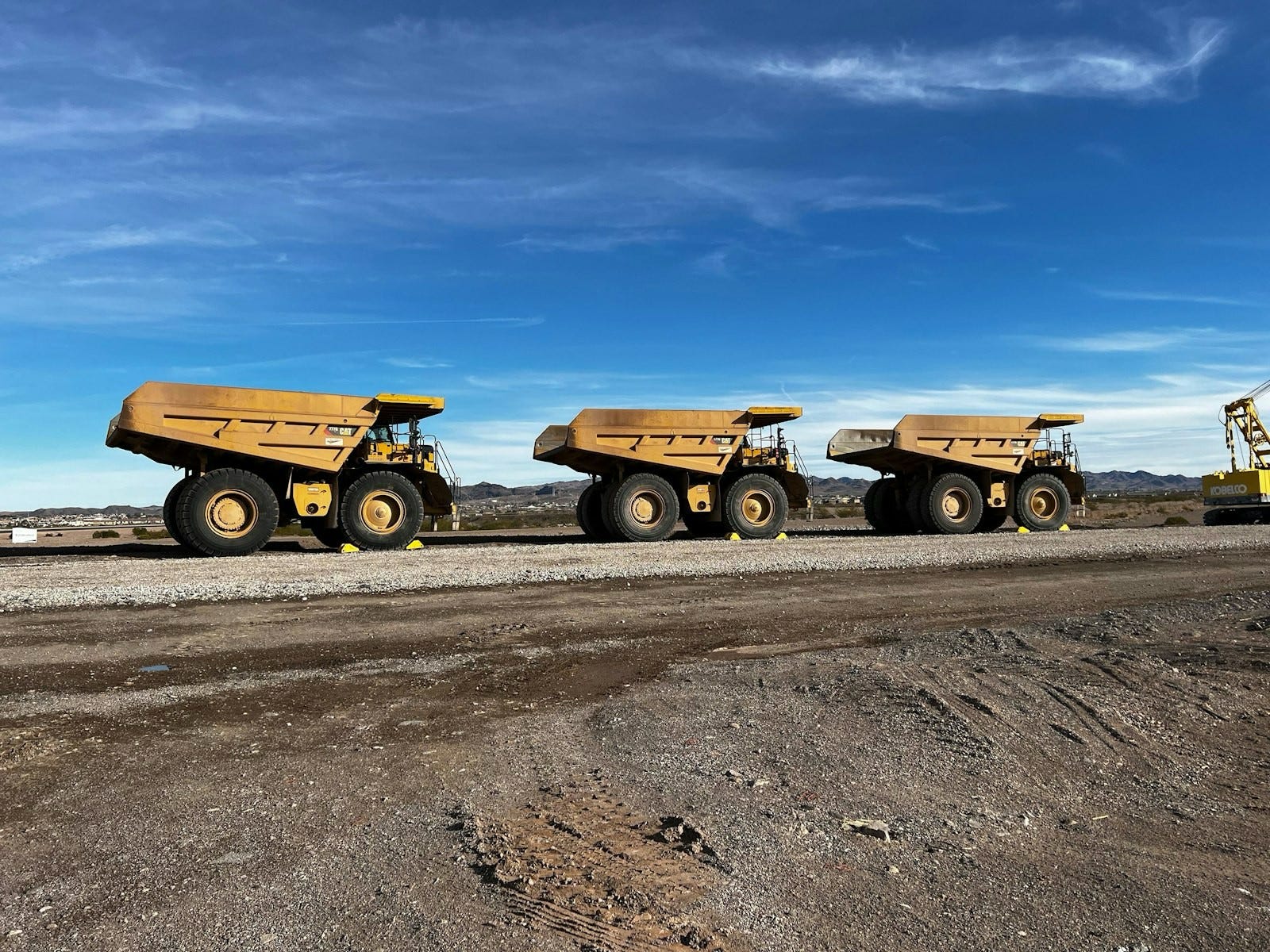
In August 2024, Rio Tinto accepted its 300th autonomous-haulage-system truck for its Pilbara operations, with the fleet distributed across ten Australian mine sites.1 The initial autonomous-haulage trial began in 2008. By the 2024 milestone, the fleet had completed 8.9 million operating hours and moved more than 4.8 billion tonnes of material. For scale, a Komatsu 930E-5SE has a rated gross vehicle weight of 521.6 tonnes.1 BHP operates a comparable autonomous fleet at its Jimblebar and Goonyella mines.2 Caterpillar and Komatsu supply the vehicles and the autonomous haulage systems that control them. Autonomous haulage is now deployed at scale across mines in Australia, Canada, Chile and China.3
The safety record has been strong. BHP reported a 65% reduction in events with fatal potential across its Western Australian Iron Ore operations between FY2018 and FY2022, attributed in part to autonomous haulage deployment.2 But it is not unblemished. In August 2023, an autonomous haul truck at BHP Mitsubishi Alliance’s Goonyella open-pit coal mine in Queensland collided with a manually operated excavator after a loss of communications on the autonomous circuit.4 No one was injured.4
In a separate Pilbara incident in November 2018, a BHP iron-ore train stopped automatically after a communications failure. The driver left the cab to apply handbrakes to individual wagons, after which a timed shutdown sequence released the locomotive brakes and the train rolled more than 90 kilometres before being deliberately derailed near Port Hedland.5 That was a conventional runaway rather than an autonomous system failure, but it illustrates the consequence of assumptions about machine control at industrial scale.
The legal framework governing autonomous mining equipment sits at the intersection of workplace health and safety regulation, product liability, environmental law and the contractual allocation of risk between mine operators and technology suppliers. Western Australia published a dedicated Code of Practice for Safe Mobile Autonomous Mining in 2015, updated most recently in February 2025.6 Queensland has its own guidance framework.7
Autonomous Haulage and the Duty Holders
Autonomous haulage was driven by safety as much as by economics. Mining is among the most hazardous industrial activities. Haul truck rollovers, collisions and pedestrian strikes account for a significant proportion of mine fatalities worldwide.
The automation that reduces aggregate risk creates a different category of dispute when it fails. A conventional haul-truck accident engages the operator’s statutory duties, potential regulatory enforcement and, in serious cases, prosecution of the corporate operator and relevant officers or other duty holders. An autonomous-system failure distributes the analysis across multiple participants. The mine operator selected and deployed the system. The technology supplier may have designed or supplied the autonomous-control software. The equipment manufacturer built the truck. Where separately engaged, a systems integrator configured the system for the particular mine site. The mine’s safety management system defined the operating parameters, exclusion zones and interaction protocols between autonomous and human-operated equipment.
Western Australia’s Code of Practice, originally approved under the former Mines Safety and Inspection Act 1994, continues in force as a transitional code of practice under the Work Health and Safety Act 2020.6 It allocates interlocking responsibilities to system builders and system operators, while site-specific obligations remain non-exclusive. Operators, designers, manufacturers, importers and suppliers may each carry distinct statutory, contractual and tort obligations regarding plant design, safety information and risk management.8 The question in any autonomous mining dispute will be which duty holder’s conduct, omission or system-design decision was causally relevant to the harm.
Queensland’s guidance takes a similar outcome-based approach, requiring proactive risk assessment before deployment and ongoing monitoring of autonomous system performance.7 QGN33 is a guidance note rather than a Recognised Standard. It assists mine operators to meet their legislative obligations but does not displace the statutory requirement to keep risk within acceptable limits and as low as reasonably achievable. Neither instrument was drafted as a bespoke regime for machine-learning models that are periodically retrained. Both nevertheless address change management, system updates and upgrades, verification and validation, communications integrity and cyber-security. The unresolved issue is whether those broad controls are sufficiently granular for model versioning, data drift, retraining validation and post-deployment monitoring.
Tailings Monitoring and the Brumadinho Legacy
The Fundao tailings dam at Mariana, operated by Samarco (a joint venture between BHP and Vale), collapsed on 5 November 2015, killing nineteen people.9 The environmental contamination extended across 600 kilometres of river. In October 2024, BHP, Vale, Samarco and Brazilian public authorities executed a reparation agreement valued at R$170 billion (approximately USD 31.7 billion), covering prior expenditure and future remediation obligations.9 That agreement addressed the public-authority claims.
Separately, over 600,000 claimants, including individuals, businesses, institutions, municipalities, utilities and Indigenous and Quilombola communities, brought proceedings against BHP in the English courts. In November 2025, the English High Court found BHP liable under Brazilian statutory environmental liability, including the polluter principle and strict liability under the applicable environmental legislation, and on fault-based grounds under the Brazilian Civil Code.10 In May 2026, the Court of Appeal refused BHP permission to appeal on the principal liability grounds, though a narrow costs-interest issue remained.10
The Brumadinho tailings dam in Minas Gerais, also operated by Vale, collapsed on 25 January 2019, killing 270 people.11 Brumadinho reinforced scrutiny of tailings monitoring, governance and escalation arrangements across the industry. The Global Industry Standard on Tailings Management, launched in 2020, established the first global standard for tailings management and requires integrated monitoring arrangements.11 Vale, for example, has operated Geotechnical Monitoring Centres since 2019, using radar, robotic stations, automated piezometers, satellite monitoring, inspection drones and video cameras using artificial intelligence.11
The legal question generated by AI-assisted monitoring turns on knowledge and response. Once a monitoring system is deployed, its alarms, calibration records, data-retention arrangements and escalation procedures may become central evidence of what the operator knew, or ought reasonably to have known, and whether its response met the applicable statutory, contractual and operational standard. If a monitoring system detects anomalous piezometric readings consistent with internal erosion but the mine operator does not evacuate or modify operations, the failure to act on the system’s output will be examined against the operator’s permit conditions, safety case and escalation protocols. The converse question is also live: if a monitoring system fails to detect instability that a competent engineer would have identified, the adequacy of the system and the operator’s reliance on it without sufficient human oversight will both be in issue.
Automated monitoring, sensor networks and dashboard alerts should not be conflated with AI. The distinct legal questions arise where an algorithmic model interprets data, predicts instability, prioritises risk or recommends operational intervention beyond rules-based alerting.
The English proceedings arising from Mariana were determined under Brazilian substantive law and are not, in themselves, a new English-law parent company duty decision. Where English law governs, Vedanta Resources plc v Lungowe confirms that parent exposure turns on ordinary duty of care principles applied to the parent’s own conduct.12 A group-wide mandate of a monitoring platform may be relevant to that inquiry, but it will not be determinative. The deployment of AI monitoring systems across a global mining group adds a dimension: if the parent specifies a particular platform across its operations and that platform proves inadequate, the parent’s selection, specification and oversight of the technology may form part of the factual matrix in which an ordinary duty of care analysis is conducted.
AI in Geological Modelling and Exploration
AI is now used across the exploration lifecycle. Machine-learning models integrate geological, geophysical and geochemical data to identify prospective mineral deposits. ALS Geoanalytics, formerly ALS GoldSpot and GoldSpot Discoveries, and other specialist providers offer AI-assisted exploration and targeting tools.13 Caterpillar’s MineStar suite illustrates a different part of the value chain: autonomous operations, fleet management and operational data analysis. Specialist providers are marketing AI-assisted tools for drill-hole targeting, ore-body modelling and resource-estimation workflows, but adoption rates vary by commodity, jurisdiction and the maturity of the underlying geological data.
Mining companies raise capital on the basis of resource and reserve estimates disclosed under reporting codes, including JORC in Australia, NI 43-101 in Canada and SAMREC in South Africa. These regimes require relevant technical disclosure to be prepared by, under the supervision of or, where the applicable instrument permits, approved by a designated Competent Person or Qualified Person, subject to their respective consent, certification and disclosure requirements.14 Professional sign-off, the scope of the professional’s supervision, applicable disclosure obligations, investor reliance, causation and the relevant securities law will together determine the exposure of each participant if an AI-assisted estimate proves materially wrong. If the responsible professional relies on an AI-generated geological model without appropriate validation of the model’s inputs, assumptions, performance and limitations, that reliance will itself be examined against the professional standard.
The risk is established in conventional geological misrepresentation. Bre-X illustrates how false or manipulated geological results can generate investor claims and securities litigation.15 AI does not alter the underlying disclosure framework, but it adds questions about model validation, data provenance, version control and the disclosure of material limitations to investors.
Strategic Outlook
Autonomous mining is currently governed through general workplace-safety duties, autonomous-mining codes and guidance, site-specific safety arrangements and supplier obligations, rather than a bespoke regime for model governance. A serious incident would test how those overlapping obligations apply to software updates, sensor failures, degraded communications, inadequate escalation and the allocation of risk within the operator–supplier contract stack.
A fatal autonomous-mining incident could generate litigation concerning the respective obligations of the mine operator, technology supplier, equipment manufacturer and, where relevant, systems integrator, against the applicable regulatory framework and the site-specific safety arrangements governing the deployment. Beyond haulage, the expansion of AI-assisted tools into geological modelling, environmental monitoring and tailings management may give rise to claims under securities law and environmental regulation and, on appropriate facts, parent-company duty principles. The regulatory frameworks in Western Australia and Queensland address change management, system updates and verification, but whether those controls are sufficiently granular for AI-specific risks remains untested.
The disputes will not turn on whether a mine used AI in the abstract. They will turn on system design, approved operating limits, version control, sensor integrity, change management, human override, alarm escalation and the allocation of responsibility across the operator-supplier contract stack.
Notes
1. Rio Tinto accepted its 300th autonomous haul truck in the Pilbara in August 2024, across ten mine sites; by that milestone the fleet had completed 8.9 million operating hours and moved more than 4.8 billion tonnes of material (Komatsu media release, 12 August 2024). Komatsu 930E-5SE rated gross vehicle weight 521.6 tonnes. Autonomous haulage trials at Rio Tinto Pilbara operations since 2008 (Rio Tinto).
2. BHP Western Australian Iron Ore operations; 65% reduction in events with fatal potential FY2018–2022, attributed in part to autonomous haulage deployment (Haight & Burgess-Limerick, CDC/NIOSH, 2023). BHP autonomous fleet deployed at Jimblebar and Goonyella mines.
3. GlobalData’s Mining Intelligence Center tracked 3,832 autonomous haul trucks operating at surface mines globally in July 2025, including systems classified as autonomous-ready as well as those operating autonomously. China accounted for 2,090 units, followed by Australia, Canada and Chile (GlobalData, Development of Autonomous Trucks in the Global Mining Sector, 2025).
4. BHP Mitsubishi Alliance, Goonyella open-pit coal mine, Queensland, August 2023; autonomous truck collided with manually operated excavator following loss of communications on autonomous circuit; no injuries (Mining Monthly, January 2024).
5. BHP Pilbara iron-ore train runaway, 5 November 2018. Train stopped automatically on communications failure; driver left cab to apply handbrakes to individual wagons; 60-minute locomotive shutdown sequence subsequently released brakes; train travelled more than 90 km before controlled derailment near Port Hedland. ATSB investigation report RO-2018-018.
6. Western Australia Code of Practice for Safe Mobile Autonomous Mining, WorkSafe WA, first published 2015, updated 17 February 2025. Originally approved under the Mines Safety and Inspection Act 1994; continues in force as a transitional code of practice under the Work Health and Safety Act 2020 (WorkSafe WA).
7. Queensland Guidance Note QGN33, Autonomous mobile machinery and vehicle introduction in coal mines (Resources Safety & Health Queensland).
8. Under WA’s Work Health and Safety Act, duties extend to persons conducting a business or undertaking, designers, manufacturers, importers and suppliers of plant, each with obligations regarding design safety, information, installation and use (WorkSafe WA).
9. Fundao tailings dam (Samarco/BHP/Vale), Mariana, collapse 5 November 2015; 19 fatalities. Reparation agreement with Brazilian public authorities signed 25 October 2024, ratified by the Brazilian Supreme Federal Court 6 November 2024; valued at R$170 billion (approx. USD 31.7 billion), covering prior expenditure and future remediation obligations (BHP media release, November 2024).
10. Municipio de Mariana & Ors v BHP Group (UK) Ltd [2025] EWHC 3001 (TCC), judgment 14 November 2025; BHP found liable under Brazilian statutory environmental liability (polluter principle, strict liability) and on fault-based grounds under the Brazilian Civil Code; over 600,000 claimants. BHP Group (UK) Ltd v Municipio de Mariana & Ors [2026] EWCA Civ 502; Court of Appeal refused BHP permission to appeal on principal liability grounds, May 2026; narrow costs-interest issue remained.
11. Brumadinho tailings dam (Vale), Minas Gerais, collapsed on 25 January 2019, causing 270 fatalities; two victims remain missing. Global Industry Standard on Tailings Management launched 5 August 2020 by UNEP, PRI and ICMM. Vale Geotechnical Monitoring Centres operating since 2019, using radar, robotic stations, automated piezometers, satellite monitoring, inspection drones and video cameras using artificial intelligence (Vale, “Vale concludes de-characterization of the first of nine upstream dams as announced earlier this year”, 27 November 2019).
12. Vedanta Resources PLC v Lungowe [2019] UKSC 20; parent-company liability in English law turns on ordinary duty-of-care principles, including the parent’s own conduct, control, group policies and assumption of responsibility.
13. ALS Geoanalytics (formerly ALS GoldSpot and GoldSpot Discoveries; renamed October 2024) offers AI-assisted exploration and targeting tools; Caterpillar MineStar suite covers autonomous operations, fleet management and operational data analysis. Precise industry-wide adoption rates vary by survey methodology and definition.
14. JORC (2012) and SAMREC require a Competent Person; NI 43-101 requires a Qualified Person. Relevant technical disclosure must be prepared by, or under the responsibility or supervision of, that person. Issuers and directors or officers may bear separate disclosure responsibility under applicable securities law.
15. McNamara v Bre-X Minerals Ltd, 57 F Supp 2d 396 (ED Tex 1999); securities-fraud claims arising from alleged fabrication of geological assay results at the Busang gold deposit, Indonesia.