

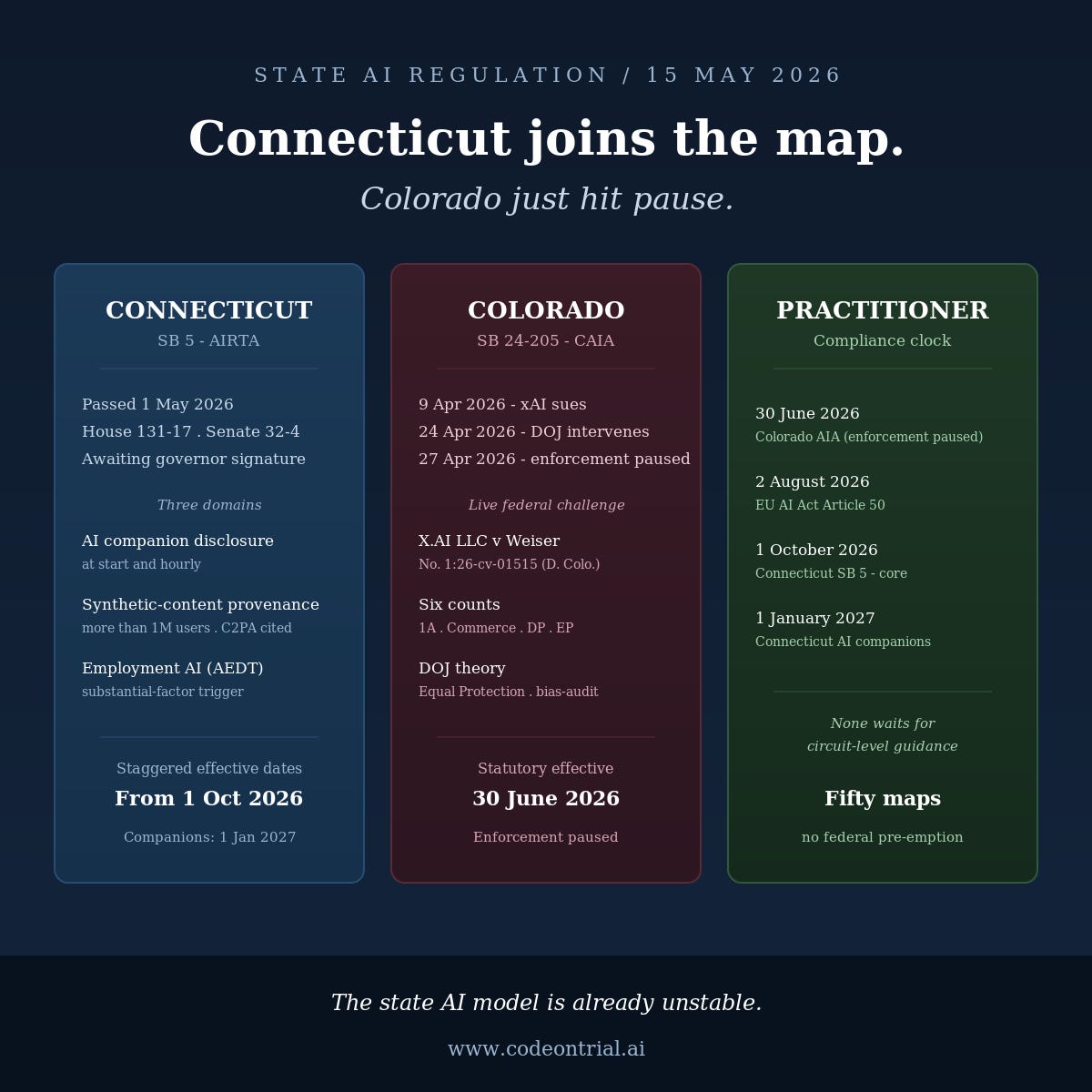
Connecticut’s General Assembly passed SB 5 on 1 May 2026 by 131–17 in the House and 32–4 in the Senate. Governor Lamont’s office has signalled he will sign. If signed, the Connecticut Artificial Intelligence Responsibility and Transparency Act will become one of the most significant state AI packages to clear a US legislature in this cycle. It arrives in a landscape where the first such package, Colorado SB 24-205, has its enforcement temporarily suspended in federal court.
The Connecticut framework
SB 5 targets three domains. AI companions must disclose that the user is interacting with AI at the start of an interaction and at hourly intervals during continuous use.1 Large generative AI providers above a one-million-user threshold face synthetic-content provenance obligations, with the C2PA technical standard identified as one relevant methodology.2 Automated employment decision tools used as a substantial factor in hiring, promotion, discipline or discharge carry compliance obligations for developers and notice obligations for deployers.3
The effective dates are staggered. Core provisions begin on 1 October 2026. AI companion obligations begin on 1 January 2027. Public summaries diverge on the precise commencement of the synthetic-content and employment deployer obligations. The enrolled bill text controls. Freshfields places the provenance obligation on 1 October 2026 and the employment deployer obligation on 1 October 2027.4 Davis Wright Tremaine describes a broader watermarking obligation for synthetic digital content beginning 1 October 2027.5 DLA Piper describes SB 5 as a set of linked but distinct AI bills rather than a single governance statute.6 For in-scope providers, the legal effect may converge. The compliance date is what matters.
The Colorado litigation, the DOJ intervention and the enforcement pause
Colorado SB 24-205, the Colorado Artificial Intelligence Act, has a statutory effective date of 30 June 2026 after the delay enacted by SB 25B-004.7 The litigation posture has now overtaken the statutory timetable.
xAI commenced federal proceedings on 9 April 2026 in X.AI LLC v Weiser, No. 1:26-cv-01515 (D. Colo.), pleading First Amendment, Commerce Clause, due process and equal protection challenges across six counts.8 On 24 April 2026, the US Department of Justice lodged a statement of interest and intervened on Equal Protection grounds, focused on the bias-audit and algorithmic-discrimination architecture of the statute.9 On 27 April 2026, the District of Colorado granted a joint motion temporarily suspending enforcement of the Colorado AI Act pending further legislative or rulemaking developments and the outcome of xAI’s preliminary-injunction motion.10
That order alters the analytical frame for every state AI bill that follows the Colorado model. Connecticut is the immediate comparator. The dormant Commerce Clause and First Amendment lines that xAI is running against Colorado could be adapted to Connecticut’s provenance regime and AI companion disclosure regime, although the statutory architecture is different. The DOJ Equal Protection theory, however, is narrower and depends on the bias-audit architecture of the Colorado statute. Connecticut does not import that architecture in the same form.
The practitioner clock and Article 50
The EU AI Act, Regulation 2024/1689, Article 50(2), requires providers of AI systems generating synthetic audio, image, video or text content to ensure outputs are marked in a machine-readable format and detectable as artificially generated or manipulated. Article 50(4) imposes disclosure obligations on deployers producing content constituting a “deep fake”. The Article 50 obligations apply from 2 August 2026 under Article 113.11
Connecticut’s provenance obligation, on the Freshfields reading, takes effect on 1 October 2026, two months after Article 50. Providers building C2PA-compatible provenance for EU compliance should be well placed to meet the technical component of Connecticut’s provenance regime if their user base brings them within scope, subject to the final enrolled text and implementing guidance. The thresholds are asymmetric. The EU obligations bind providers and deployers regardless of user size, with limited research and security exceptions. The Connecticut threshold is one million monthly active users. A smaller generative AI provider that escapes Connecticut will still be caught by Article 50.
The technical question of how to mark synthetic content is convergent across the EU, Connecticut and the C2PA-aligned platform stack. The legal exposure question is fragmented. The Colorado enforcement pause makes clear that state AI regulation is unstable before the second state’s first effective date arrives. Practitioners should treat state-law compliance calendars as operationally provisional, while treating provenance architecture, particularly C2PA-style implementation, as a likely direction of travel.
_____
1 Connecticut SB 5, AI companion notice provisions; see DLA Piper, Unpacking SB5: Connecticut’s new AI law, May 2026.
2 Connecticut SB 5, generative AI provenance provisions; see Freshfields, Connecticut Poised to Enact One of the Nation’s Most Comprehensive AI Laws; Transparency Coalition AI, TCAI Bill Guide: SB 5.
3 Connecticut SB 5, AEDT provisions; see Freshfields; Shipman & Goodwin, Connecticut’s AI Responsibility and Transparency Act: Key Impacts on the Workplace.
4 Freshfields, Connecticut Poised to Enact One of the Nation’s Most Comprehensive AI Laws.
5 Davis Wright Tremaine, Connecticut Adopts AI Transparency, Safety, and Consumer Protection Law.
6 DLA Piper, Unpacking SB5: Connecticut’s new AI law, May 2026: SB 5 described as “not a broad governance statute” but “a set of separate AI bills linked together”.
7 Colorado SB 24-205, Colorado Artificial Intelligence Act, effective date delay enacted by SB 25B-004, shifting commencement from 1 February 2026 to 30 June 2026.
8 X.AI LLC v Weiser, No. 1:26-cv-01515 (D. Colo. filed Apr. 9, 2026).
9 DOJ press release, Justice Department Intervenes in xAI Lawsuit Challenging Colorado’s Algorithmic Discrimination Statute, 24 April 2026.
10 Order, X.AI LLC v Weiser, No. 1:26-cv-01515 (D. Colo. Apr. 27, 2026), per Norton Rose Fulbright, xAI Sues, DOJ Intervenes, Enforcement of Colorado AI Act Suspended.
11 EU Regulation 2024/1689 (the AI Act), Articles 50 and 113.