

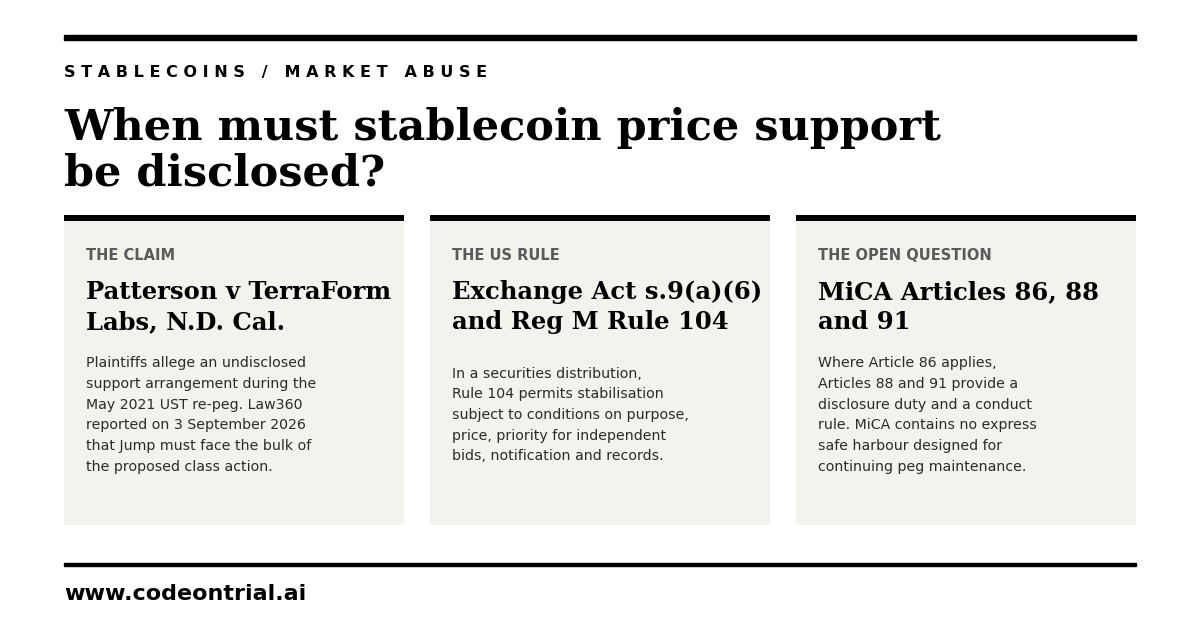
Jump Trading must face the bulk of a proposed securities class action over the Terra collapse, on a ruling reported on 3 September in Patterson v TerraForm Labs Pte Ltd, No. 22-cv-03600 (N.D. Cal.).1 Plaintiffs allege that when UST lost its dollar peg in May 2021 and Terraform’s algorithm failed to restore it, Jump agreed with Do Kwon to buy large quantities of UST at above market prices to hold the coin at $1, without disclosing the arrangement.
On the available reporting, the omission and manipulation theories do not appear to treat price support as wrongful in itself. Alleged concealment is central to the case.
The US stabilisation framework
Section 9(a)(6) of the Securities Exchange Act, 15 U.S.C. § 78i(a)(6), makes it unlawful to effect a series of transactions in any security other than a government security for the purpose of pegging, fixing or stabilising its price, but only in contravention of rules the Commission prescribes. The provision once reached only securities registered on a national securities exchange. Section 929L of the Dodd-Frank Act removed that limit in 2010.2 Whether the section and an implementing rule could reach a given digital asset therefore requires analysis of the instrument and the conduct, and is not disposed of by noting that the asset trades off exchange.
Regulation M Rule 104, 17 CFR 242.104, supplies the rules.3 Stabilisation is permitted subject to conditions covering the purpose of the bid, price limits, notification and recordkeeping, together with the requirement in Rule 104(c) that a person stabilising grant priority to any independent bid at the same price, irrespective of the size of that bid. Disclosure alone does not satisfy those conditions, and silence alone does not make out a fraud or manipulation claim.
Rule 104 is built around stabilisation in connection with a securities distribution. Its price tests and disclosure machinery assume an offering context and a distribution with a beginning and an end. Ordinary peg maintenance is not necessarily tied to that structure and is designed to operate continuously.
Section 17 of the GENIUS Act, Public Law 119-27, carves a payment stablecoin issued by a permitted payment stablecoin issuer out of the definition of security in the 1933 and 1934 Acts and out of the definition of commodity in the Commodity Exchange Act.4 UST was not issued by a permitted payment stablecoin issuer, and the statutory exclusion does not govern the pleaded events. Where the exclusion applies, a claim cannot proceed merely by assuming that the qualifying payment stablecoin is itself a security. It would require a connection to another security or a different legal route. Terra remains a useful comparison about concealed support without carrying the cause of action across.
Disclosure and manipulation under MiCA
Within the scope fixed by Article 86, which covers crypto-assets admitted to trading or for which admission has been requested, MiCA addresses this territory from two directions. Article 88 requires issuers, offerors and persons seeking admission to trading to disclose inside information directly concerning them as soon as possible. Disclosure may be delayed where immediate disclosure would prejudice legitimate interests, delay is not likely to mislead the public and confidentiality can be ensured. Article 87 supplies the inside information test. A support arrangement could engage that duty depending on its precision, its non-public character, its likely price significance and whether it directly concerns the disclosing person.
Article 91(2)(a) prohibits, unless carried out for legitimate reasons, entering into a transaction or engaging in behaviour which gives or is likely to give false or misleading signals as to supply, demand or price, or which secures or is likely to secure the price of a crypto-asset at an abnormal or artificial level. Maintaining a token’s promised reference value is not automatically maintaining an artificial price, and the mechanism, the representations made about it and the surrounding circumstances all bear on the answer.
What Title VI does not contain is a counterpart to Article 5 of the Market Abuse Regulation, which exempts stabilisation carried out in accordance with Commission Delegated Regulation (EU) 2016/1052. That instrument sets instrument-specific periods, thirty calendar days from commencement of trading for an initial offer of shares, with separate treatment for debt, and staged disclosure under Article 6 before the offer, during the period and within a week of its close.5
Classification is often put the wrong way round here. Recital 41 provides that where a crypto-asset falls within the asset-referenced token or e-money token definition, the applicable title applies irrespective of the mechanism by which the issuer intends to maintain a stable value, algorithmic mechanisms included. Inability to satisfy a regime’s requirements is not the same as falling outside its scope. A token purporting to maintain a stable value by reference to one official currency is an e-money token under Article 3(1)(7), which puts a dollar-referencing design in Title IV rather than Title III.
The remaining regulatory question
The GENIUS Act framework binds permitted issuers from 18 January 2027 on the section 20 backstop, subject to the earlier commencement mechanism if final implementing rules are issued. A permitted issuer holding a reserve may face redemption pressure capable of moving the secondary price below par. Redemption at par and secondary market purchases are different responses with different consequences, and the choice between them is a live commercial question.
MiCA contains a disclosure duty and a manipulation rule capable of applying to a concealed support arrangement within Article 86. The GENIUS Act prescribes reserve, redemption and publication requirements, but does not supply an equivalent rule for undisclosed peg-support purchases. Neither regime contains a dedicated framework equivalent to Rule 104 or Article 5 for continuing peg maintenance.
Notes
1 Reported by Law360, “Jump Trading Must Face Terraform Stablecoin Fraud Claims”, 3 September 2026, and The D&O Diary, September 2026. The order itself was not accessible. Its date, reasoning and the precise claims permitted to proceed have not been verified against the record, and the May 2021 characterisation is pleaded rather than established.
2 Dodd-Frank Wall Street Reform and Consumer Protection Act, Public Law 111-203, section 929L(1).
3 17 CFR 242.104, including Rule 104(c).
4 GENIUS Act, Public Law 119-27, 139 Stat. 419, section 17.
5 Commission Delegated Regulation (EU) 2016/1052, Articles 5 and 6.