

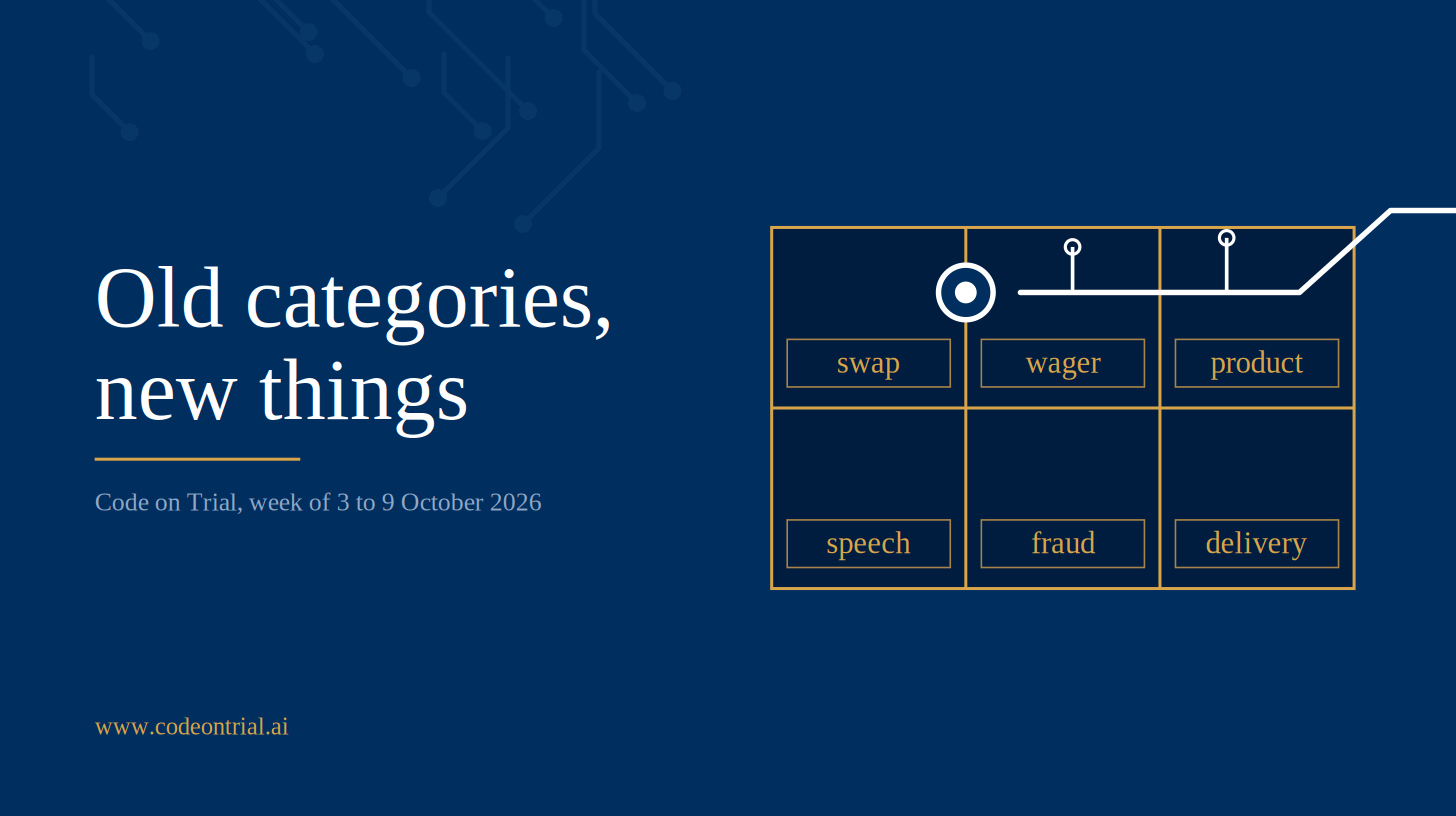
The NFL wants the Supreme Court to treat a sports-event contract as a bet. Kentucky’s Attorney General pleads that a chatbot is a defective product. A Manhattan jury has found that transactions a smart contract processed were computer fraud. In three of this week’s five developments the outcome depends on which existing legal category a court puts the new thing into. I have ordered the week around that question.
The NFL backs New Jersey in Flaherty v KalshiEX
On 8 October the National Football League filed an amicus brief supporting New Jersey’s petition for certiorari in Flaherty v KalshiEX, LLC, No. 26-299. Ohio, 38 other states and the District of Columbia had filed a joint brief the day before. Gary Gensler and Christopher Dodd, whose name the 2010 Act carries, were among those filing on 8 October. The league’s central argument is that a swap hedges a risk that already exists, whereas a sports-event contract creates one, so the definition in the Commodity Exchange Act does not reach it. The brief puts NFL contracts at $1.8 billion of the $3.3 billion traded on prediction markets on the first Sunday of this season.
The split the petition relies on now runs across three circuits. The Third Circuit affirmed Kalshi’s preliminary injunction against New Jersey in April. The Ninth Circuit reached the opposite result on Nevada in August and on 25 September a unanimous Sixth Circuit panel held in KalshiEX LLC v Schuler that Kalshi had not shown its contracts were swaps. The Sixth Circuit added an alternative holding that the Act would not pre-empt the gambling laws of Ohio or Tennessee even if they were. Each of those decisions applied a likelihood standard to a preliminary-injunction record. If the Court grants review it will be construing section 1a(47) on interlocutory reasoning. Because of the Sixth Circuit’s alternative holding it will also face two divided questions, the scope of the swap definition and the reach of pre-emption. Kalshi’s response is due on 9 November.
The verdict in United States v Spalletta
A jury in the Southern District of New York, sitting before Judge Jed Rakoff, convicted Jonathan Spalletta on 7 October of computer fraud and money laundering arising from two attacks on the Uranium Finance exchange in April 2021. Prosecutors put the losses at more than $50 million. Their case was that he sent a deceptive series of transactions to the exchange’s smart contract and kept about $386,000 from the first attack as what they called a sham bug bounty. Sentencing has not yet taken place and the laundering count carries a maximum of 20 years.
Bloomberg’s report of the trial says the defence told the jury that Spalletta used publicly accessible functions of the contracts and never employed spoofed credentials or malicious code. The jury convicted on the prosecution’s theory that transactions engineered to deceive the system were computer fraud all the same. A general verdict gives no reasons, so the case produces no statement of law on authorisation. If Spalletta appeals, that is where the question will be argued.
Kentucky’s unredacted complaint against Character.AI
Kentucky’s Attorney General, Russell Coleman, brought proceedings against Character Technologies and its founders in the Franklin Circuit Court in January (No. 26-CI-00029). On 7 October his office filed an unredacted version of the complaint and gave it to Reuters. According to that reporting, the newly disclosed passages allege that the platform’s chatbots advised some users to cut themselves, starve or kill themselves and that the company prioritised engagement over the safety of children. None of these allegations has been tested.
The complaint has described Character.AI as a defective and unreasonably dangerous product from the outset. That theory depends on the court treating the chatbot’s output as part of a product. If the output is treated as expression, free-speech arguments come into play that a design-defect claim would otherwise not have to meet. The unredacted pleading puts specific alleged outputs in front of the court, so the classification question will be decided on concrete examples.
USA Today Co v OpenAI Foundation
USA Today Co. and thirteen companies it owns, the Detroit Free Press among them, sued seven OpenAI entities, including the OpenAI Foundation and OpenAI Group PBC, in the Southern District of New York on 8 October (No. 1:26-cv-08892). The 79-page complaint covers content from 19 publications and seeks damages in excess of $250 million. It pleads direct and vicarious copyright infringement and removal of copyright management information under section 1202 of the DMCA. It asks for an injunction and for destruction under section 503(b) of the GPT models and training sets that incorporate the publishers’ content.
The complaint goes beyond training. It sets out GPT-5.6 responses that summarise the publishers’ articles and quotes OpenAI’s Head of ChatGPT acknowledging that once ChatGPT gives an answer there is “no good reason to click” through to the source. A summary that answers the reader’s question competes with the article it summarises. An acknowledgement of that from inside OpenAI goes straight to the fourth fair-use factor.
The CFTC’s advance notice on retail crypto transactions
On 5 October the CFTC published an advance notice of proposed rulemaking on retail commodity transactions in crypto assets under section 2(c)(2)(D) of the Commodity Exchange Act, which covers leveraged, margined or financed retail transactions. Regulation Crypto Asset Transactions would set out when such transactions fall within the section and Regulation Crypto Asset Markets would create a subcategory of designated contract market registration called a crypto asset market. The notice creates no binding obligation. Chairman Michael Selig described the purpose as rules that prevent fraudulent schemes such as FTX instead of only prosecuting them after the fact. Comments are due within 60 days of publication in the Federal Register.
The reach of any eventual regime depends on the actual delivery exception, since a retail transaction that results in actual delivery within 28 days falls outside section 2(c)(2)(D). The notice records the Commission’s preliminary view, drawing on the Ninth Circuit’s decision in Monex, that possession and control of a crypto asset may require possession of the private keys to the wallet that holds it. If that view is carried into a rule, a leveraged or financed purchase left in a custodial exchange account would be hard to describe as delivered.
Sources
Supreme Court docket, No. 26-299: https://www.supremecourt.gov/docket/docketfiles/html/public/26-299.html
NFL amicus brief: https://www.supremecourt.gov/DocketPDF/26/26-299/428826/20261008053543625_NFL%20Amicus%20Brief.pdf
USA Today Co v OpenAI Foundation complaint: https://storage.courtlistener.com/recap/gov.uscourts.nysd.674652/gov.uscourts.nysd.674652.1.0.pdf
USAO SDNY release, United States v Spalletta: https://www.justice.gov/usao-sdny/pr/jonathan-spalletta-convicted-defrauding-crypto-exchange-over-50-million-hacks-0
Kentucky AG complaint, No. 26-CI-00029 (January 2026): https://www.ag.ky.gov/Press%20Release%20Attachments/CTI%20Complaint%20Motion%20and%20Order%20Filed.pdf
CFTC press release 9307-26: https://www.cftc.gov/PressRoom/PressReleases/9307-26
CFTC advance notice (Regulation CTX and Regulation CAM): https://www.cftc.gov/media/14716/Proposed_Regulation_CTX_and_Regulation_CAM/download