

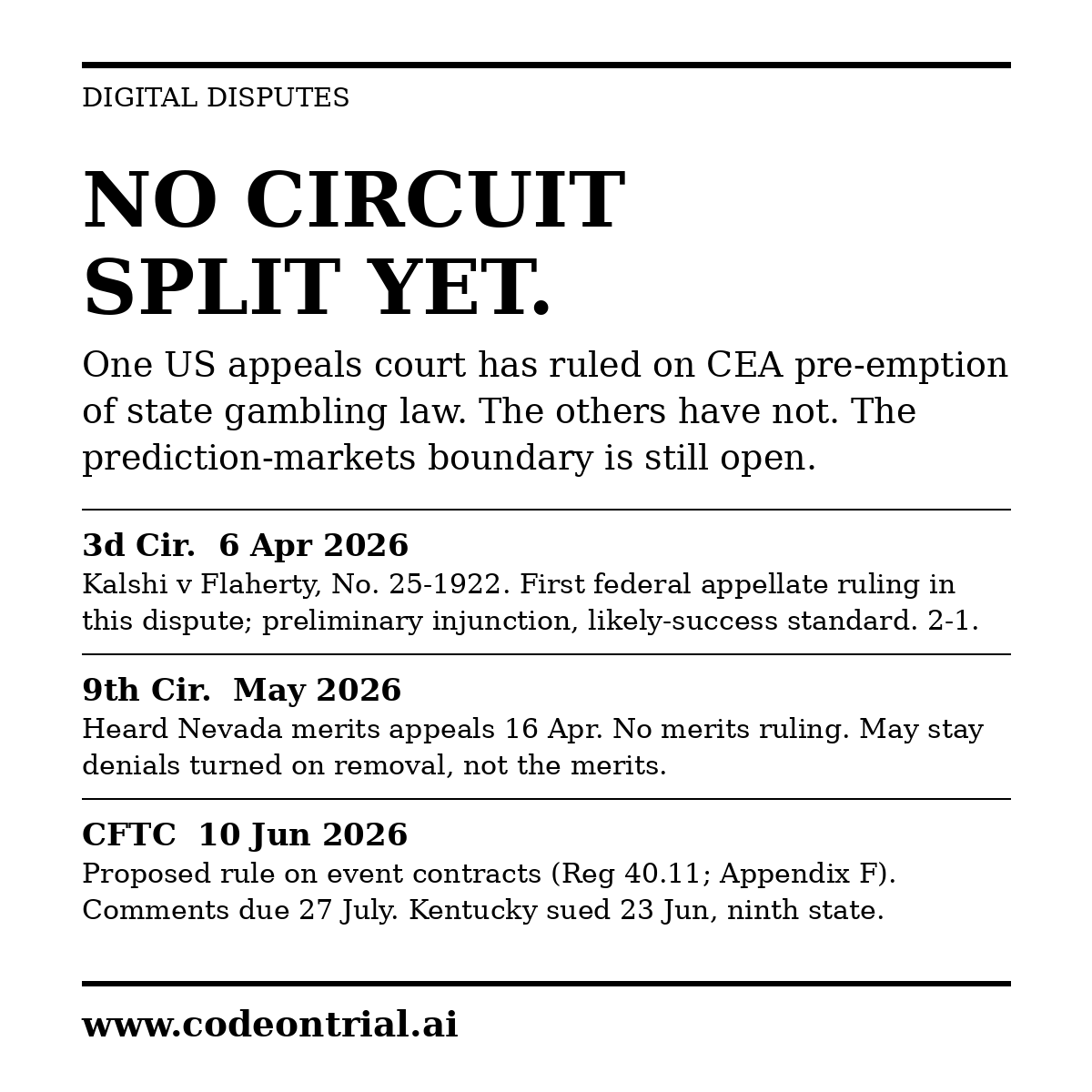
The federal-state boundary for prediction markets is unsettled, but it is not yet the subject of an appellate circuit split. One US court of appeals has ruled on whether the Commodity Exchange Act pre-empts state gambling law as applied to sports-event contracts. The other courts positioned to answer have not. The recent appellate orders that read like a contrary signal in fact decided something narrower.
The Third Circuit’s ruling and its limits
In KalshiEX LLC v Flaherty, No. 25-1922, the Third Circuit on 6 April 2026 affirmed a preliminary injunction preventing New Jersey from applying its gambling laws to Kalshi’s sports-event contracts.[1] Writing for a 2-1 majority, Judge Porter, joined by Chief Judge Chagares, held that Kalshi had demonstrated a reasonable chance of success on its argument that the Commodity Exchange Act pre-empts the relevant application of New Jersey law, and that both field and conflict pre-emption applied. The posture is important. The court granted that relief on a likelihood-of-success standard, before any trial on the merits. Judge Roth dissented, invoking the presumption against pre-emption with “special force” in gambling regulation and treating the products as functionally identical to online sportsbooks.
Why the Ninth Circuit’s May orders are not a contrary answer
It is tempting to read the Ninth Circuit as having gone the other way. It has not done so yet. The court heard the consolidated Nevada appeals involving Kalshi, Crypto.com and Robinhood on 16 April 2026.[2] Separately, in May, it denied interim stays pending appeal from remand orders. In the Washington matter the panel reasoned that CEA pre-emption is an affirmative defence and therefore does not itself create federal-question jurisdiction for removal.[3] Those orders let the remands take effect and left the state-enforcement actions in state court. They did not decide whether the CEA ultimately pre-empts the relevant state gambling laws. The current landscape is best described as an emerging inter-district and inter-state conflict rather than an appellate circuit split. The Fourth and Sixth Circuits are weighing the same issue, the latter on appeals from conflicting Tennessee and Ohio decisions, so a genuine split could still form.
The savings clauses, the criminal front and what a rule cannot do
The sharpest intra-panel disagreement concerns the CEA’s savings clauses. The majority treated them as preserving state common-law actions and state-court jurisdiction without retaining concurrent state regulatory authority over trading on a CFTC-registered designated contract market. Judge Roth regarded the clauses as incompatible with complete field pre-emption. That disagreement, rather than any clash between circuits, is where the doctrine is currently unsettled.
Criminal enforcement runs alongside the civil dispute. On 17 March 2026 Arizona brought a 20-count misdemeanour criminal information against Kalshi entities alleging unlicensed gambling activity, four counts of which concerned election-event contracts, including the 2028 presidential election.[4] The CFTC and the United States answered with state-specific pre-emption actions, beginning with Arizona, Connecticut and Illinois on 2 April 2026 and extending to further states, most recently Kentucky on 23 June 2026.[5] In Arizona, federal relief temporarily restrained the State from enforcing its gambling laws against event contracts listed on CFTC-regulated markets while the pre-emption question is litigated.
The CFTC has now entered the same boundary dispute through rulemaking. On 10 June 2026 it announced a notice of proposed rulemaking to amend Regulation 40.11 and introduce Appendix F governing event contracts, published in the Federal Register on 12 June with comments due by 27 July.[6] The proposal concerns how the agency treats event contracts under its public-interest framework, including a proposed definition of “gaming” and a proposed standard for when an event contract “involves” an underlying activity. It does not amend the statutory definition of “swap” in 7 U.S.C. § 1a(47), nor the CEA’s jurisdictional and savings-clause provisions. The proposal cannot itself conclusively resolve whether the CEA pre-empts a particular application of state gambling law. The narrower question is what persuasive weight a reviewing court will give the CFTC’s eventual reasoning when construing the statute.
Dodd-Frank expressly addressed event contracts and authorised a special CFTC review process for contracts involving gaming. The statute anticipated the category. The harder issue is whether the federal regime for trading those contracts displaces state gambling law where the products functionally resemble sportsbook wagers. Congress may yet redraw the line. The proposed Prediction Markets Are Gambling Act, introduced on 23 March 2026, would amend the CEA to prohibit CFTC-registered entities from listing specified sports and casino-style event contracts.[7] Until Congress acts or an appellate court resolves the merits with a nationally controlling answer, the position remains state-by-state and court-by-court, and the comment period is the immediate formal opportunity for exchanges, platforms, state regulators and market participants to shape the federal framework.
[1] KalshiEX, LLC v Flaherty, 172 F.4th 220 (3d Cir. 2026) (No. 25-1922), 2-1 (Porter, J., joined by Chagares, C.J.; Roth, J., dissenting), affirming a preliminary injunction. Swap definition: Commodity Exchange Act, 7 U.S.C. § 1a(47).
[2] KalshiEX, LLC v Hendrick, No. 25-7516 (9th Cir., argued 16 April 2026), consolidated Nevada appeals heard with the Crypto.com and Robinhood matters.
[3] Washington v KalshiEX, LLC, No. 26-3106 (9th Cir., order denying stay pending appeal, 21 May 2026).
[4] State of Arizona, 20-count misdemeanour criminal information against KalshiEX LLC and Kalshi Trading LLC, 17 March 2026; four counts concerned election-event contracts, including the 2028 presidential election.
[5] CFTC and the United States, state-specific pre-emption actions, commencing against Arizona, Connecticut and Illinois on 2 April 2026 and extending to further states, including Kentucky, the ninth state as at 23 June 2026. Arizona criminal proceeding temporarily restrained by federal relief.
[6] Prediction Markets; Public Interest Determinations, 91 Fed. Reg. 35,806 (proposed 12 June 2026) (amendments to Regulation 40.11; proposed Appendix F; comments due 27 July 2026).
[7] Prediction Markets Are Gambling Act (introduced 23 March 2026; Sens. Schiff and Curtis), proposing to amend the CEA to prohibit CFTC-registered entities from listing specified sports and casino-style event contracts.