

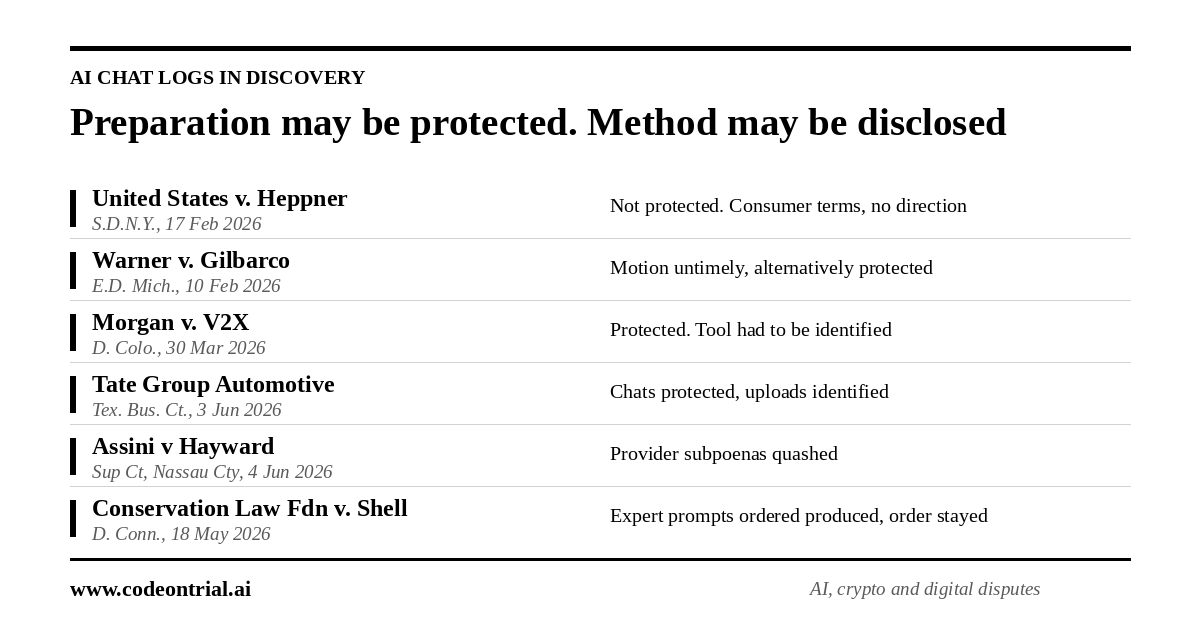
Judge Rakoff ruled in February that a criminal defendant’s exchanges with a consumer AI chatbot were protected by neither the attorney-client privilege nor the work product doctrine.1 Four months later two state courts reached different work-product results under different procedural rules. A stayed order in Connecticut raises a further question that none of them addresses.
What Heppner decided
Bradley Heppner, indicted in the Southern District of New York on securities and wire fraud counts arising from his conduct at GWG Holdings, used the consumer version of Anthropic’s Claude after receiving a grand jury subpoena and retaining counsel. He put information learned from his attorneys into the tool, generated reports on possible defences, then gave those reports to his lawyers. The court held that the privilege did not attach, the provider’s terms having permitted disclosure of user data and the use of prompts and outputs for training. It treated the reports as Heppner’s own research rather than as material prepared at counsel’s direction, which disposed of the work product claim.2
The more tentative observation concerned what might have followed had counsel instructed the use of the tool. On that footing, the court suggested, the tool might have functioned as a lawyer’s agent in the manner contemplated by United States v. Kovel.3 Kovel extended the privilege to an accountant engaged by counsel to make the client’s information intelligible to the lawyer. Whether a model can occupy that role is untested. For in-house teams the practical consequence is that the instruction trail may do more work than the procurement decision.
The June divergence
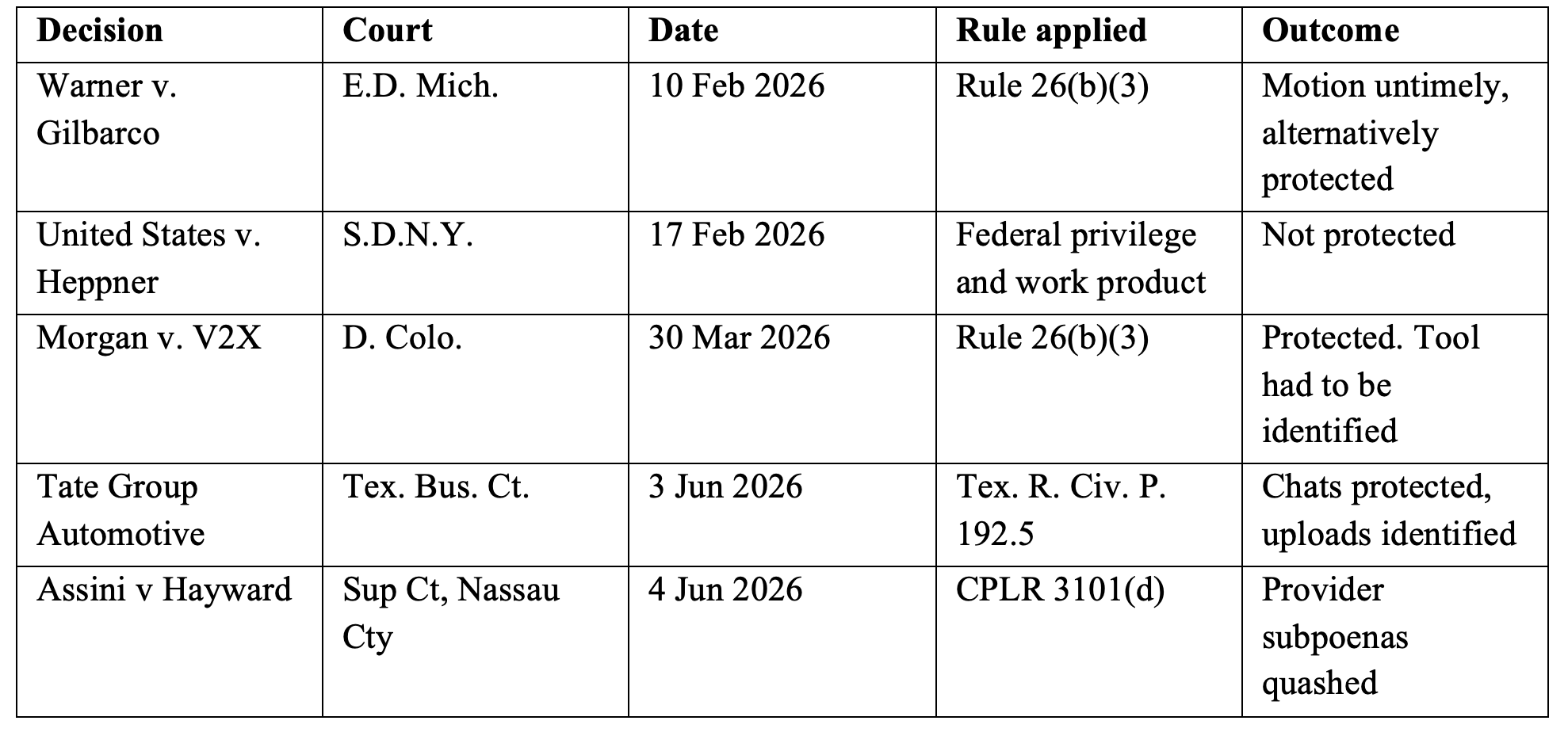
The two state decisions rest on different rules. Tate Group turned on the breadth of the Texas provision, which reaches material prepared and mental impressions developed in anticipation of litigation by or for a party or a party’s representatives. That language covers a party principal who is neither a lawyer nor self-represented. Assini applied a narrower New York standard, since CPLR 3101(d) attaches only where the material was prepared solely in anticipation of litigation.4 Justice Fischer quashed both subpoenas served on OpenAI OpCo, LLC in their entirety. She then referred the litigant to 22 NYCRR Part 161 with a sanctions warning, so the protection came with a supervisory direction attached.
Where the English position differs
An English practitioner should not assume that the American answers transfer. Three Rivers (No 5) defines the corporate client narrowly, but Aabar Holdings v Glencore held that legal advice privilege may also cover documents created or circulated within the client group for the dominant purpose of seeking legal advice.5 Picken J gave preparatory notes for a meeting with counsel as an example. A standalone AI chat therefore does not fail merely because no lawyer participated in it. Whether it is protected will depend on who created it, its purpose, its intended use and whether it remained confidential. Material created by an employee outside the client group remains more difficult. Litigation privilege is the alternative route, requiring after SFO v Eurasian Natural Resources Corporation that litigation be in reasonable contemplation and that the dominant purpose of the document be conducting it.6
Expert use raises a separate question. In Conservation Law Foundation, Inc. v. Shell Oil Co., Magistrate Judge Thomas O. Farrish ordered production of the GPT-4o prompts used to cull the defendants’ document production for an expert report, holding that the culling process formed part of methodology rather than protected notes or drafts.7 The order was stayed pending the district judge’s ruling on a Rule 72(a) objection. It therefore remains subject to review. The order should therefore be treated cautiously. English procedure approaches the point differently. CPR 35.10 requires the report to state the substance of all material instructions. Those instructions are not privileged under CPR 35.10(4), though the court will not order disclosure or permit questioning unless there are reasonable grounds to consider the statement inaccurate or incomplete. Undisclosed use of a model to select the documents considered by the expert may provide grounds for arguing that the statement of material instructions is incomplete. Whether the prompts themselves would then be ordered disclosed has not been decided in England.
What to do about it
Segregate litigation work from general enquiries and record any instruction to use the tool. Where an expert uses AI, preserve the prompts and outputs, establish what role they played and ensure that the report accurately describes the material methodology. The present authorities are too fact-specific to justify assuming either protection or disclosure.
1 United States v. Heppner, No. 1:25-cr-00503 (S.D.N.Y.), bench ruling 10 February 2026, written opinion 17 February 2026, 2026 WL 436479, 2026 U.S. Dist. LEXIS 32697.
2 The two grounds are summarised in the same terms in the contemporaneous firm reporting of the bench ruling and of the written opinion.
3 United States v. Kovel, 296 F.2d 918 (2d Cir. 1961).
4 Assini v Hayward, 2026 NY Slip Op 26086, Index No. 607683/2024 (Sup Ct, Nassau County, 4 June 2026) (Fischer, J.). The “solely in anticipation of litigation” requirement is taken from Agovino v. Taco Bell 5083, 225 AD2d 569 (2d Dept 1996). The substantive reasoning adopted is that of Morgan v. V2X, Inc., 2026 WL 864223, 2026 U.S. Dist. LEXIS 67939 (D. Colo. 30 March 2026), which framed the question as whether disclosure substantially increased the likelihood that an adversary would obtain the material. Warner v. Gilbarco, Inc., No. 2:24-cv-12333 (E.D. Mich. 10 February 2026), ECF No. 94, 2026 WL 373043 (Patti, M.J.), is to the same effect on waiver.
5 Aabar Holdings S.A.R.L. and others v Glencore plc, Ivan Glasenberg and Steven Frank Kalmin [2026] EWHC 877 (Comm), Case Nos FL-2022-000024 and others, Commercial Court (KBD), Financial List, 16 April 2026, per Picken J. The holding is at paragraph 16. Three Rivers District Council v Governor and Company of the Bank of England (No 5) [2003] EWCA Civ 474, [2003] QB 1556, was distinguished as concerned with material outside the client group. Support was drawn from R (Jet2.com Ltd) v Civil Aviation Authority [2020] EWCA Civ 35. The decision is one of first instance in the Commercial Court.
6 Director of the Serious Fraud Office v Eurasian Natural Resources Corporation Ltd [2018] EWCA Civ 2006.
7 Conservation Law Foundation, Inc. v. Shell Oil Co., No. 3:21-cv-00933 (D. Conn.), ECF No. 970 (18 May 2026). The order was stayed by Judge Vernon D. Oliver at ECF No. 977 on 3 June 2026 pending consideration of the objection at ECF No. 975 and the stay motion at ECF No. 974. Briefing closed on 29 June 2026 at ECF No. 986. The docket was checked on 10 September 2026, at which date the objection remained undecided.