

An Illinois court has been asked to stop the state’s first-in-the-nation digital asset tax before it takes effect on 1 January 2027. The twenty-six-page memorandum of law is dated 8 September. It rests principally on a statute written in 1998 for a commercial internet that did not yet have assets of its own.[1]
Two suits, one statute
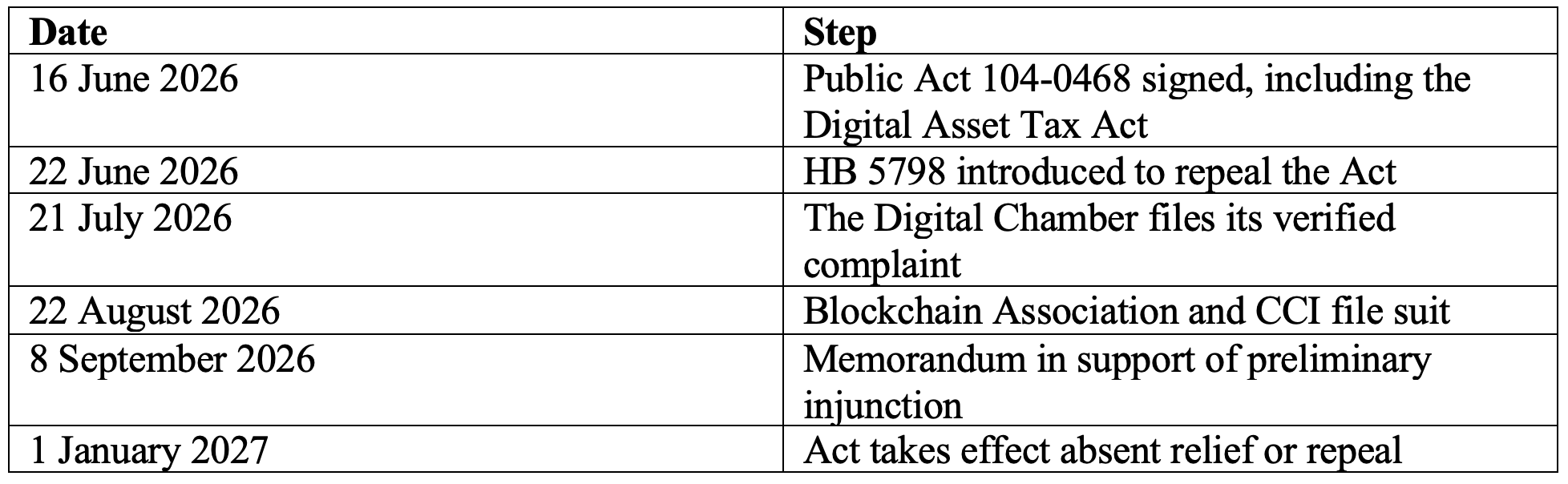
The Digital Asset Tax Act reached the statute book by an unusual route. Senate Bill 3019 was introduced in January 2026 as a two-page measure on agricultural property loans. On the final day of the 2026 session two amendments replaced everything after the enacting clause and produced a 1,624-page bill covering gambling licences, vehicle weight restrictions and much else. Twenty of those pages were the Act. The bill cleared committee and both chambers in under twenty-four hours on one hour’s public notice. The Governor signed it on 16 June 2026.[2] House Bill 5798, introduced six days later, would repeal the Act outright.
Two challenges are now before the same court. The Digital Chamber filed a verified complaint on 21 July advancing six counts, including the Illinois Uniformity Clause, the proportionate penalties clause, the dormant Commerce Clause and preemption under the Internet Tax Freedom Act.[3] The Blockchain Association and the Crypto Council for Innovation filed their action on 22 August and have now moved for interim relief, represented by Gibson Dunn with Springfield local counsel.
What the preemption test actually requires
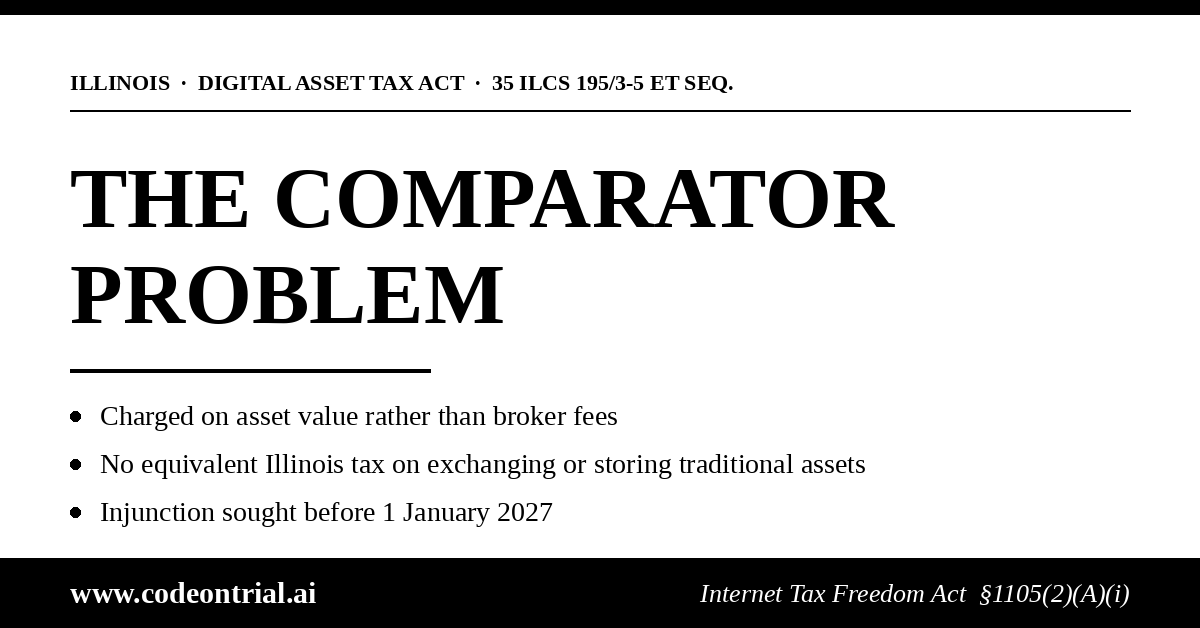
Section 1105(2)(A)(i) of the Internet Tax Freedom Act defines a discriminatory tax as one imposed on electronic commerce that is not generally imposed on transactions involving similar property, goods, services or information accomplished through other means.
The operative word is similar. In Performance Marketing Association v Hamer the comparison was straightforward. Illinois had imposed a collection obligation on retailers using online performance marketing while leaving offline marketing untouched. The Illinois Supreme Court held the statute void and unenforceable.[4] The Maryland Tax Court reached the same conclusion about digital advertising on 14 August, reasoning that Congress could not have been clearer that internet services should not be taxed unless similar services in the broader sense were taxed as well.[5]
Neither statute presented the difficulty this one does. Advertising and marketing exist off the internet, so the comparison holds. A native digital asset has no off-chain version of itself. The plaintiffs therefore pitch similarity at the level of function: Illinois exempts bullion and currency from sales and use tax and does not tax the exchange or storage of stocks and bonds, so an asset used as a medium of exchange, unit of account or store of value ought to be treated alike whatever the ledger.[6] Should the court instead require a physical analogue, the protection of a technology-neutral tax policy would be unavailable precisely to the technology that has no analogue.
Apportionment and the full-value measure
The apportionment challenge turns on internal consistency. Under the second limb of Complete Auto a state tax must be internally consistent, meaning that identical adoption of the same rule by every state would not place interstate activity at a disadvantage.[7]
Section 3-25 presumes a customer to be in Illinois on the strength of a home address, a mailing address, an Illinois IP address or other place-of-primary-use data. The burden of proving the negative falls on the broker. A resident who trades from another state and a visitor who trades while passing through are both presumptively Illinois customers. The plaintiffs argue that if every state adopted the same rule, competing address and IP presumptions could subject one transaction to more than one full-value charge. That, they say, is the internal-consistency defect identified in Wynne.
The stablecoin question
The Act borrows its definition of digital asset from the Digital Assets and Consumer Protection Act, which excludes digital representations of value having substantial value or utility beyond mere existence as a digital asset. A payment stablecoin, whose reserves must meet the federal one-for-one requirement, is on the plaintiffs’ case a strong candidate for that exclusion. The Department of Financial and Professional Regulation nonetheless proposed a rule in May treating payment stablecoins as digital assets.[8]
If that construction is maintained, transferring a dollar-backed token would be taxed at 0.2% of its value while transferring a dollar would not. That is the cleanest comparator the challenge is likely to get. From 1 January a digital asset broker that violates any provision of the Act commits a Class 3 felony under section 3-55. The collection obligation in section 3-35(a) reaches brokers maintaining a place of business in Illinois, a definition that captures $100,000 of Illinois gross receipts over the preceding twelve months. The registration, remittance and recordkeeping provisions are not limited consistently by that threshold, which is one of the vagueness complaints. Those provisions take effect on 1 January unless the court grants relief or the legislature repeals the Act.
Notes to the text
1. Blockchain Association and Crypto Council for Innovation v Harris, Raoul and Milhiser, No. 2026 MR 000312 (Cir. Ct. 7th Jud. Cir., Sangamon County), memorandum of law in support of plaintiffs’ motion for preliminary injunction, dated 8 September 2026. The Crypto Council for Innovation announced the motion on 9 September 2026.
2. SB 3019, 104th Gen. Assemb., enacted as Public Act 104-0468. The Digital Asset Tax Act is codified at 35 ILCS 195/3-5 et seq.
3. Chamber of Digital Commerce v Harris, Circuit Court of Sangamon County, verified complaint filed 21 July 2026.
4. Performance Marketing Association, Inc. v Hamer, 2013 IL 114496 (18 October 2013).
5. Google LLC v Comptroller of Maryland, No. 23-DA-OO-0649 (Md. Tax Ct., 14 August 2026), decided with Apple Inc. v Comptroller and Peacock TV, LLC v Comptroller.
6. 35 ILCS 105/3-5(8), 35 ILCS 120/2-5(18) and 86 Ill. Admin. Code 130.120(a).
7. Complete Auto Transit, Inc. v Brady, 430 U.S. 274 (1977), Comptroller of the Treasury of Maryland v Wynne, 575 U.S. 542 (2015) and Oklahoma Tax Commission v Jefferson Lines, Inc., 514 U.S. 175 (1995).
8. 205 ILCS 731/1-5(a). See also Illinois Department of Financial and Professional Regulation, proposed rule, 50 Ill. Reg. 6746, 6752-55 (15 May 2026).