

The collapse of the FTX cryptocurrency exchange in November 2022 represented a definitive threshold in the history of financial technology, marking the transition from an era of unbridled speculative growth to one of institutional accountability and legislative maturity. What began as a liquidity crisis triggered by a series of investigative revelations and adversarial market manoeuvres rapidly unravelled into the exposure of one of the most sophisticated financial frauds in modern history.[1, 2, 3]
This review provides a deconstruction of the mechanisms that led to the exchange’s failure, the ongoing efforts to remunerate victims, the judicial outcomes for the principal actors and the systemic lessons that have reshaped the regulatory landscape as of January 2026.
Historical Genesis: The Convergence of Arbitrage and Ambition
The foundations of the FTX collapse were laid years prior to its public insolvency, rooted in a structural lack of corporate boundaries between the exchange and its sister trading firm, Alameda Research. Founded in 2017 by Samuel Bankman-Fried and Tara MacAulay, Alameda Research initially presented itself as a high-frequency trading firm specialising in crypto-arbitrage.[1, 2] Bankman-Fried, an adherent of the “Effective Altruism” movement, marketed the firm as a vehicle to generate wealth for the purpose of global philanthropic impact. However, the internal reality was characterised by high-risk strategies and a fundamental disregard for traditional risk management protocols.
As early as September 2018, Alameda was raising debt from investors by offering a 15% annualised fixed rate loan, promising “high returns with no risk”.[1] This promise was inherently contradictory to the volatile nature of the cryptocurrency markets and suggested an early reliance on continuous capital inflows to sustain operations. When FTX was launched in November 2019, it was marketed as an exchange “built by traders, for traders.” The platform’s rapid ascent was fuelled by its user-friendly interface and the introduction of complex products like tokenised stocks and crypto derivatives.[2, 4]
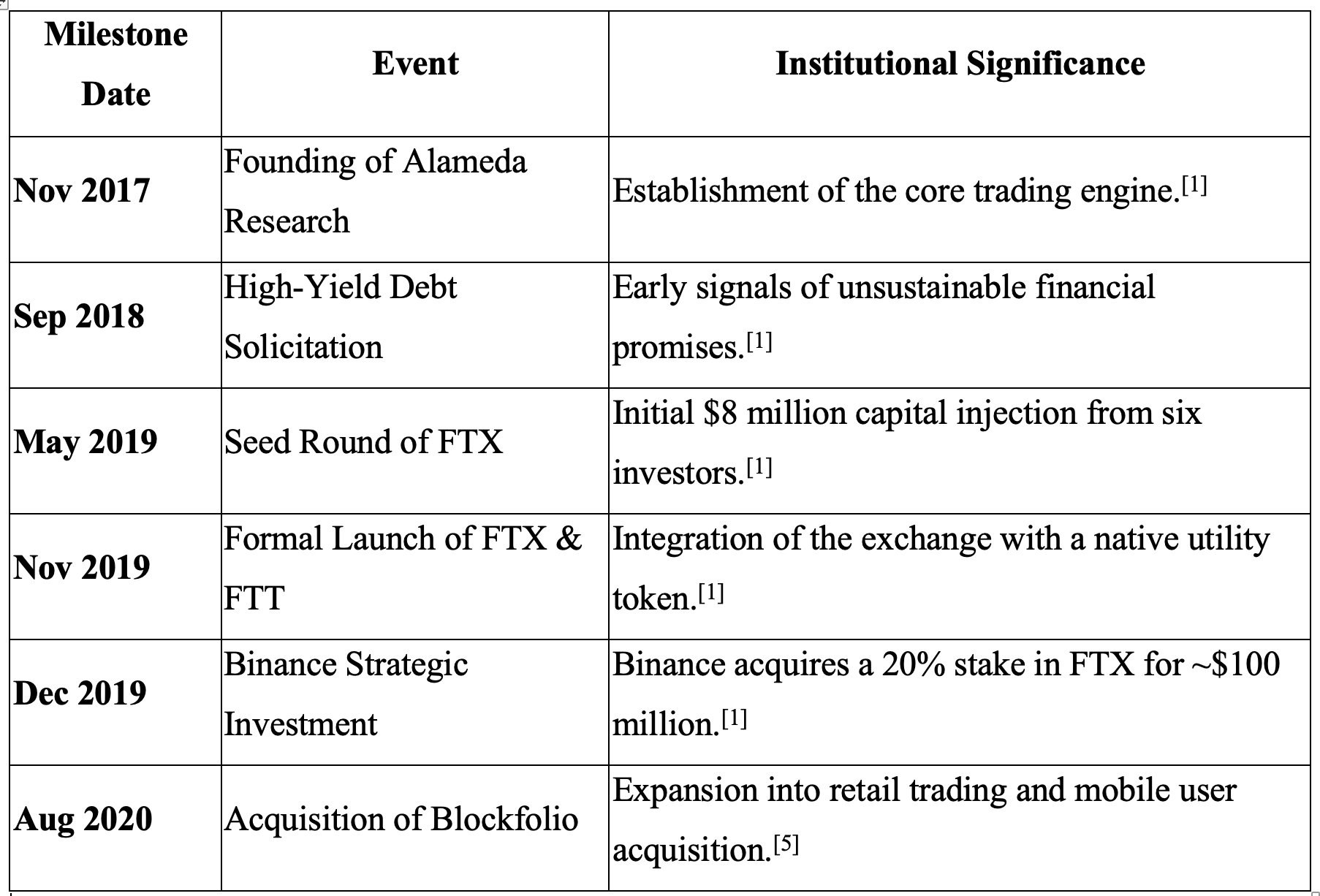
The strategic investment by Binance in late 2019 provided FTX with both capital and market credibility. However, the relationship between the two giants would eventually sour, leading to a buy-back of Binance’s equity stake in 2021, a transaction largely funded by the FTT token.[6] This decision inadvertently created the ammunition that would eventually be used to trigger the exchange’s downfall.
The Mechanics of Malfeasance: Backdoors and the FTT Flywheel
The architectural instability of the FTX-Alameda nexus was predicated on a technological backdoor that bypassed the exchange’s automated risk mitigation systems. Testimony from senior executives like Gary Wang and Nishad Singh revealed that, at the direction of Bankman-Fried, the FTX software code was altered to grant Alameda Research a “virtually unlimited” line of credit.[3, 7] While ordinary customers were subject to immediate liquidation if their collateral fell below required levels, Alameda was exempt from these controls.
The Duality of the FTT Token
A central component of this fragile ecosystem was the FTX Token (FTT). FTT was utilised not merely as a utility token for fee discounts but as a primary form of collateral that allowed Alameda to borrow against its own sister company’s perceived value.[1, 8] By late 2021, Alameda’s balance sheet was heavily concentrated in FTT, creating a circular dependency where the solvency of the trading firm was inextricably linked to the market price of the exchange’s native token.
Alameda Research moved away from delta-neutral strategies in December 2021, beginning to take large directional risks on leverage.[1] This shift coincided with the “crypto winter” of early 2022. When the Terra-Luna ecosystem collapsed in May 2022, it triggered a massive credit crunch. To hide the resultant losses at Alameda, FTX began lending the firm billions of dollars in customer funds - a decision Bankman-Fried later described to colleagues as a “poor judgment call”.[1, 6]
The Shadow Account: North Dimension
The misappropriation was further obfuscated through the use of an entity called North Dimension. Before FTX established its own banking relationships, customers were directed to wire fiat currency to Alameda Research’s bank accounts. These funds were never consistently transferred to FTX. Instead, they were held by Alameda and used for its own operations, investments, and expenses.[7, 9] Bankman-Fried contended in his defence that he believed these funds were being held as a “borrow,” but the lack of formal accounting meant that over $8 billion in customer liabilities were effectively invisible to the exchange’s internal dashboards.[9, 10]
The Spiral of 2022: Contagion and Concealment
Throughout the summer of 2022, Bankman-Fried sought to project an image of financial strength by offering bailouts to struggling crypto platforms like Voyager Digital, Celsius and BlockFi.[1] In reality, these actions were defensive manoeuvres intended to prevent the liquidation of Alameda’s positions on those platforms, which would have exposed its insolvency. By June 2022, Alameda had become the largest source of liquidity for FTX, accounting for a staggering 30% of USD Coin transfers and 10% of Tether transfers on the exchange.[6]
The internal culture at the FTX headquarters in the Bahamas was characterised by an extreme lack of professional oversight. The executive team, which included Caroline Ellison as the sole CEO of Alameda after Sam Trabucco’s departure in August 2022, operated without a traditional management team or a functioning board of directors.[1, 11] This vacuum allowed for the unchecked execution of high-risk strategies, including the use of customer funds for personal real estate purchases and millions of dollars in political contributions to candidates from both parties.[3, 4]
The Seven Days in November: A Forensic Timeline
The terminal phase of the FTX collapse was initiated by a public loss of confidence. On November 2, 2022, CoinDesk published an article detailing Alameda’s balance sheet, which revealed that $6 billion of its $14.6 billion in assets were FTT tokens.[6, 8] This exposure of the “circular collateral” model signalled that the firm’s equity was built on a foundation of its own creation.
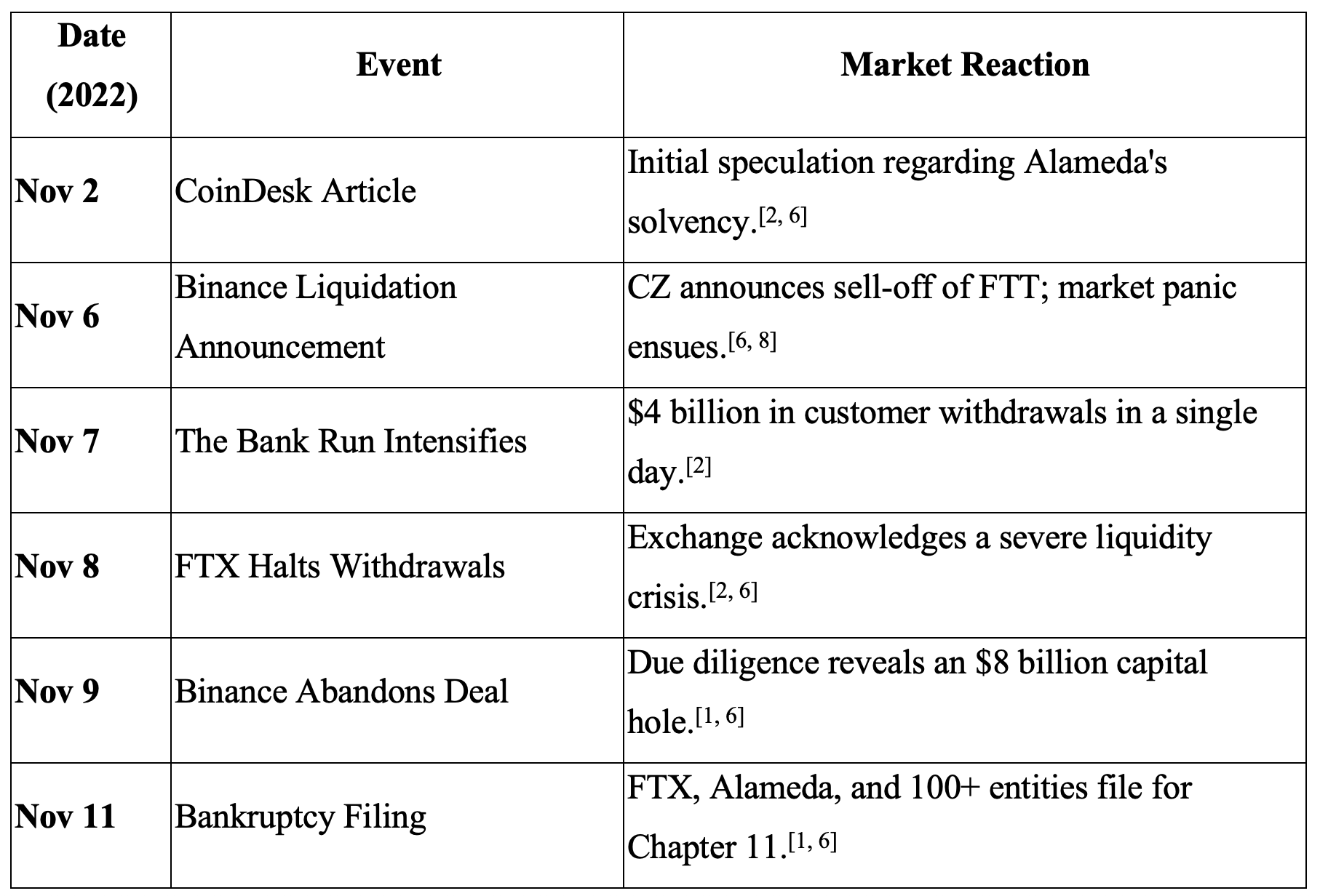
The announcement by Changpeng Zhao (CZ) that Binance would sell its $529 million FTT position triggered an immediate 80% drop in the token’s value.[6] Caroline Ellison attempted to stabilise the price by offering to buy Binance’s holdings at $22, which only intensified speculation that Alameda had loans that would be liquidated if the price fell below that threshold.[1, 8] Unable to meet a $6 billion withdrawal demand, Bankman-Fried sought a rescue package of up to $9.4 billion from various investors before finally resigning and filing for bankruptcy.[1, 6]
The Post-Collapse Void: The Administration of John J. Ray III
Upon the bankruptcy filing, John J. Ray III was appointed CEO. Ray’s first reports to the Delaware Bankruptcy Court were scathing, noting that “never in my career have I seen such a complete failure of corporate controls and such a complete absence of trustworthy financial information”.[2, 12] His findings highlighted that FTX had no accounting department and that the function had been entirely outsourced to firms that lacked the capacity to manage a multi-billion dollar enterprise.[11]
Control Failures and Security Breaches
The forensic analysis of the FTX infrastructure revealed systemic vulnerabilities. Key wallet secrets and operational credentials were stored in a shared cloud environment (including a single AWS account) creating a single point of compromise; passwords and private keys/seed phrases were poorly segregated and, in some instances, stored in plain text or committed to code repositories.[13] Within roughly 24 hours of the Chapter 11 filing, FTX reported “unauthorised transactions,” and blockchain analytics firm Elliptic estimated that approximately $477 million in cryptoassets was moved out of FTX-controlled wallets.[54]
Ray’s team discovered that the group’s financial records were so poor that they could not initially produce an accurate list of employees or bank accounts.[11, 12] The consolidated assets as of September 30, 2022, were reported at approximately $13.4 billion, but this was heavily skewed by custodial liabilities and crypto asset borrowings that were not properly reflected in the books under Bankman-Fried’s control.[5]
Judicial Reckoning: Criminal and Civil Outcomes
The legal proceedings against the FTX executive team concluded with significant prison sentences and permanent industry bans. As of January 2026, the principal architects of the scheme have seen their initial sentences upheld or reached the terminal phases of their incarceration.
Samuel Bankman-Fried: The Mastermind Narrative
On March 28, 2024, Samuel Bankman-Fried was sentenced to 25 years in federal prison and ordered to forfeit $11 billion.[3, 14] Judge Lewis Kaplan summarily rejected the defence’s argument that the harm to customers was “zero” because the bankruptcy estate hoped to pay them back. The court characterised the fraud as one of the largest in history, second only to the prosecution of Bernie Madoff.[10]
In November 2025, Bankman-Fried’s appeal was argued before the Second Circuit. His counsel contended that the trial court’s evidentiary rulings prevented the jury from hearing material evidence relating to counsel involvement and his asserted good faith beliefs; the appellate panel expressed scepticism, because Bankman-Fried disclaimed reliance on a formal “advice of counsel” defence at trial.[15, 16, 17] The timing of a decision remains uncertain.
Executive Cooperation and Sentencing
The other members of the “inner circle” received significantly lighter sentences, reflecting (among other factors) extensive cooperation with prosecutors. Caroline Ellison, who testified that Bankman-Fried directed the misappropriation of funds, was sentenced to two years’ imprisonment; she reported to custody in November 2024, was transferred to community confinement in October 2025, and was released on January 21, 2026.[18] Gary Wang and Nishad Singh avoided prison time and were sentenced to time served.[7, 19]
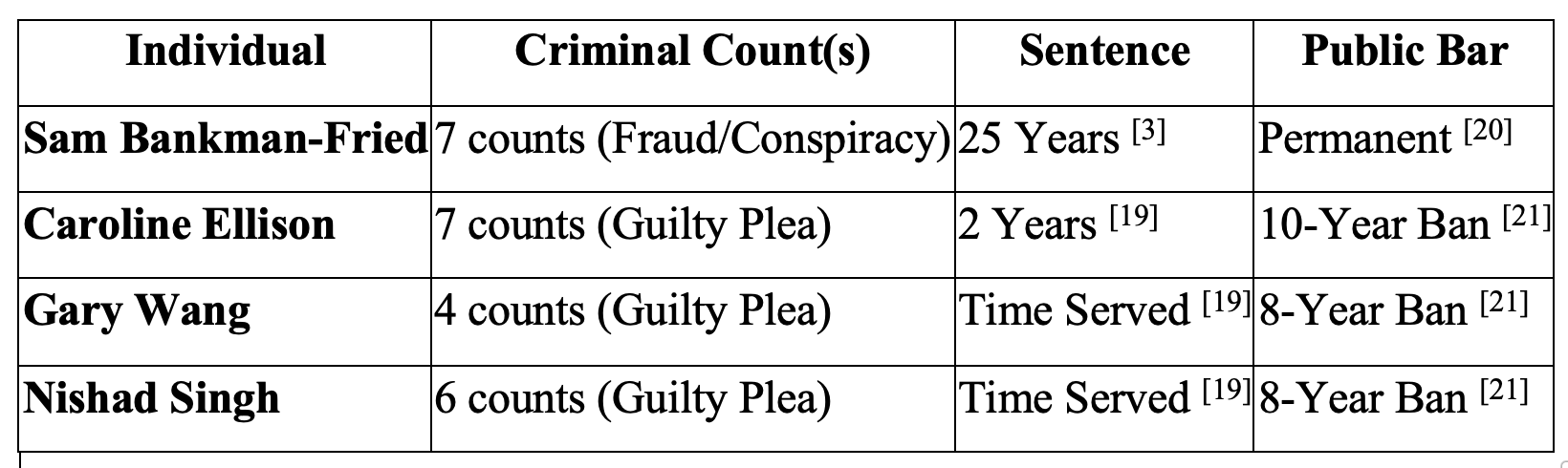
In addition to criminal penalties, the SEC obtained final consent judgments against Ellison, Wang and Singh in December 2025, permanently enjoining them from violating antifraud provisions and imposing multi-year bans on serving as officers or directors of public companies.[20, 21]
Remuneration and the Bankruptcy Estate: The Path to 119% Recovery
Despite the chaotic state of the company at the time of the filing, the bankruptcy estate has been remarkably successful in recovering assets. This success is attributed to the appreciation of crypto holdings, the liquidation of venture investments like the stake in Anthropic and the recovery of funds from political donations and real estate.[2, 22]
The Payout Schedule and Creditor Controversy
The Chapter 11 reorganisation plan, approved in late 2024, became effective on January 3, 2025.[23, 24] The plan specifies that 98% of creditors by number (the “Convenience Class” with claims under $50,000) will receive 100% of their allowed claim value plus a 9% annual interest rate, reaching a total of roughly 120% recovery.[24, 25, 26]
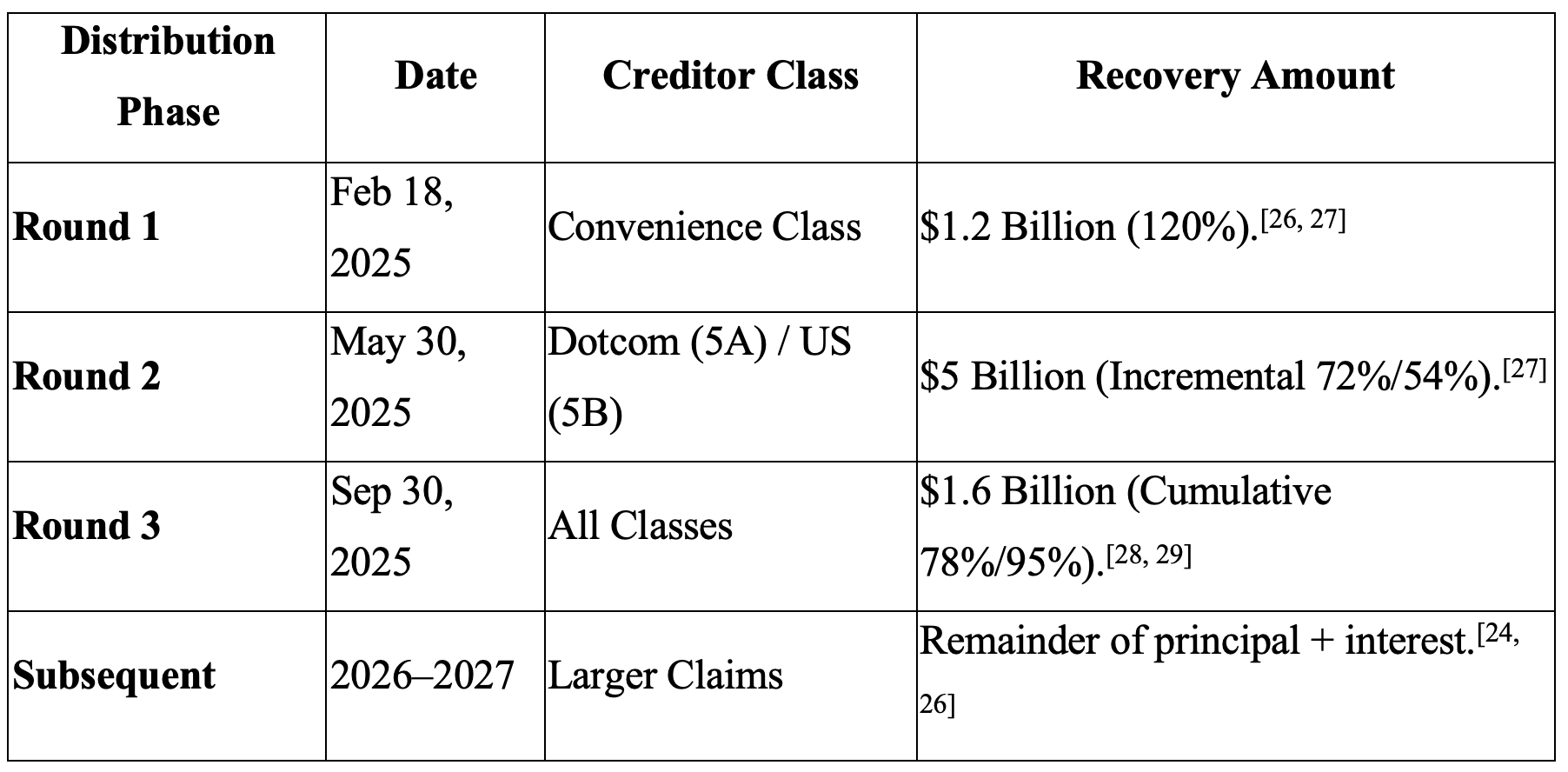
While the nominal recovery figures are high, many creditors have expressed frustration. The payouts are based on the value of the crypto assets at the time of the bankruptcy filing in November 2022.[27, 30] Because the broader crypto market has surged since that time, creditors are receiving only a fraction of what their tokens would be worth if they had not been liquidated. For example, a user who had 1 Bitcoin at the time of the crash, valued at ~19,000, while the market price of Bitcoin in early 2026 is exponentially higher.[22, 27]
Regulatory Reconstruction: The Global Legislative Response
The systemic failure of FTX served as a major catalyst for intensified regulatory activity in digital finance. In the United States, the legislative response included enactment of the Guiding and Establishing National Innovation for U.S. Stablecoins Act (the GENIUS Act) on 18 July 2025, and House passage of the Digital Asset Market Clarity Act (the CLARITY Act), which (as of late 2025) remains pending in the Senate.[31, 32, 55, 56]
The GENIUS Act: A New Standard for Stability
Signed into law on July 18, 2025, the GENIUS Act established the first federal regulatory framework for payment stablecoins.[32, 33, 34] The act was designed specifically to prevent the type of commingling that occurred between FTX and Alameda.
1. 1:1 Reserve Mandate: Issuers must back all stablecoins 1:1 with high-quality liquid assets like U.S. dollars or short-term Treasuries.[32, 35]
2. Segregation and Bankruptcy Priority: Reserve assets must be held in segregated accounts and are legally excluded from the issuer’s bankruptcy estate, giving holders priority over all other creditors.[33, 34, 36]
3. Prohibitions on Interest: To maintain the status of stablecoins as payment tools rather than securities, issuers are prohibited from paying yield to holders.[33, 36]
4. Enforcement and Fines: Wilful noncompliance can result in civil fines of up to $200,000 per day and criminal liability for executives.[33]
The GENIUS Act’s principal requirements phase in through 2026–2027: the statute generally contemplates implementing regulations within one year of enactment and the effective date is tied to the earlier of January 2027 or a defined period after final rules are issued.[33, 35, 36]
The SEC’s “Project Crypto” and Global Coordination
On 31 July 2025, SEC Chairman Paul Atkins announced “Project Crypto,” a Commission-wide initiative aimed at modernising securities regulation to support “on-chain” market infrastructure.[57] In parallel, the European Union’s Markets in Crypto-Assets Regulation (MiCA) became fully applicable from 30 December 2024 (with stablecoin provisions applying from 30 June 2024), creating a harmonised licensing and “passporting” regime for crypto-asset service providers across the EU.[58]
Technological Sovereignty: Proof of Reserves and ZK-Proofs
In the post-FTX landscape, the industry has adopted new technical standards to restore trust. The most significant of these is “Proof of Reserves” (PoR), a cryptographic process that allows users to verify that an exchange holds the assets it claims to hold.[37, 38]
Technical Evolution of PoR
By 2025, PoR had evolved beyond simple snapshots. Some exchanges publish Merkle-tree-based attestations (Kraken), while others have begun to add zero-knowledge techniques (OKX, which states it uses zk-STARK) to prove liabilities without revealing individual balances.[37, 38]
The use of zk-SNARKs (Zero-Knowledge Succinct Non-Interactive Argument of Knowledge) allows an exchange to prove it has a certain balance without revealing the underlying transaction details or user identities.[40, 41] This addresses the “liabilities problem” mentioned by critics: it is not enough to show what you have; you must show what you owe. Modern PoR systems include margin accounts, futures holdings, and staked assets in their liability calculations.[37]
Structural Lessons for the Global Financial Ecosystem
The fall of FTX provides crucial lessons for entrepreneurs, investors and regulators. It underscores the danger of “moving too fast” without the guardrails of traditional corporate governance.
The Failure of Due Diligence
Venture capital firms like Sequoia Capital, Paradigm and Softbank faced intense criticism for failing to identify glaring red flags at FTX. These included the lack of an independent board, the absence of a CFO and the use of “little-known” auditing firms like Prager Metis.[42, 43, 44] The “bandwagon effect” and the fear of missing out (FOMO) led even sophisticated investors to ignore the fact that the company’s control environment was essentially non-existent.[45, 46]
Auditor Liability and Independence
The SEC’s action against Prager Metis, resulting in a $1.95 million settlement, set a new precedent for auditor liability in the crypto space.[47, 48] The firm was charged with negligence for failing to understand the FTX-Alameda relationship and for violating independence rules by including indemnification provisions in engagement letters for over 200 audits.[44, 48, 49] The case highlights that industry-specific expertise is not optional when auditing complex digital asset platforms.[49]
The Shift Toward Decentralisation
Perhaps the most enduring lesson is the growing preference for non-custodial solutions. The proportion of crypto spot trading conducted on decentralised exchanges (DEXs), measured by the DEX-to-CEX spot volume ratio, reached about 21% in late 2025.[50] Traders, weary of centralised exchange failures, increasingly sought direct control over their assets through DeFi platforms and self-custody wallets.
The collapse of FTX served as a “leverage reset” that purged the market of speculative theatre and replaced it with systems that actually work.[51, 52] While the human and financial cost was immense, the resultant regulatory and technological infrastructure has positioned the digital asset sector for a more stable and institutionally integrated future.
1. The collapse of FTX - KPMG agentic corporate services, https://assets.kpmg.com/content/dam/kpmg/cn/pdf/en/2022/11/the-collapse-of-ftx.pdf
2. The FTX Collapse: A Complete Guide - CoinLedger, https://coinledger.io/learn/the-ftx-collapse
3. Samuel Bankman-Fried Sentenced to 25 Years for His Orchestration of Multiple Fraudulent Schemes - Department of Justice, https://www.justice.gov/archives/opa/pr/samuel-bankman-fried-sentenced-25-years-his-orchestration-multiple-fraudulent-schemes
4. Sam Bankman-Fried’s FTX | MIT Sloan, https://mitsloan.mit.edu/sites/default/files/2024-06/Sam%20Bankman-Fried%27s%20FTX.pdf
5. IN THE UNITED STATES BANKRUPTCY COURT FOR THE DISTRICT OF DELAWARE In re: FTX TRADING LTD., et al.,1 Debtors. Chapter 11 Case No - AWS, https://pacer-documents.s3.amazonaws.com/33/188450/042020648197.pdf
6. Bankruptcy of FTX - Wikipedia, https://en.wikipedia.org/wiki/Bankruptcy_of_FTX
7. Bankman-Fried’s ex-deputy Wang avoids prison time over crypto fraud - Reuters, https://www.reuters.com/legal/bankman-frieds-ex-deputy-wang-avoids-prison-time-over-crypto-fraud-2024-11-20/
8. FTX’s downfall and Binance’s consolidation: The fragility of centralised digital finance - LSE Research Online, https://eprints.lse.ac.uk/119902/1/FTX_s_downfall.pdf
9. Sam Bankman-Fried - Wikipedia, https://en.wikipedia.org/wiki/Sam_Bankman-Fried
10. Crypto Comeuppance: A Deep Dive Into the Sentencing of FTX Founder Sam Bankman-Fried | Eye on Enforcement, https://www.eyeonenforcement.com/2024/04/crypto-comeuppance-a-deep-dive-into-the-sentencing-of-ftx-founder-sam-bankman-fried/
11. Culture, Controls, and Corporate Governance: Lessons from the FTX Fiasco | Walton College | University of Arkansas, https://walton.uark.edu/insights/posts/culture-controls-and-corporate-governance-lessons-from-the-ftx-fiasco.php
12. John J. Ray III - Wikipedia, https://en.wikipedia.org/wiki/John_J._Ray_III
13. FTX TRADING LTD., et al. Debtors’ Report on Failure of Internal Controls (Apr. 9, 2023) (Case 22-11068-JTD, Doc. 1242-1), https://www.fishmanhaygood.com/wp-content/uploads/2023/04/April-9-Debtor-Report-on-Failure-of-Internal-Controls-1.pdf
14. Sam Bankman-Fried sentenced to 25 Years on multi-billion-dollar fraud | WYPR, https://www.wypr.org/2024-03-28/sam-bankman-fried-sentenced-to-25-years-on-multi-billion-dollar-fraud
15. Sam Bankman-Fried’s Appeal: Key Dates, Arguments, and What’s Next - CCN.com, https://www.ccn.com/news/crypto/sbf-appeal-key-dates-arguments/
16. Sam Bankman-Fried asks Second Circuit for retrial of FTX fraud case, https://www.courthousenews.com/sam-bankman-fried-asks-second-circuit-for-retrial-of-ftx-fraud-case/
17. Appeals court skeptical of Sam Bankman-Fried’s bid to toss FTX fraud conviction - Reuters, https://www.reuters.com/legal/government/sam-bankman-frieds-lawyers-argue-new-fraud-trial-ftx-founder-2025-11-04/
18. FTX’s Caroline Ellison Set to Leave Prison Early - PYMNTS.com, https://www.pymnts.com/legal/2025/ftxs-caroline-ellison-set-to-leave-prison-early/
19. FTX co-founder Nishad Singh avoids prison after helping prosecutors - Reuters, https://www.reuters.com/legal/ftx-co-founder-nishad-singh-avoids-prison-after-helping-prosecutors-2024-10-30/
20. Caroline Ellison, Gary Wang, and Nishad Singh - SEC.gov, https://www.sec.gov/enforcement-litigation/litigation-releases/lr-26450
21. FTX execs settle with SEC and agree to officer-director bans - DL News, https://www.dlnews.com/articles/regulation/ftx-alameda-execs-agree-to-company-bars/
22. FTX to pay out additional $1.6 billion to creditors in third distribution | The Block, https://www.theblock.co/post/371486/ftx-to-pay-out-additional-1-6-billion-to-creditors-in-third-distribution
23. FTX Announces Effective Date and Record Date of January 3, 2025 for its Chapter 11 Plan of Reorganization - PR Newswire, https://www.prnewswire.com/news-releases/ftx-announces-effective-date-and-record-date-of-january-3-2025-for-its-chapter-11-plan-of-reorganization-302332816.html
24. FTX Creditors: Payment Timeline and What to Expect | Enes on Binance Square, https://www.binance.com/en/square/post/18419037908377
25. FTX Founder Sentenced, Bankruptcy Court Approves Reorganization Plan - Attorneys.Media, https://attorneys.media/ftx-sentencing-bankruptcy-plan/
26. FTX Repayment Progress Update! Large creditors will receive the remaining 27.5% principal, plus up to 80% interest compensation | Zombit on Binance Square, https://www.binance.com/en/square/post/26342493001897
27. FTX starts $5B payouts — Here’s what you need to know - TradingView, https://es.tradingview.com/news/cointelegraph%3A5eb33f286094b%3A0-ftx-starts-5b-payouts-here-s-what-you-need-to-know/
28. FTX set to repay USD 1.6 billion to creditors| The Paypers, https://thepaypers.com/crypto-web3-and-cbdc/news/ftx-set-to-repay-usd-16-billion-to-creditors-by-the-end-of-september-2025
29. FTX Recovery Trust to Distribute Approximately $1.6 Billion to Creditors in Third Distribution on September 30, 2025 - PR Newswire, https://www.prnewswire.com/news-releases/ftx-recovery-trust-to-distribute-approximately-1-6-billion-to-creditors-in-third-distribution-on-september-30--2025--302561856.html
30. FTX to start next creditor payout on Sep. 30 with $1.9 billion granted by court | The Block, https://www.theblock.co/post/364059/ftx-next-creditor-payout-sep-30
31. 2025 Crypto Regulatory Round-Up - Chainalysis, https://www.chainalysis.com/blog/2025-crypto-regulatory-round-up/
32. 2026 Crypto Regulation Outlook | The Block, https://www.theblock.co/post/383653/2026-crypto-regulation-outlook
33. Real GENIUS: Landmark U.S. Federal Payment Stablecoin Legislation | Winston & Strawn, https://www.winston.com/en/blogs-and-podcasts/non-fungible-insights-blockchain-decrypted/real-genius-landmark-us-federal-payment-stablecoin-legislation
34. Fact Sheet: President Donald J. Trump Signs GENIUS Act into Law - The White House, https://www.whitehouse.gov/fact-sheets/2025/07/fact-sheet-president-donald-j-trump-signs-genius-act-into-law/
35. GENIUS Act Is Officially Law — Now What? The Most Important Deadlines Stablecoin Businesses Should Know - Falcon Rappaport & Berkman, https://frblaw.com/genius-act-is-officially-law-now-what-the-most-important-deadlines-stablecoin-businesses-should-know/
36. The GENIUS Act: A New Era of Stablecoin Regulation - Gibson Dunn, https://www.gibsondunn.com/the-genius-act-a-new-era-of-stablecoin-regulation/
37. Kraken releases September 2025 Proof of Reserves, continuing our ..., https://blog.kraken.com/news/september-2025-proof-of-reserves
38. Proof of Reserves | Cryptocurrency Asset Verification | OKX (zk‑STARK description), https://www.okx.com/proof-of-reserves
39. A Comparative Analysis of zk-SNARKs and zk-STARKs: Theory and Practice - arXiv, https://arxiv.org/html/2512.10020v1
40. What Is ZK-SNARK? Cryptocurrency Use, Definition, and History - Investopedia, https://www.investopedia.com/terms/z/zksnark.asp
41. New regulations for cryptocurrency exchanges: a paradigm revolution in technical compliance, https://www.hashkey.com/en-US/blog/crypto-knowledge-hub/new-regulations-for-cryptocurrency-exchanges-a-paradigm-revolution-in-technical-compliance
42. Lessons to Learn from the Fall of FTX, https://www.nacdonline.org/all-governance/governance-resources/directorship-magazine/private-company-directorship-newsletter/lessons-to-learn-from-the-fall-of-ftx/
43. FTX – Lessons Learned from a Lack of Due Diligence - Azzad Asset ..., https://azzadasset.com/blog/ftx-lessons-learned-from-a-lack-of-due-diligence/
44. Prager Metis Settles SEC Charges for Faulty FTX Audits, Violations of Auditor Independence Rule - Thomson Reuters, https://tax.thomsonreuters.com/news/prager-metis-settles-sec-charges-for-faulty-ftx-audits-violations-of-auditor-independence-rule/
45. Cryptocurrency: Lessons From The Fall Of FTX | Oyster Consulting, https://www.oysterllc.com/what-we-think/cryptocurrency-lessons-from-the-fall-of-ftx/
46. 5 lessons to learn from the collapse of FTX. - Simon Business School, https://simon.rochester.edu/blog/deans-corner/5-lessons-learn-collapse-ftx
47. Prager Metis CPAs, LLC - SEC.gov, https://www.sec.gov/enforcement-litigation/litigation-releases/lr-26112
48. Audit Firm Prager Metis Settles SEC Charges for Negligence in FTX Audits and for Violating Auditor Independence Requirements - SEC.gov, https://www.sec.gov/newsroom/press-releases/2024-133
49. Auditor Negligence: Insights from the FTX & Prager Metis Case - Milosevic & Associates, https://www.mlflitigation.com/media/auditor-negligence-insights-from-the-ftx-and-prager-metis-case/
50. DEX to CEX Volume Ratios Reach New Highs in 2025 - CoinGecko Research (Nov. 28, 2025), https://www.coingecko.com/research/publications/dex-to-cex-volume-ratios-reach-new-highs-in-2025
51. How Crypto Rewired Itself for 2026 | DWF Labs, https://www.dwf-labs.com/research/from-4-billion-to-18-billion-in-rwas-and-50-stablecoin-growth-how-crypto-rewired-itself-for-2026
52. Crypto Price Forecast: Top Trends for Crypto in 2026 | INN - Investing News Network, https://investingnews.com/crypto-forecast/
53. Digital assets in 2026: From early days to regulated scale | Walkers - JDSupra, https://www.jdsupra.com/legalnews/digital-assets-in-2026-from-early-days-9657010/
54. $477 Million Moved out of FTX in Suspected Theft - Elliptic (Nov. 20, 2022), https://www.elliptic.co/blog/analysis/477-million-in-unauthorized-transfers-from-ftx
55. S.1582 — Guiding and Establishing National Innovation for U.S. Stablecoins Act (GENIUS Act) — Congress.gov, https://www.congress.gov/bill/119th-congress/senate-bill/1582
56. H.R.3633 — Digital Asset Market Clarity Act (CLARITY Act) — Congress.gov, https://www.congress.gov/bill/119th-congress/house-bill/3633
57. The SEC Launches “Project Crypto” — U.S. Securities and Exchange Commission (Aug. 5, 2025), https://www.sec.gov/about/sec-launches-project-crypto
58. European crypto-assets regulation (MiCA) — EUR-Lex summary (application dates), https://eur-lex.europa.eu/EN/legal-content/summary/european-crypto-assets-regulation-mica.html