


The year 2025 served as the definitive conclusion to the era of speculative artificial intelligence law, transitioning into a rigorous period of judicial determination, technical standardisation, and high-stakes licensing. While the initial wave of litigation filed in 2023 and 2024 sought to establish broad principles regarding the legality of machine learning, 2025 provided the first substantive answers to the core questions of fair use, authorship and the durability of copyright in a post-generative landscape. This period represents a “Great Recalibration” where rightsholders and developers moved beyond existential rhetoric toward a pragmatic framework defined by multi-billion dollar settlements, sophisticated provenance standards and a fragmented global regulatory map. The evolution of the legal landscape suggests that while the act of training artificial intelligence models has found a fragile shelter under the umbrella of transformative fair use, the acquisition of data and the nature of the generated outputs remain under intense scrutiny, setting the stage for a 2026 characterised by appellate finality and the emergence of autonomous agentic liability.
Judicial Determinism and the Fair Use Crucible
The central legal battlefield of 2025 focused on the interpretation of the four statutory factors of fair use under 17 U.S.C. § 107. The federal judiciary, particularly in the Northern District of California and the District of Delaware, began the arduous process of applying these decades-old factors to the novel mechanics of large language models and diffusion systems. The resulting jurisprudence indicates that courts are increasingly willing to view the “reading” and “learning” phases of AI as transformative, provided the end product does not serve as a direct market substitute for the original creative works.
The Divergent Paths of Transformative Use
The mid-year rulings in Bartz v. Anthropic and Kadrey v. Meta established a critical precedent for the industry, marking the first time major generative AI developers successfully defended their training practices on the merits of fair use.[1, 2] On June 23, 2025, Judge William Alsup of the Northern District of California issued a summary judgment holding that the use of copyrighted books to train the Claude large language model was “spectacularly” transformative.[3, 4] The court’s reasoning relied on a cognitive analogy, suggesting that the AI training process is fundamentally akin to a human student reading the classics to learn the mechanics of language and style.[5] Because the model’s purpose was to generate new, unrelated text rather than to redistribute the books themselves, the first factor of fair use weighed heavily in favour of the developer.[4, 5]
However, this endorsement of the training process was coupled with a severe limitation regarding data provenance. The court distinguished between “lawfully acquired” materials—such as physical books purchased, scanned, and destroyed in a “print-to-digital” workflow—and materials obtained through “shadow libraries” or pirated repositories.[3, 5] Judge Alsup found that while the act of training might be fair, the unauthorised acquisition and digitisation of pirated works constituted a distinct, non-fair use act of reproduction.[3, 6] This “clean hands” requirement suggests that the future of fair use in AI will hinge as much on the procurement chain as on the technical transformation of the data.
Two days later, in Kadrey v. Meta, Judge Vince Chhabria reached a similar conclusion regarding the transformative nature of training the Llama model, but focused more intensely on the fourth factor: market harm.[3, 4] The court granted summary judgment to Meta because the plaintiffs failed to provide empirical evidence that the model’s outputs served as a market substitute for their original works.[5, 6] Notably, Judge Chhabria introduced the theory of “indirect substitution,” imagining a future where the sheer volume of AI-generated content could devalue or “crowd out” human authors.[4, 5] While this theory did not result in a loss for Meta in 2025 due to a lack of evidence, it provides a roadmap for future plaintiffs to challenge AI companies by documenting the actual economic displacement caused by generative outputs.
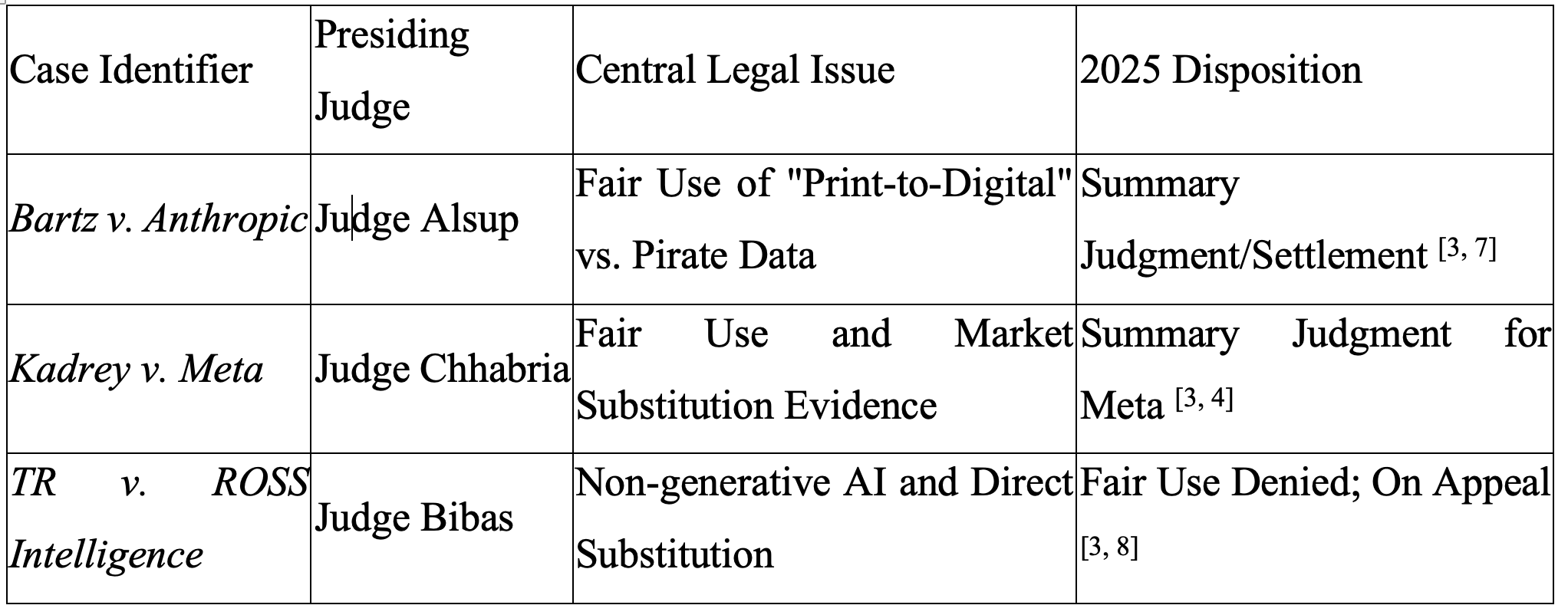

The outlier in this trend was Thomson Reuters v. ROSS Intelligence, decided in February 2025.[3] Judge Stephanos Bibas held that ROSS’s use of Westlaw’s copyrighted headnotes to build a competing legal research tool was not a fair use as a matter of law.[3, 8] The court found that because ROSS intended to build a direct market substitute for a rightsholder’s core product using that product’s own curated content, the use was commercial and non-transformative.[3, 8] This ruling clarifies that the AI industry cannot rely on a blanket “training is always transformative” defence when the resulting application targets the specific market niche of the training data provider.
The UK High Court Benchmarking of Synthetic Liability
International jurisprudence provided a critical counterbalance to the US district court rulings, most notably with the November 2025 judgment in Getty Images v. Stability AI.[11] This case, overseen by Mrs Justice Joanna Smith in the High Court of England and Wales, represented the first major AI copyright trial to reach a judgment in the United Kingdom.[12, 13] The court’s dismissal of Getty’s secondary copyright infringement claims was based on the technical finding that the Stable Diffusion model does not “store” or “contain” reproductions of the images it was trained on.[11]
A pivotal legal insight from the judgment was the court’s determination that the “model weights” of an AI system are “articles” under the Copyright, Designs and Patents Act 1988, and that such articles can be intangible digital files.[11, 14] While this was a theoretical win for authors—extending the scope of what can be considered an “infringing copy”—the practical failure of Getty to prove that the model weights actually retained copies of the original works meant that the developer was not liable for secondary infringement.[14, 15] However, the court found limited trademark infringement and passing off, noting that Stability AI maintained “meaningful control” over the generation of synthetic watermarks that resembled Getty’s branding.[14] This indicates a judicial trend toward holding developers liable not for the process of learning, but for the indifference shown toward infringing hallmarks in the generated outputs.
Institutional Directives and the Human Authorship Mandate
As the courts tackled infringement, the U.S. Copyright Office (USCO) and international regulatory bodies focused on the boundaries of protection. The year 2025 saw the publication of pivotal reports that solidified the “human-centric” nature of copyright in the age of automation.
The US Copyright Office Report: Parts 2 and 3
Released on January 29, 2025, Part 2 of the USCO report on Copyright and Artificial Intelligence addressed the copyrightability of generative outputs.[16, 17] The Office’s conclusions remained anchored in the constitutional requirement of human authorship, affirming that purely AI-generated works lack the “guiding human hand” necessary for protection.[18, 19] Based on an analysis of over 10,000 public comments, the USCO concluded that current technology does not allow end-users to exercise sufficient control through “mere prompts” to qualify as authors.[16, 17]
However, the Office provided a nuanced “hybrid authorship” framework. Works that incorporate AI-generated material may still be protected if a human author has made “creative arrangements or modifications” or if the AI was used merely as an “assistive tool”.[17, 20] This policy reinforces the idea that copyright is a tool for incentivising human expression, and extending it to machines would “undermine rather than further the constitutional goals” of the law.[17]
Part 3 of the report, released in pre-publication form in May 2025, shifted the focus to the training phase.[16] It provided a comprehensive technical mapping of how data is curated, filtered, and cleaned for machine learning.[16] The report identified that the “downloading, transferring, and converting” of works into training datasets clearly implicate the right of reproduction.[16] Perhaps most importantly, the report explored the feasibility of “statutory approaches” to compensation, including compulsory licensing and collective management, as potential alternatives to the current litigation-heavy status quo.[16]
The EU AI Act and the Code of Practice
Across the Atlantic, the European Union moved from legislation to implementation. The EU AI Act’s provisions for “general-purpose AI” (GPAI) became operational reality on July 10, 2025, with the publication of the first General-Purpose AI Code of Practice.[21] This code, signed by industry giants including Amazon, Google, Microsoft, and OpenAI, serves as a voluntary but legally significant roadmap for compliance with the AI Act’s safety and transparency obligations.[21]
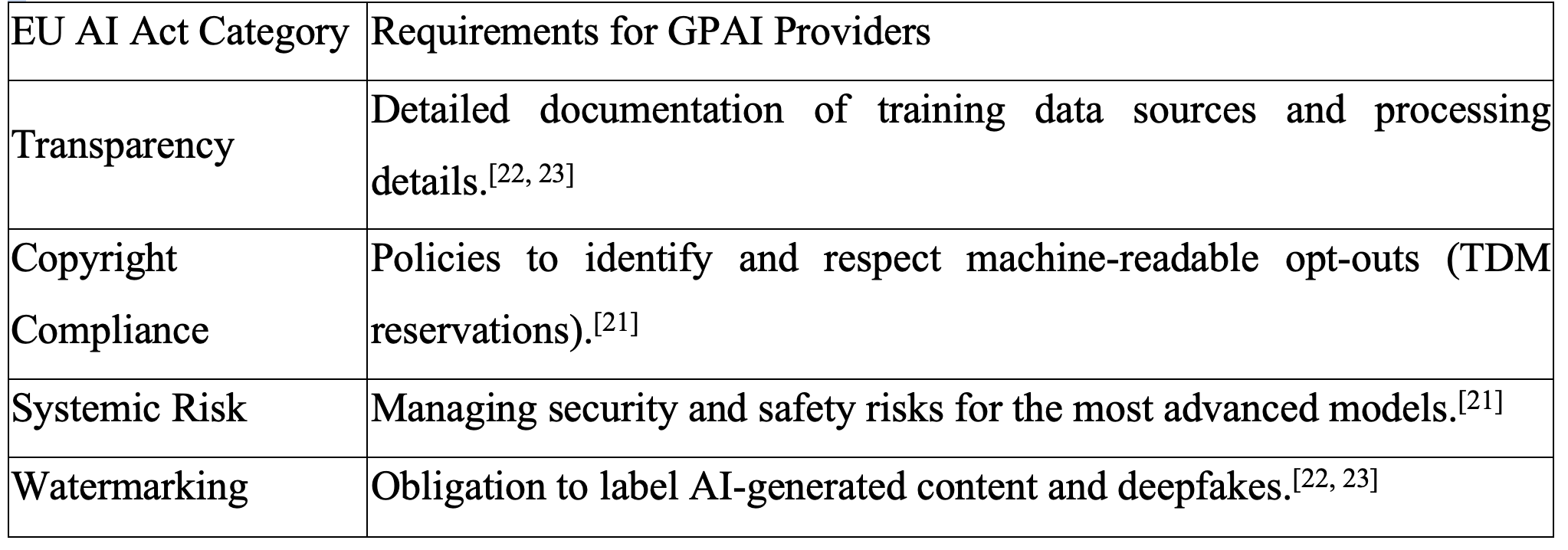
The European Commission’s December 2025 consultation on Text and Data Mining (TDM) opt-out protocols represents a critical step toward standardising how rightsholders can “pull the handbrake” on AI scraping.[21, 24] By seeking agreement on “state-of-the-art” technical protocols, the EU is attempting to move copyright enforcement from the courtroom into the internet’s infrastructure.[21]
Economic Realignment: The Shift to Licensing and Settlement
The most significant shift of 2025 was the transition from “total war” to “managed coexistence” between major content owners and AI developers. The realisation that AI training might be deemed a fair use led rightsholders to secure their financial futures through licensing agreements rather than gambling on unpredictable court verdicts.
The Music Industry’s Synchronised Settlement
The music industry, led by the Recording Industry Association of America (RIAA), transitioned from aggressive litigation against AI generators like Suno and Udio to high-value catalogue licensing.[25, 26] On November 21, 2025, the startup Klay Vision announced it had signed a historic licensing agreement with the “Big Three”—Universal Music Group (UMG), Sony Music Entertainment, and Warner Music Group (WMG).[26, 27] This deal allows Klay to train its models on millions of recordings to create a subscription service that remakes songs in new styles while ostensibly “celebrating” human craft.[27]
A similar settlement was reached with Udio and Suno in late 2025.[27, 28] Suno, following its agreement with WMG, revised its terms of service for 2026 to emphasise subscriber-only monetisation and stricter ownership definitions.[28]
These deals often include:
• Upfront Advances: Significant initial payments for the right to use back-catalogues.
• Equity Stakes: Labels becoming partial owners of the AI platforms, aligning their financial interests.[29]
• Royalty Frameworks: Ongoing payments based on the use of specific artists’ styles or manipulated content.[29]
However, this “platformisation” of music has drawn sharp criticism from groups like the European Composer and Songwriter Alliance (ECSA), who argue that the deals lack transparency regarding how individual creators are remunerated.[25] The fear is that major labels will replicate the “streaming model,” where the lion’s share of AI revenue is retained by the distributors rather than the authors.[25]
The News Industry and the “RAG” War
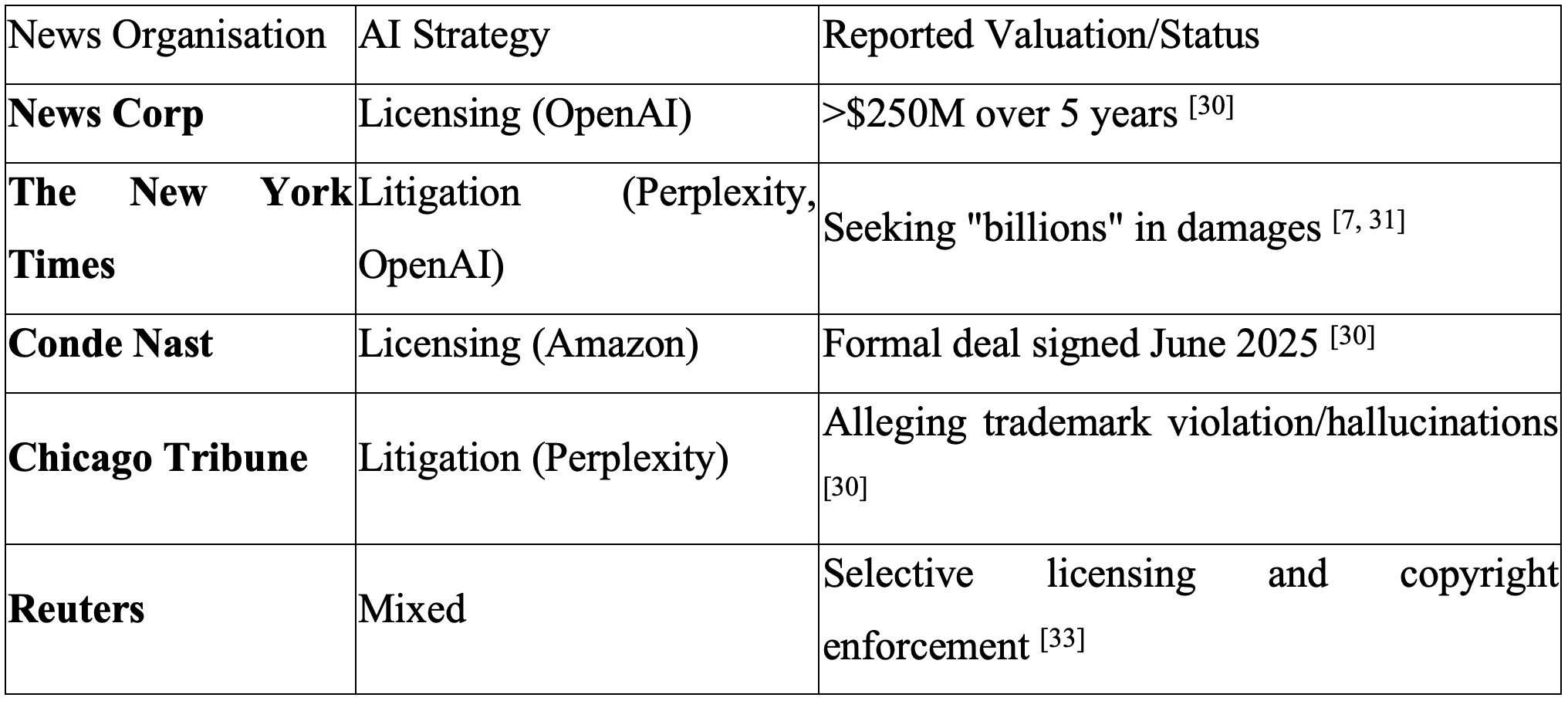
While the music industry consolidated, the news industry remained a theatre of conflict, primarily over “Retrieval-Augmented Generation” (RAG). Unlike traditional LLM training, RAG allows an AI to crawl the live internet to pull specific content in response to a user query.[9, 30]
The December 2025 lawsuit filed by the New York Times against Perplexity AI highlights this tension.[31, 32] The Times accused Perplexity of using RAG to “steal” content from behind its paywall, delivering real-time summaries to customers that bypass the need to visit the newspaper’s website.[30] This is viewed by publishers as a “direct market substitute” that threatens the advertising and subscription revenue models essential for local journalism.[30] Simultaneously, News Corp reportedly secured a deal worth over $250 million over five years with OpenAI, demonstrating a widening gap between those who chose to partner and those who chose to fight.[30]
Technical Infrastructure and the Battle for the Open Web
As the legal world focused on liability, the technical world focused on “provenance” and “preference.” The year 2025 saw the rise of new standards designed to make the digital ecosystem more transparent and controllable.
Content Provenance and C2PA 2.2
The Coalition for Content Provenance and Authenticity (C2PA) emerged as the “consensus industry standard” for digital transparency in 2025.[34] The C2PA specification, expected to be adopted as ISO international standard 22144, uses cryptographically signed metadata to establish a “chain of provenance” for digital assets.[34, 35]
A key technical advancement in 2025 was the differentiation between “hard binding” and “soft binding” [36, 37]:
1. Hard Binding: A cryptographic hash of the raw content tied to the metadata. This is highly secure but easily broken if the file is even slightly modified (e.g., resized for social media).[37]
2. Soft Binding: The use of invisible watermarks or perceptual hashes (fingerprints) to re-associate metadata with an asset that has been “decoupled” from its original manifest.[36, 37]
These “Content Credentials” are now being implemented at the browser and hardware level, with companies like Google and LinkedIn using them to help users identify if media was “created or edited by AI”.[34] By late 2025, Trufo, Google, and SSL.com became the inaugural “Root Certificate Authorities” for this ecosystem, providing the trust layer necessary for global adoption.[37]
The IETF and the AI Preferences (AIPREF) Conflict
While C2PA focused on labelling outputs, the Internet Engineering Task Force (IETF) became a battleground for controlling inputs. The AI Preferences (AIPREF) Working Group, chartered in January 2025, sought to develop a more granular successor to robots.txt.[38, 39]
The debate centred on whether websites should have “veto power” over certain uses of scraped data.[40] Organisations like the Electronic Frontier Foundation (EFF) argued that rightsholders were attempting to “make an end-run around fair use” by encoding business-model preferences into technical standards.[40] The concern is that if an IETF standard allows a website to block “AI training” while allowing “web search,” it effectively forces a licensing regime on what has historically been a public, crawlable internet.[40] By the end of 2025, the IETF initiative was reportedly “taking more time than initially expected,” with stakeholders unable to reach a consensus on a vocabulary that balances publisher rights with the open web’s accessibility.[39]
2026 Forecast: From Pilot Projects to Enterprise Infrastructure
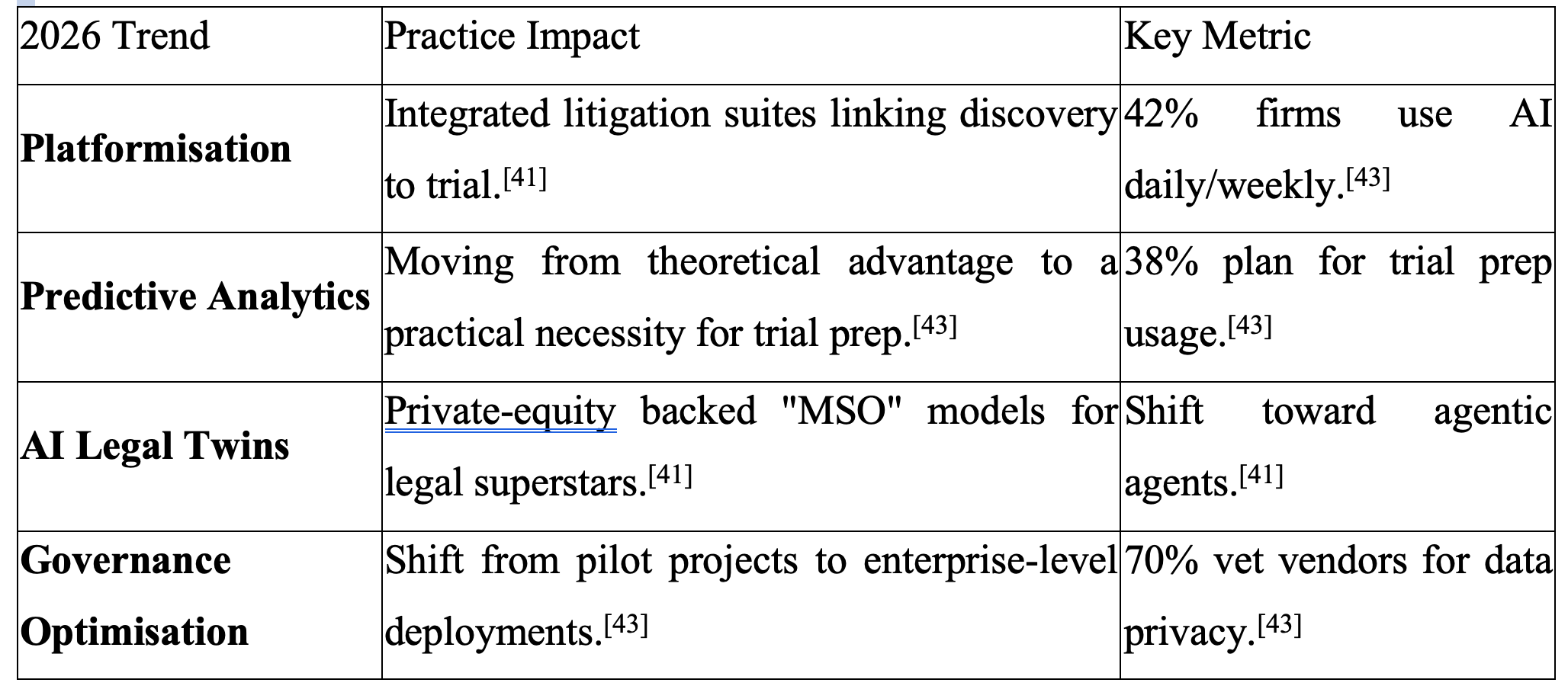
The transition into 2026 marks a shift from experimental AI use toward what analysts call “Agentic AI” and “Platformisation.” For the legal industry, this means a move away from documenting “what happened” to predicting “what will happen” using advanced litigation tools.
The Rise of Agentic AI and Autonomous Liability
In 2026, the industry is expected to move beyond simple chat-based interfaces to “agentic” systems—AI that can execute complex, multi-step workflows autonomously.[41, 42] This shift introduces profound new legal questions:
• Agent-to-Agent Exploits: As autonomous agents interact, the risk of “indirect prompt injection” and “poisoned retrieval sources” increases.[42]
• Contractual Authority: When an AI agent signs an invoice or manages an inventory workflow, the liability for errors will shift toward a “product liability” framework.[8, 42] This was foreshadowed by the May 2025 ruling in Garcia v. Character AI, where a judge allowed product liability claims to proceed against an AI platform.[8]
• Democratic ‘Vibe Coding’: The acceleration of agent creation by non-technical users will create a “wave of unmanaged agents” that bypass traditional security and governance frameworks, placing boards of directors under heightened scrutiny.[42]
The Legal Technology Tipping Point
The 2026 outlook for the legal profession itself is one of rapid integration. According to a survey of over 2,000 legal professionals, 42% of firms are now using AI, with that number expected to double by 2026.[43] Success in 2026 will no longer hinge on a tool’s capability, but on its “ROI” and “interconnectivity”.[43]
The Appellate Calendar and the “Thaler” Decision
The judiciary will continue to be a primary shaper of AI’s future in 2026, with several high stakes appeals set to be argued:
• Third Circuit: Thomson Reuters v. ROSS Intelligence will provide critical guidance on whether “intermediate” training is fair use when the result is a non-generative research tool.[3, 44]
• Ninth Circuit: Doe v. GitHub and other interlocutory appeals will address the “stripping” of Copyright Management Information (CMI) from training data.[10, 40]
• Supreme Court: The justices asked the government to respond to Stephen Thaler’s petition regarding AI authorship by January 26, 2026.[44] A decision to hear the case could fundamentally redefine the “Human Authorship” requirement established by the Copyright Office.
Regulatory Milestones and the Global Fragmentation
The year 2026 will see the effective dates for several foundational AI laws, creating a “complex landscape for businesses leveraging AI”.[23]
1. California: The Transparency in Frontier Artificial Intelligence Act (SB 53) and the Generative AI Training Data Transparency Act (AB 2013) both take effect on January 1, 2026. AB 2013 requires developers to publish high-level summaries of training data sources, including dataset descriptions, intellectual property status, and whether personal information was used. SB 53 applies narrowly to “frontier models” developed by large companies, requiring them to publish safety frameworks and incident reporting protocols. [23, 45]
2. Colorado: A new law governing privacy and decision-making in “high-risk” scenarios (healthcare, lending, employment) takes effect in 2026.[2]
3. United Kingdom: The Secretary of State must publish a report by March 18, 2026, on the use of copyrighted works in AI systems, potentially proposing new “technical measures and standards” for metadata control.[46]
4. China: Following the 2025 Labelling Measures, China is expected to refine its “national AI strategy” under the AI Plus Action Plan, balancing innovation with the need for “centralised oversight” amid geopolitical tensions.[47, 48]
Nuanced Conclusions: The Emergence of the “Ethical AI” Premium
As 2025 draws to a close, the “Great Recalibration” reveals a bifurcated future for AI copyright. On one side, the judicial acceptance of training as a transformative act (in Bartz and Kadrey) suggests that the core engine of generative AI is legally viable in the United States.[3, 5] On the other, the “shadow library” rulings and the Perplexity RAG lawsuits indicate that the era of “free” data is ending.[3, 31]
The industry is moving toward an “Ethical AI” premium. Developers like Klay Vision and startups that secure explicit licenses are being rewarded with market certainty and institutional support.[26, 27] Conversely, companies that rely on “scraping by stealth” are facing a “piracy bottleneck” as content owners implement C2PA watermarks and IETF preference signals to lock down their assets.[40, 44]
By 2026, the primary differentiator for AI firms will not be the size of their model, but the “traceability of the creative process”.[49] As intangible assets (patents, trademarks, and proprietary data) become the core of corporate value, the ability to demonstrate “clean” training data flows will become essential for securing financing and avoiding the “billions of dollars” in liability currently being sought in the courts.[7, 49] The profession faces a choice: treat AI as a peripheral tool, or as a “partner in redesigning how legal services are delivered”.[41] Those who invest in the “agentic” future, where human expertise is combined with data-backed litigation insights, will define the competitive edge in the era of 2026 and beyond.[43]
--------------------------------------------------------------------------------
1. AI Intellectual Property Disputes: The Year in Review | 12 | 2025 ..., https://www.debevoise.com/insights/publications/2025/12/ai-intellectual-property-disputes-the-year-in
2. AI’s War in the Courtroom: Copyright Disputes Spike in 2025 - Best Law Firms, https://www.bestlawfirms.com/articles/ai-war-in-the-courtroom-copyright-disputes-spike-in-2025/7186
3. Copyright and AI Collide: Three Key Decisions on AI Training and Copyrighted Content from 2025 - IPWatchdog.com, https://ipwatchdog.com/2025/12/23/copyright-ai-collide-three-key-decisions-ai-training-copyrighted-content-2025/
4. AI and Fair Use: Two US Court Decisions Shaping the Landscape, https://www.acc.com/resource-library/ai-and-fair-use-two-us-court-decisions-shaping-landscape
5. AI Companies Prevail in Path-Breaking Decisions on Fair Use | Crowell & Moring LLP, https://www.crowell.com/en/insights/client-alerts/ai-companies-prevail-in-path-breaking-decisions-on-fair-use
6. F__r Use: Do Recent U.S. Court Decisions Indicate AI Training is Covered Under Fair Use?, https://www.verrill-law.com/news/f__r-use-do-recent-u-s-court-decisions-indicate-ai-training-is-covered-under-fair-use/
7. AI Infringement Case Updates: September 15, 2025 - McKool Smith, https://www.mckoolsmith.com/newsroom-ailitigation-36
8. AI Wrapped 2025: The Year Hypothetical AI Risks Became Operational Reality, https://www.manatt.com/insights/articles/2025/ai-wrapped-2025-the-year-hypothetical-ai-risks-became-operational-reality
9. Case Tracker: Artificial Intelligence, Copyrights and Class Actions ..., https://www.bakerlaw.com/services/artificial-intelligence-ai/case-tracker-artificial-intelligence-copyrights-and-class-actions/
10. Status of all 57 copyright lawsuits v. AI (Oct. 26, 2025): Apple hit with 3 lawsuits., https://chatgptiseatingtheworld.com/2025/10/26/status-of-all-56-copyright-lawsuits-v-ai-oct-26-2025-apple-hit-with-3-lawsuits/
11. Getty Images v Stability AI English High Court Rejects Secondary Copyright Claim, https://www.lw.com/en/insights/getty-images-v-stability-ai-english-high-court-rejects-secondary-copyright-claim
12. A Mark of Progress? Getty v Stability AI’s impact on IP infringement in the age of AI, https://www.lewissilkin.com/insights/2025/12/02/a-mark-of-progress-getty-v-stability-ais-impact-on-ip-infringement-in-the-age-102lwdo
13. Getty Images v Stability AI: the UK High Court decision offers guidance, but critical questions on AI and copyright infringement remain | DLA Piper, https://www.dlapiper.com/insights/publications/2025/11/getty-images-v-stability-ai-the-uk-high-court-decision-offers-guidance-but-critical-questions-on-ai
14. Getty Images v Stability AI: High Court delivers long awaited judgment - Wiggin LLP, https://www.wiggin.co.uk/insight/getty-images-v-stability-ai-high-court-delivers-landmark-judgment/
15. Stability AI defeats Getty Images copyright claims in first of its kind dispute before the High Cour, https://www.twobirds.com/en/insights/2025/uk/stability-ai-defeats-getty-images-copyright-claims-in-first-of-its-kind-dispute-before-the-high-cour
16. Copyright and Artificial Intelligence | U.S. Copyright Office, https://www.copyright.gov/ai/
17. Copyright Office Releases Part 2 of Artificial Intelligence Report, https://www.copyright.gov/newsnet/2025/1060.html
18. Copyright and Artificial Intelligence, Part 2 Copyrightability Report, https://www.copyright.gov/ai/Copyright-and-Artificial-Intelligence-Part-2-Copyrightability-Report.pdf
19. Generative Artificial Intelligence and Copyright Law - Congress.gov, https://www.congress.gov/crs-product/LSB10922
20. Inside the Copyright Office’s Report, Copyright and Artificial Intelligence, Part 2: Copyrightability - Library of Congress Blogs, https://blogs.loc.gov/copyright/2025/02/inside-the-copyright-offices-report-copyright-and-artificial-intelligence-part-2-copyrightability/
21. Commission launches consultation on protocols for reserving rights ..., https://digital-strategy.ec.europa.eu/en/consultations/commission-launches-consultation-protocols-reserving-rights-text-and-data-mining-under-ai-act-and
22. AI Regulations in 2025: US, EU, UK, Japan, China & More - Anecdotes AI, https://www.anecdotes.ai/learn/ai-regulations-in-2025-us-eu-uk-japan-china-and-more
23. 2026 Outlook: Artificial Intelligence | Insights - Greenberg Traurig, LLP, https://www.gtlaw.com/en/insights/2025/12/2026-outlook-artificial-intelligence
24. AI Copyright Law 2025: Latest US & Global Policy Moves - VKTR.com, https://www.vktr.com/ai-ethics-law-risk/ai-copyright-law/
25. Major labels’ licensing deals with AI companies: ECSA calls for transparent licensing agreements that truly value the works of composers and songwriters • News, https://composeralliance.org/news/2025/11/major-labels-licensing-deals-with-ai-companies-ecsa-calls-for-transparent-licensing-agreements-that-truly-value-the-works-of-composers-and-songwriters/
26. Major music studios strike licensing deals with AI firms | Semafor, https://www.semafor.com/article/11/21/2025/major-music-studios-strike-licensing-deals-with-ai-firms
27. Major Labels Announce Deal with AI Music Startup - Relix, https://relix.com/news/detail/major-labels-announce-deal-with-ai-music-startup/
28. Suno adjusts AI music ownership terms after Warner Music partnership | Music In Africa, https://www.musicinafrica.net/magazine/suno-adjusts-ai-music-ownership-terms-after-warner-music-partnership
29. Musicians are deeply concerned about AI. So why are the major labels embracing it? | Music, https://www.theguardian.com/music/2025/dec/16/musicians-are-deeply-concerned-about-ai-so-why-are-the-major-labels-embracing-it
30. News generative AI deals revealed: Who is suing, who is signing? - Press Gazette, https://pressgazette.co.uk/platforms/news-publisher-ai-deals-lawsuits-openai-google/
31. New York Times sues AI startup for ‘illegal’ copying of millions of articles - The Guardian, https://www.theguardian.com/technology/2025/dec/05/new-york-times-perplexity-ai-lawsuit
32. Generative AI Lawsuits Timeline: Legal Cases vs. OpenAI, Microsoft, Anthropic, Google, Nvidia, Perplexity, Salesforce, Apple and More - Sustainable Tech Partner for IT Service Providers, https://sustainabletechpartner.com/topics/ai/generative-ai-lawsuit-timeline/
33. New York Times reporter sues Google, xAI, OpenAI over chatbot training, https://m.economictimes.com/tech/artificial-intelligence/new-york-times-reporter-sues-google-xai-openai-over-chatbot-training/articleshow/126133052.cms
34. C2PA NIST Response - Regulations.gov, https://downloads.regulations.gov/NIST-2024-0001-0030/attachment_1.pdf
35. Content Credentials: Strengthening Multimedia Integrity in the Generative AI Era - DoD, https://media.defense.gov/2025/Jan/29/2003634788/-1/-1/0/CSI-CONTENT-CREDENTIALS.PDF
36. C2PA Implementation Guidance, https://spec.c2pa.org/specifications/specifications/2.2/guidance/Guidance.html
37. The C2PA Provenance Standard - Trufo, https://trufo.ai/standards
38. Launch of the IETF Community Survey 2025, https://www.ietf.org/blog/launch-of-the-ietf-community-survey-2025/
39. Notes, September 30th, 2025 | TDM Reservation Protocol Community Group - W3C, https://www.w3.org/community/tdmrep/2025/10/01/notes-september-30th-2025/
40. Artificial Intelligence, Copyright, and the Fight for User Rights: 2025 ..., https://www.eff.org/deeplinks/2025/12/artificial-intelligence-copyright-and-fight-user-rights-2025-review
41. Predictions for 2026 in AI and the Law - American Arbitration Association, https://www.adr.org/podcasts/ai-and-the-future-of-law/predictions-for-2026-in-ai-and-the-law/
42. Our tech predictions for 2026 - Lewis Silkin LLP, https://www.lewissilkin.com/insights/2025/12/19/our-tech-predictions-for-2026
43. The 2026 Legal Tech & AI Outlook - U.S. Legal Support, https://www.uslegalsupport.com/blog/2026-legal-tech-ai-trends/
44. Music Piracy, AI Lawsuits Top 2026 Copyright Litigation Calendar - Bloomberg Law News, https://news.bloomberglaw.com/ip-law/music-piracy-ai-lawsuits-top-2026-copyright-litigation-calendar
45. Five Big Questions (and Zero Predictions) for the U.S. Privacy and AI Landscape in 2026, https://fpf.org/blog/five-big-questions-and-zero-predictions-for-the-u-s-privacy-and-ai-landscape-in-2026/
46. AI View - September 2025, https://www.simmons-simmons.com/en/publications/cmf423feb008iv9ts2dbd7d8m/ai-view-september-2025
47. Global AI Governance Law and Policy: China - IAPP, https://iapp.org/resources/article/global-ai-governance-china/
48. AI, Machine Learning & Big Data Laws 2025 | China - Global Legal Insights, https://www.globallegalinsights.com/practice-areas/ai-machine-learning-and-big-data-laws-and-regulations/china/
49. Six IP trends that will shape how companies protect innovation in 2026 - ClarkeModet, https://www.clarkemodet.com/en/articles/six-ip-trends-that-will-shape-how-companies-protect-innovation-in-2026/