

The Ontological Crisis of Legal Truth: A Comparative Analysis of AI Hallucinations in the Courtrooms of the United States, United Kingdom, and European Union
The integration of generative artificial intelligence into the global legal infrastructure has precipitated a fundamental shift in the nature of judicial proceedings, replacing traditional research methodologies with probabilistic text generation models. This transition has introduced a pervasive and destructive phenomenon: the AI hallucination.
In the legal context, a hallucination occurs when a large language model (LLM) generates outputs that are factually incorrect or entirely fabricated, yet presented with a degree of structural and stylistic plausibility that mimics authoritative legal prose.[1, 2] These fabrications are not merely errors in calculation but are the result of the probabilistic nature of transformer-based architectures, which predict the next most likely token in a sequence rather than retrieving verified facts from a static database.[1, 3] As these tools have moved from experimental curiosities to professional necessities, the incidence of non-existent case law, fictitious statutes, and fabricated judicial quotations appearing in court filings has escalated globally.[4, 5]
The Technical Genesis of Fabricated Authority
To understand the legal risks of artificial intelligence, it is necessary to examine the architecture of Large Language Models, which operate on the principle of linguistic probability rather than logical deduction or factual retrieval. These models, such as GPT-4, Claude, or Gemini, are trained on vast datasets of scraped internet content, literature, and in some cases, specialised legal texts.[3, 6] The process of text generation involves calculating the conditional probability of a word (or unit of text called a “token”) given the preceding context.
This can be expressed through the fundamental probabilistic framework of the transformer architecture, where the model seeks to maximise the likelihood of a sequence. In this framework, the model lacks an internal concept of “truth” or a verification mechanism to check if a cited case actually exists in the physical world.[1, 7] Instead, it generates a citation that structurally resembles a valid citation because it follows the patterns found in its training data—combining common case names, plausible years, and the stylistic formatting of neutral citations.[8, 9] This “probabilistic mimicry” allows the AI to return what it calculates is a likely response, even if the case cited is entirely fictitious.[1] In this sense, an LLM acts as an articulate entity with no memory of specific books, but rather a sophisticated understanding of how stories (or legal briefs) are usually told.[1]
The Plausibility Trap and Algorithmic Dependency
The danger of these hallucinations lies in their “plausible but false” nature. Because LLMs excel at mimicking the register and formal tone of legal writing, a hallucinated case summary may sound as authoritative as a genuine Supreme Court decision.[10, 11] This leads to a phenomenon described as “algorithmic dependency,” where legal professionals, under pressure to increase efficiency and lower costs, trust the machine output over their own professional judgment.[10, 12, 13] Evidence suggests that hallucinations are more frequent in complex legal tasks that require nuanced reasoning or a deep understanding of the relationship between precedents.[11] A study by the Stanford Institute for Human-Centered Artificial Intelligence (HAI) revealed that when LLMs are asked to interpret the precedential relationship between two cases, their performance often degrades to the level of random guessing.[11] Furthermore, hallucination rates for specific legal queries range from 69% to 88% in standard general-purpose models, with significant deterioration in tasks involving localised legal knowledge or lower court cases.[11]
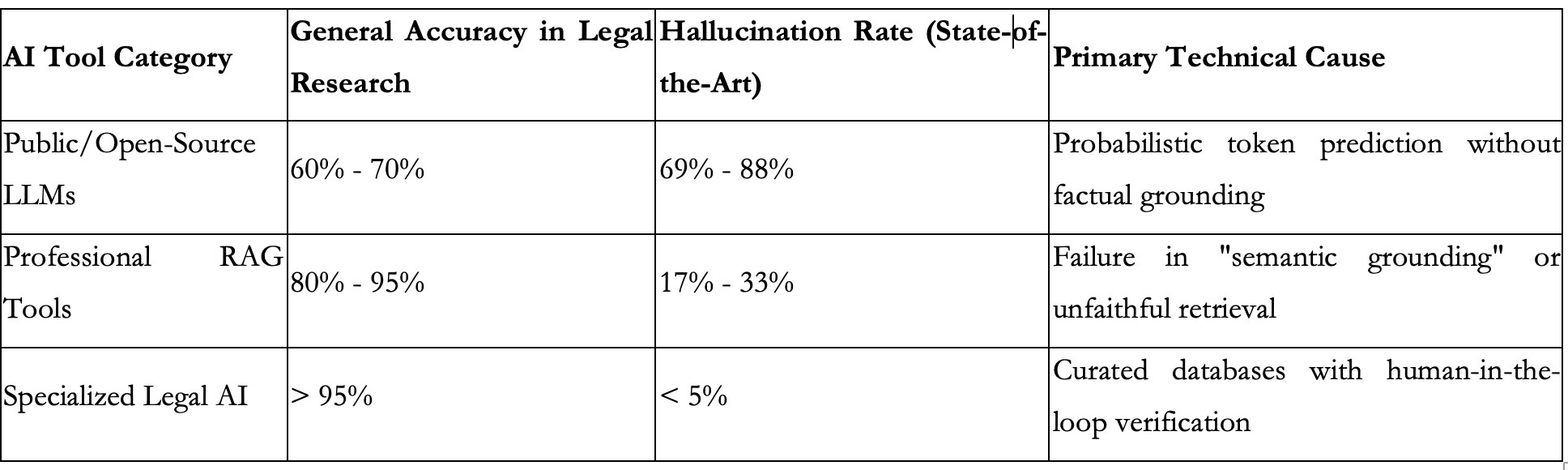
The statistical prevalence of these errors highlights a core problem: LLMs struggle with the “knowledge cut-off” and the proprietary nature of legal databases like Westlaw and LexisNexis, which are often excluded from open training corpora.[3, 8, 14] In the absence of direct access to these authoritative sources, the model extrapolates based on statistical patterns, effectively “filling in” gaps with plausible but fabricated authorities.[8]
The American Jurisprudential Experience: Sanctions and Rule 11
The United States has served as the primary theatre for the first major “collisions” between generative AI and the judiciary. The landmark case of Mata v. Avianca, Inc. 678 F. Supp. 3d 443, remains the foundational precedent for how courts handle AI-generated fabrications.[15, 16] In Mata, an attorney submitted a brief containing six fake case citations generated by ChatGPT, which included fabricated quotations and internal citations.[15, 17] The court’s reaction established that technological assistance does not absolve a lawyer of the duty to ensure the accuracy of their filings.[16] Judge P. Kevin Castel noted numerous inconsistencies in the opinion summaries, describing the legal analysis as “gibberish” and holding that the lawyers acted with “subjective bad faith” sufficient for sanctions under Federal Rule of Civil Procedure Rule 11.[15]
The Proliferation of AI-Related Sanctions
Since the Mata decision, the issue has evolved from an “unprecedented circumstance” to a recurring ethical challenge across various federal and state jurisdictions.[16, 18] In Morgan & Morgan, a prominent personal injury firm, lawyers were sanctioned for submitting motions with hallucinated cases.[2] The court imposed fines not only on the drafting lawyer (1,000 each), emphasising that the duty of Rule 11 cannot be delegated to junior staff or automated systems.[2]
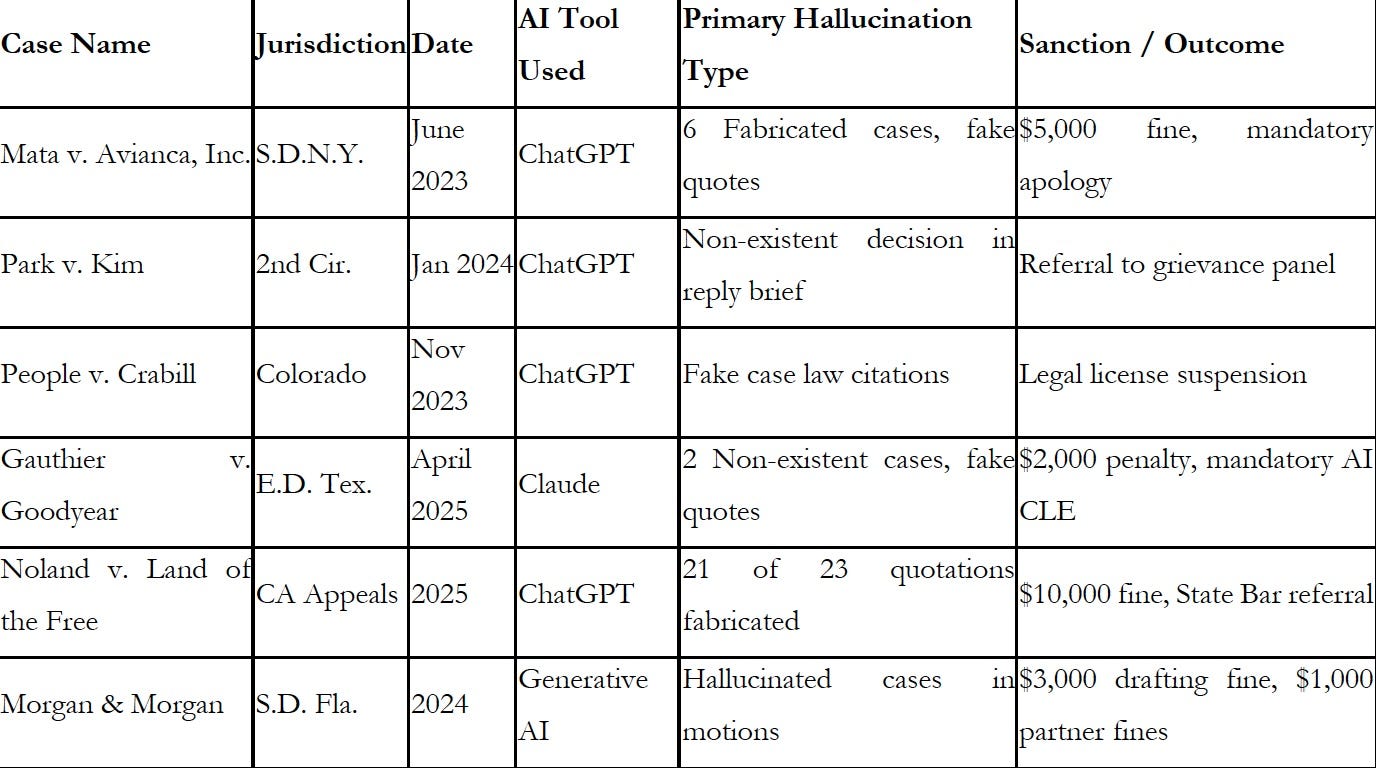
The Noland case in California introduced a significant nuance: the court declined to award fees to the opposing counsel because they had failed to detect the hallucinated citations themselves.[19] This suggests a burgeoning judicial expectation that attorneys must not only police their own AI usage but also serve as a secondary check on the integrity of their adversaries’ submissions.[19]
Standing Orders and Mandatory Disclosures
The judicial response in the USA has led to a patchwork of “Standing Orders” that require lawyers to disclose AI usage or certify that human verification has occurred.[20] These requirements vary by jurisdiction, creating a complex compliance landscape. In the Eastern District of Texas and the District of New Mexico, any party using generative AI must file a “Certificate of Generative AI Usage”.[21, 22] Some judges, such as those in Ohio and Illinois, have taken a more aggressive stance, banning AI use in court documents entirely.[20] As of late 2025, 36 states have no jurisdiction-wide rule, while others like California and New Jersey are “court dependent,” meaning rules vary by individual judge.[20]
The United Kingdom: The Hamid Jurisdiction and Professional Conduct
The United Kingdom’s encounter with AI hallucinations began with litigants-in-person (LIPs) but rapidly expanded to involve regulated professionals. The first major incident occurred in Harber v. HMRC UKFTT 1007 (TC), where an appellant seeking to avoid tax penalties submitted nine non-existent tribunal decisions.[1, 9] While the First-tier Tribunal (FTT) accepted that the LIP did not know the cases were fake, it highlighted the harm caused to judicial integrity and the “waste of time and money” incurred by the opposing party.[7, 17]
The Divisional Court’s Warning in Ayinde and Al-Haroun
A definitive shift in the UK judicial attitude was signalled in June 2025 by the Divisional Court in Ayinde v. London Borough of Haringey and Al-Haroun v. Qatar National Bank EWHC 1383 (Admin).[1, 23] These cases involved a barrister and a solicitor who submitted fake citations, claiming they were “minor citation errors” when challenged.[24] The court’s warning was severe, extending beyond professional sanctions to the realm of criminal law. The presiding judges noted that deliberately placing false material before the court with the intention of interfering with the administration of justice amounts to the common law criminal offence of “perverting the course of justice,” which carries a maximum sentence of life imprisonment.[23, 25, 26] The Court rejected the “relative inexperience” of counsel as a complete shield from responsibility.[24]
In Ayinde, the barrister submitted grounds containing five fictitious case citations and a misstatement of section 188(3) of the Housing Act 1996, portraying a discretionary power as a mandatory duty.[27, 28] The result was a wasted costs order of £2,000 for both the legal representatives and counsel, alongside a referral to the Bar Standards Board (BSB) and Solicitors Regulation Authority (SRA).[23, 25]
UK Regulatory Guidance and the AI Literacy Mandate
In response to these incidents, UK regulators have updated their guidance to codify AI literacy as a baseline professional competence.[8] The Bar Council’s November 2025 guidance emphasises that misuse of AI—even if inadvertent—may be classified as “incompetent and grossly negligent,” potentially invalidating professional indemnity insurance and engaging Core Duties 1, 3, and 5 of the BSB Handbook.[25, 28, 29]
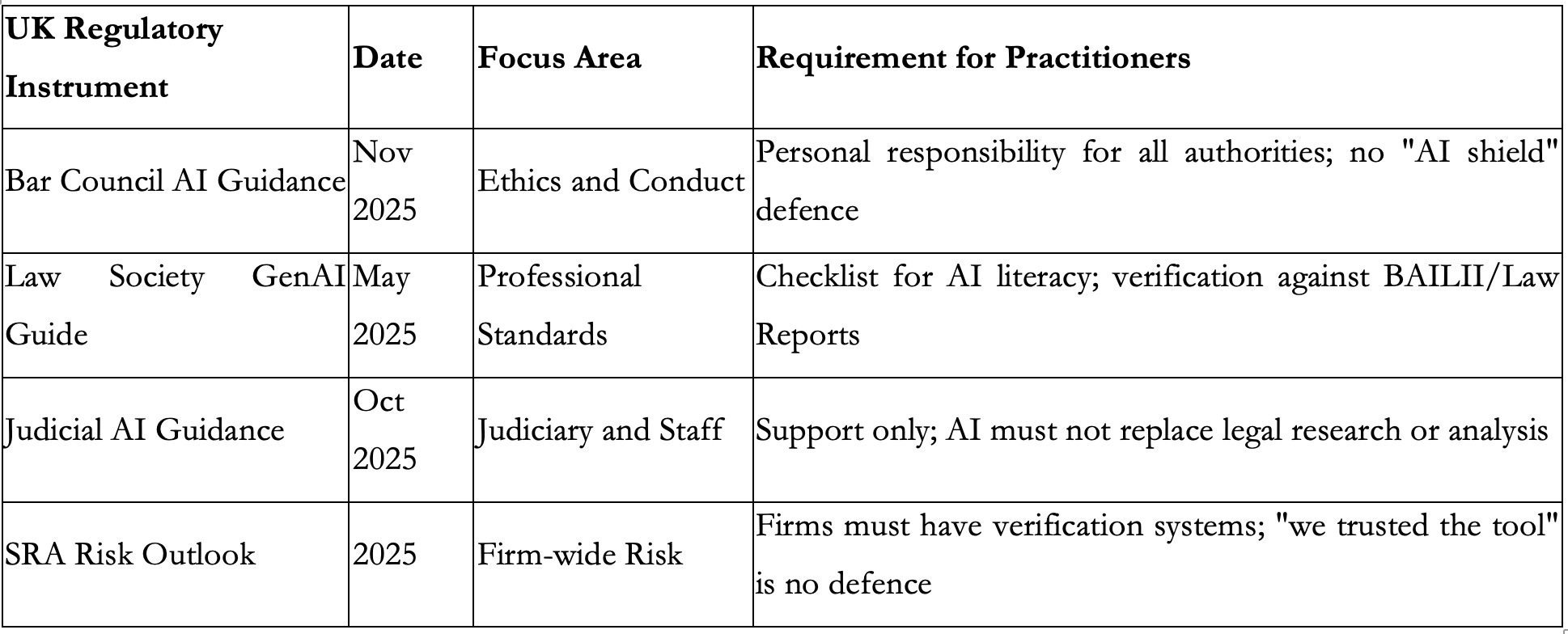
Firm-wide Risk
Firms must have verification systems; “we trusted the tool” is no defence
The Ayinde judgment introduced a systemic requirement for “leadership responsibility,” where heads of chambers and law firm partners are expected to ensure that every individual in their organisation understands their ethical duties regarding AI.[26, 28] This marks a shift from individual accountability to institutional oversight.[27, 30]
The European Union: Risk-Based Regulation and Continental Case Law
The European approach to AI hallucinations is defined by the EU AI Act, which classifies AI systems used in the “administration of justice” as high-risk.[31, 32] This classification triggers stringent transparency, data quality, and human oversight obligations that go beyond the professional codes of conduct found in common law jurisdictions.[33, 34]
The AI Act and Prohibited Practices
As of February 2, 2025, the EU AI Act’s prohibitions are in effect, carrying fines of up to 7% of worldwide annual turnover for non-compliance.[35] While “hallucinating” chatbots are not necessarily prohibited per se, they are subject to transparency obligations where providers must inform users that content is AI-generated.[32, 35] However, AI systems that use “purposefully manipulative or deceptive techniques” to distort human behaviour are strictly banned.[35, 36] Deployers who use a general-purpose AI system for a prohibited purpose, including by bypassing safety guardrails, will be held in breach of Article 5.[35]
Germany: The Frontline of Truth and Copyright
Germany has emerged as a key battleground for the legal implications of AI hallucinations and the copyright status of the data that feeds them.
• The Grok Injunction: In September 2025, the Hamburg Regional Court issued an injunction against Elon Musk’s xAI (Grok) for spreading false claims.[37] The court explicitly held that AI chatbots are “obligated to give the truth” and cannot simply shrug off false claims, subjecting the company to a fine of up to €250,000 for each violation.[37]
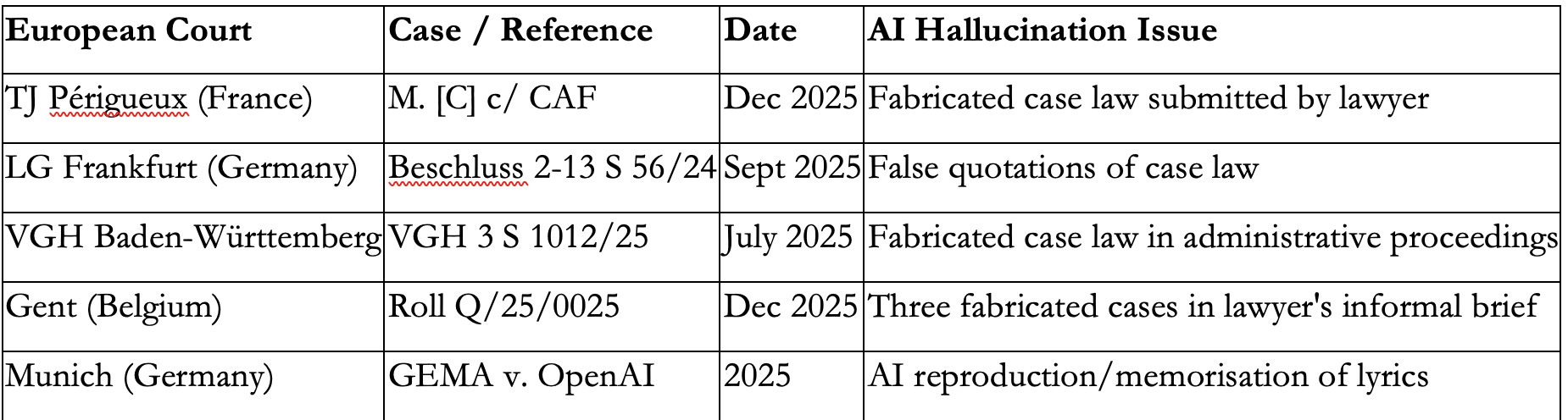
• GEMA v. OpenAI: The Munich Court ruled that the “memorisation” of training data (such as song lyrics) constitutes a copyright reproduction.[38, 39] This is critical because hallucinations often stem from the model’s attempt to reconstruct a memorised pattern that it no longer has access to in full, leading to a distorted version of the original text.[38, 39]
• Cologne Family Court: In July 2025, a family court admonished an attorney for relying on fabricated case law and doctrinal work, warning that knowingly disseminating untruths violates Section 43a(3) of the Federal Lawyers’ Act (BRAO).[40]
The Council of Bars and Law Societies of Europe (CCBE) published a guide in October 2025 emphasising that confidentiality cannot be “outsourced” to AI.[41] The guide warns that inputting personal or confidential client data into public LLMs could be interpreted as sharing it with a third party, thereby breaking legal professional privilege.[41, 42]
The RAG Paradox: Retrieval-Augmented Generation vs. Hallucinations
Legal technology providers have touted Retrieval-Augmented Generation (RAG) as the solution to hallucinations. RAG allows an LLM to pull information directly from a “closed universe” of trusted data, such as case law and statutes, rather than relying on its “hazy internal knowledge”.[14, 43] However, empirical studies reveal that RAG is not a complete panacea.[44, 45]
Findings of the Stanford RAG Study
The Stanford study, titled “Hallucination-Free? Assessing the Reliability of Leading AI Legal Research Tools,” tested Lexis+ AI and Westlaw AI-Assisted Research. The study found that while RAG reduces hallucinations compared to general-purpose chatbots, the problem remains significant.[45]
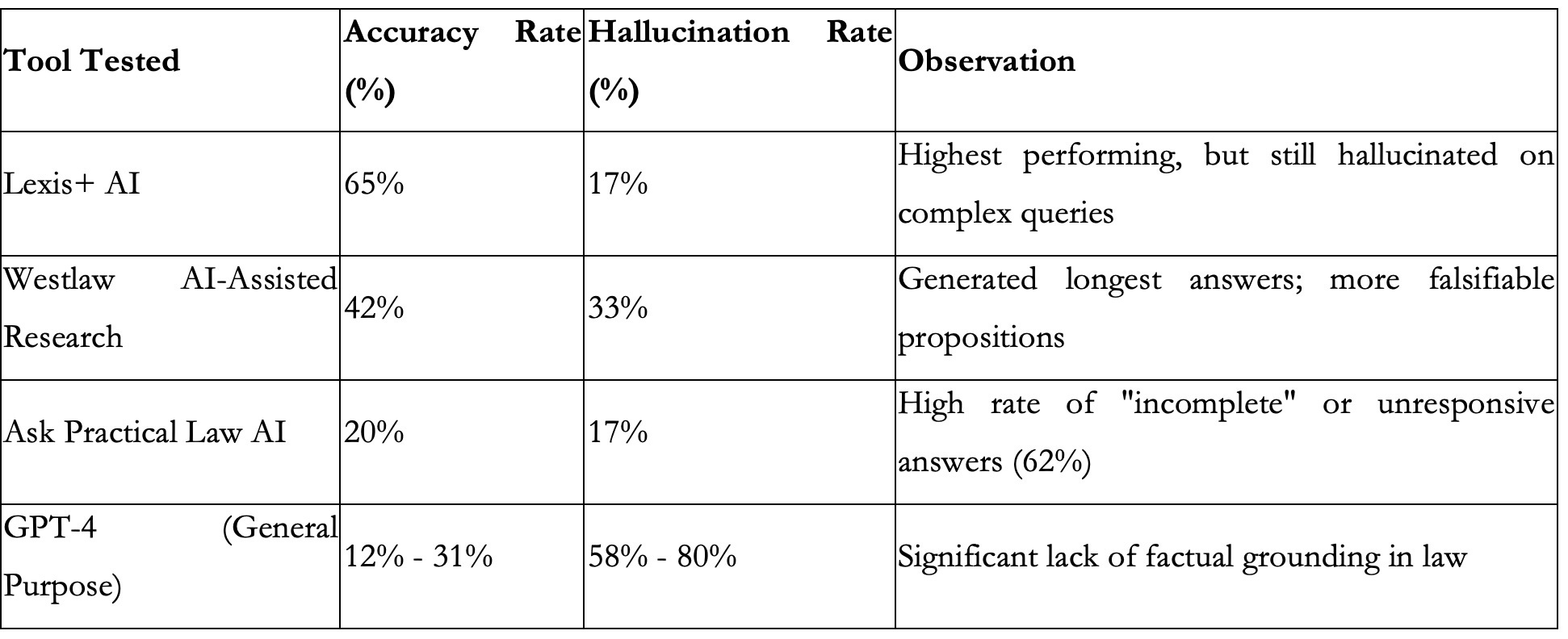
Hallucinations in RAG systems often take the form of citing real cases that do not actually support the generated legal conclusion.[45] For example, a system might provide a link to a real case but falsely claim it stands for a proposition that it never discussed.[45] This “insidious” form of hallucination is harder to detect than entirely fictitious names because the citation itself appears valid in a quick search.[45]
Second and Third-Order Insights: The Evolution of Legal Truth & The Pollution of the Legal Record
The integration of generative AI into the courtroom has created a feedback loop that threatens the stability of legal precedent and judicial efficiency. One of the most concerning third-order effects is the “pollution of the legal ecosystem”.[46] As UK and US courts begin to preserve false citations directly in their judgments—often to explain why a party lost—these fabricated cases enter searchable public records.[46] Eventually, these “fake” cases are scraped by web crawlers and included in the training data for the next generation of AI models, creating a feedback loop where hallucinations become part of the “established” data set.[46] This cycle degrades the quality of the very tools intended to assist lawyers.[46]
The Asymmetry of Judicial Leniency
There is a widening gap in how courts treat AI hallucinations based on the user’s professional status. In Harber (UK) and Gunnarsson (UK), litigants-in-person were treated with relative lenience because they lacked the resources to verify authorities.[8, 9, 30] Conversely, in Ayinde (UK) and Mata (USA), professional lawyers were met with excoriating criticism and financial penalties.[23, 24] This asymmetry codifies a higher standard of care for professionals, as of course it should, where AI literacy is no longer aspirational but a mandatory component of professional competence.[8]
The Lamborghini Doctrine and the Duty to Verify
The judicial system is predicated on the “Lamborghini Doctrine” of authenticity—a reliance on the verifiable existence of precedent and the integrity of evidence.[16] When this bedrock is compromised by “phantom authorities,” the efficiency of the court is degraded as judges and opposing counsel must expend significant resources to verify (and often debunk) submissions.[7, 19] The court in Ayinde reaffirmed that placing one’s name on a legal document carries full professional responsibility for its content, regardless of the drafting method.[27] This “personal responsibility” mandate means that “we trusted the tool” is no longer a valid legal defence.[24, 46]
Future Outlook and Recommendations for the Profession
The transition from “unprecedented” incidents in 2023 to systematic judicial referrals and potential criminal liability in 2025 demonstrates a rapid hardening of the regulatory landscape. To mitigate the risk of AI hallucinations, legal professionals and firms must adopt a “human-in-the-loop” strategy that prioritises verification over speed.
Practical Mitigation Strategies
1. Independent Verification: Every authority, citation, or doctrinal proposition generated with the assistance of AI must be independently checked against reliable sources such as BAILII, Westlaw, or LexisNexis.[8, 46]
2. Disclosure and Record-Keeping: Where AI materially contributes to client advice or court submissions, lawyers should consider disclosing its use to maintain transparency with clients and the court.[3, 8, 42]
3. Anonymisation of Inputs: To safeguard confidentiality and privilege, practitioners should avoid inputting sensitive or privileged client data into public AI systems, using generic placeholders like “Party A” instead.[10, 41]
4. Institutional Safeguards: Firms must invest in internal policies, quality-control processes, and mandatory AI CLE training for all staff, including partners and junior associates.[18, 46, 47]
The courtroom of the future will inevitably utilise AI for administrative and efficiency gains, but the “gatekeeping role” of the attorney remains the final defence against the erosion of legal truth. As the Court in Ayinde made clear, generative AI may assist, but it does not excuse.[26, 27] The administration of justice depends on facts that exist in the real world, not those calculated by a probabilistic next-token predictor.[1, 7] Lawyers who fail to adapt to this new verification mandate risk not only sanctions and reputational ruin but also the prospect of criminal investigation for perverting the course of justice.[23, 25, 26]
-----------------------------------------------------------------------------------------------------------------------------------
1. Part 2 - AI for legal professionals: Hallucinations | - Hausfeld, https://www.hausfeld.com/en-gb/what-we-think/perspectives-blogs/part-2-ai-for-legal-professionals-hallucinations
2. AI Hallucinations: a Costly Mistake for Lawyers - Clio, https://www.clio.com/blog/ai-hallucination-case/
3. Generative AI Guidance - Law Society, https://www.lawsociety.ie/artificial-intelligence-ai/generative-ai-guidance/
4. Four New UK AI Hallucination Cases (24 in Total) - Natural and Artificial Intelligence in Law, https://naturalandartificiallaw.com/uk-ai-hallucination-cases-24-in-2025/
5. AI Hallucination Cases - Simon Willison’s Weblog, https://simonwillison.net/2025/May/25/ai-hallucination-cases/
6. When AI hallucinations hit the courtroom: Why content quality determines AI reliability in legal practice, https://legal.thomsonreuters.com/blog/when-ai-hallucinations-hit-the-courtroom-why-content-quality-determines-ai-reliability-in-legal-practice/
7. A cautionary tale of using AI in law; UK case finds that AI generated fake case law citations, https://www.burges-salmon.com/articles/102ivgu/a-cautionary-tale-of-using-ai-in-law-uk-case-finds-that-ai-generated-fake-case-l/
8. Oops! AI Made a Legal Mistake: Now What? AI Hallucinations, Professional Responsibility, and the Future of Legal Practice - The Barrister Group, https://thebarristergroup.co.uk/blog/ai-made-a-legal-mistake
9. ¡AI, caramba! Do you see what AI see? - 25 Canada Square Chambers, https://www.25canadasquarechambers.co.uk/news-and-events/ai-caramba-do-you-see-what-ai-see/
10. AI Hallucination in Legal Practice: When Technology Gets the Law Wrong | Super Lawyers, https://www.superlawyers.com/resources/science-and-technology-law/ai-hallucination-in-legal-practice/
11. Hallucinating Law: Legal Mistakes with Large Language Models are Pervasive, https://hai.stanford.edu/news/hallucinating-law-legal-mistakes-large-language-models-are-pervasive
12. From Enhancement to Dependency: What the Epidemic of AI Failures in Law Means for Professionals | Jones Walker LLP, https://www.joneswalker.com/en/insights/blogs/ai-law-blog/from-enhancement-to-dependency-what-the-epidemic-of-ai-failures-in-law-means-for.html?id=102l04x
13. Judges Issue Guidance on Use of Generative Artificial Intelligence in Court Filings in the Wake of Attorneys Citing to Nonexistent Cases Created by ChatGPT - Fredrikson & Byron, https://www.fredlaw.com/alert-judges-issue-guidance-on-use-of-generative-artificial-intelligence-in-court-filings-in-the-wake-of-attorneys-citing-to-nonexistent-cases-created-by-chatgpt
14. Answers to Questions About Using Generative AI to Practice Law - Northern District of New York Federal Court Bar Association - NDNY-FCBA, https://ndnyfcba.org/answers-to-questions-about-using-generative-ai-to-practice-law/
15. Mata v. Avianca, Inc. - Wikipedia, https://en.wikipedia.org/wiki/Mata_v._Avianca,_Inc.
16. AI Case Law Update: The Lamborghini Doctrine of Hallucinations | Relativity Blog, https://www.relativity.com/blog/ai-case-law-update-the-lamborghini-doctrine-of-hallucinations/
17. AI Hallucination risk for Legal Sector as seen in Harber v HMRC | Preiskel & Co, https://www.preiskel.com/ai-hallucination-risk-for-legal-sector-as-seen-in-harber-v-hmrc/
18. Trust, But Verify: Avoiding the Perils of AI Hallucinations in Court | Thought Leadership, https://www.bakerbotts.com/thought-leadership/publications/2024/december/trust-but-verify-avoiding-the-perils-of-ai-hallucinations-in-court
19. A New Wrinkle in AI Hallucination Cases: Lawyers Dinged for Failing to Detect Opponent’s Fake Citations | LawSites, https://www.lawnext.com/2025/09/a-new-wrinkle-in-ai-hallucination-cases-lawyers-dinged-for-failing-to-detect-opponents-fake-citations.html
20. What to Know about Court-Mandated Disclosure of Artificial Intelligence in Court Submissions - American Bar Association, https://www.americanbar.org/groups/litigation/resources/newsletters/mass-torts/court-mandated-disclosure-artificial-intelligence-court-submissions/
21. Standing Order Regarding Use of Generative AI - United States District Court District of New Mexico, https://www.nmd.uscourts.gov/sites/nmd/files/Standing%20Order%20Regarding%20Use%20of%20Generative%20AI.pdf
22. 1 IN THE UNITED STATES DISTRICT COURT FOR THE EASTERN DISTRICT OF TEXAS TYLER DIVISION STANDING ORDER ON DISCLOSURE AND CERTIFIC, https://coop.txed.uscourts.gov/sites/default/files/judgeFiles/JDL%20Standing%20Order%20on%20AI%204.9.25.pdf
23. AI Fabricated Citations and the Legal Profession: Lessons from the ..., https://www.biicl.org/blog/116/ai-fabricated-citations-and-the-legal-profession-lessons-from-the-high-court
24. AI hallucinations hit the High Court - DAC Beachcroft, https://www.dacbeachcroft.com/en/What-we-think/AI-hallucinations-hit-the-high-court
25. Technology: UK judge warns lawyers about risks of AI use in court, https://www.ibanet.org/Technology-UK-judge-warns-lawyers-about-risks-of-AI-use-in-court
26. Ayinde -v- London Borough of Haringey, and Al-Haroun -v- Qatar National Bank - Courts and Tribunals Judiciary, https://www.judiciary.uk/wp-content/uploads/2025/06/Ayinde-v-London-Borough-of-Haringey-and-Al-Haroun-v-Qatar-National-Bank.pdf
27. Generative AI and Legal Practice: A Warning from the High Court, https://www.fieldfisher.com/en/insights/generative-ai-and-legal-practice-a-warning-from-the-high-court
28. Considerations when using ChatGPT and generative artificial intelligence software based on large language models, https://www.barcouncilethics.co.uk/wp-content/uploads/2024/01/Considerations-when-using-ChatGPT-and-generative-artificial-intelligence-Nov-2025.pdf
29. Bar Council’s updated AI guidance – clearer expectations, limited change in practice, https://www.hoganlovells.com/en/publications/bar-councils-updated-ai-guidance-clearer-expectations-limited-change-in-practice
30. The rise and rise of fake cases | COUNSEL | The Magazine of the Bar of England and Wales, https://www.counselmagazine.co.uk/articles/the-rise-rise-of-fake-cases
31. Generative AI and Article 6 of the European Convention on Human Rights (Chapter 25), https://www.cambridge.org/core/books/cambridge-handbook-of-generative-ai-and-the-law/generative-ai-and-article-6-of-the-european-convention-on-human-rights/12D777345A82438DD75B115BD15D4C63
32. AI Hallucination Reveals More Than Its Creator Bargained For - Cranfill Sumner LLP, https://www.cshlaw.com/resources/ai-hallucination-reveals-more-than-its-creator-bargained-for/
33. European Union: Legal safeguarding against AI hallucination pitfalls - Global Compliance News, https://www.globalcompliancenews.com/2024/02/08/https-insightplus-bakermckenzie-com-bm-technology-media-telecommunications_1-europe-legal-safeguarding-against-ai-hallucination-pitfalls_01252024/
34. Europe: Legal safeguarding against AI hallucination pitfalls - Baker McKenzie InsightPlus, https://insightplus.bakermckenzie.com/bm/technology-media-telecommunications_1/europe-legal-safeguarding-against-ai-hallucination-pitfalls
35. Prohibited practices under the AI Act: Answered and unanswered questions in the Commission’s guidelines | Inside Tech Law, https://www.insidetechlaw.com/blog/2025/03/prohibited-practices-under-the-ai-act-answered-and-unanswered-questions
36. Article 5: Prohibited AI Practices | EU Artificial Intelligence Act, https://artificialintelligenceact.eu/article/5/
37. German xAI/Grok injunction poses fundamental legal threat to all AI chatbots in Germany: liability for falsehoods, https://aifray.com/german-xai-grok-injunction-poses-fundamental-legal-threat-to-all-ai-chatbots-in-germany-liability-for-falsehoods/
38. Germany delivers landmark copyright ruling against OpenAI: What it means for AI and IP, https://www.insidetechlaw.com/blog/2025/11/germany-delivers-landmark-copyright-ruling-against-openai-what-it-means-for-ai-and-ip
39. GEMA, Getty and beyond: AI and copyright litigation in the EU and the UK - Taylor Wessing, https://www.taylorwessing.com/de/interface/2025/online-and-ai-generated-content/ai-and-copyright-litigation-in-the-eu-and-the-uk
40. AI Hallucination Cases Database – Damien Charlotin, https://www.damiencharlotin.com/hallucinations/?q=&sort_by=-date&states=Germany&period_idx=0
41. AI, Client Secrets, and the Lawyer’s Duty of Confidentiality | Leeds Beckett University, https://www.leedsbeckett.ac.uk/blogs/leeds-law-school/2025/10/ai-client-secrets-and-the-lawyers-duty-of-confidentiality/
42. CCBE guide on the use of generative AI by lawyers, https://www.ccbe.eu/fileadmin/speciality_distribution/public/documents/IT_LAW/ITL_Guides_recommendations/EN_ITL_20251002_CCBE-guide-on-the-use-of-the-use-of-generative-AI-for-lawyers.pdf
43. Accuracy in AI: Reducing hallucinations at work | Thomson Reuters, https://www.thomsonreuters.com/en/insights/articles/accuracy-in-ai
44. Hallucination-Free? Assessing the Reliability of Leading AI Legal Research Tools, https://isps.yale.edu/research/publications/isps25-33
45. Hallucination‐Free? Assessing the Reliability of ... - Daniel E. Ho, https://dho.stanford.edu/wp-content/uploads/Legal_RAG_Hallucinations.pdf
46. The increasing legal liability of AI hallucinations: Why UK law firms face rising regulatory and litigation risk - VinciWorks, https://vinciworks.com/blog/the-increasing-legal-liability-of-ai-hallucinations-why-uk-law-firms-face-rising-regulatory-and-litigation-risk/
47. AI Hallucinations in Court: A Wake-Up Call for the Legal Profession | EDRM - JD Supra, https://www.jdsupra.com/legalnews/ai-hallucinations-in-court-a-wake-up-4503661/