

The pleading
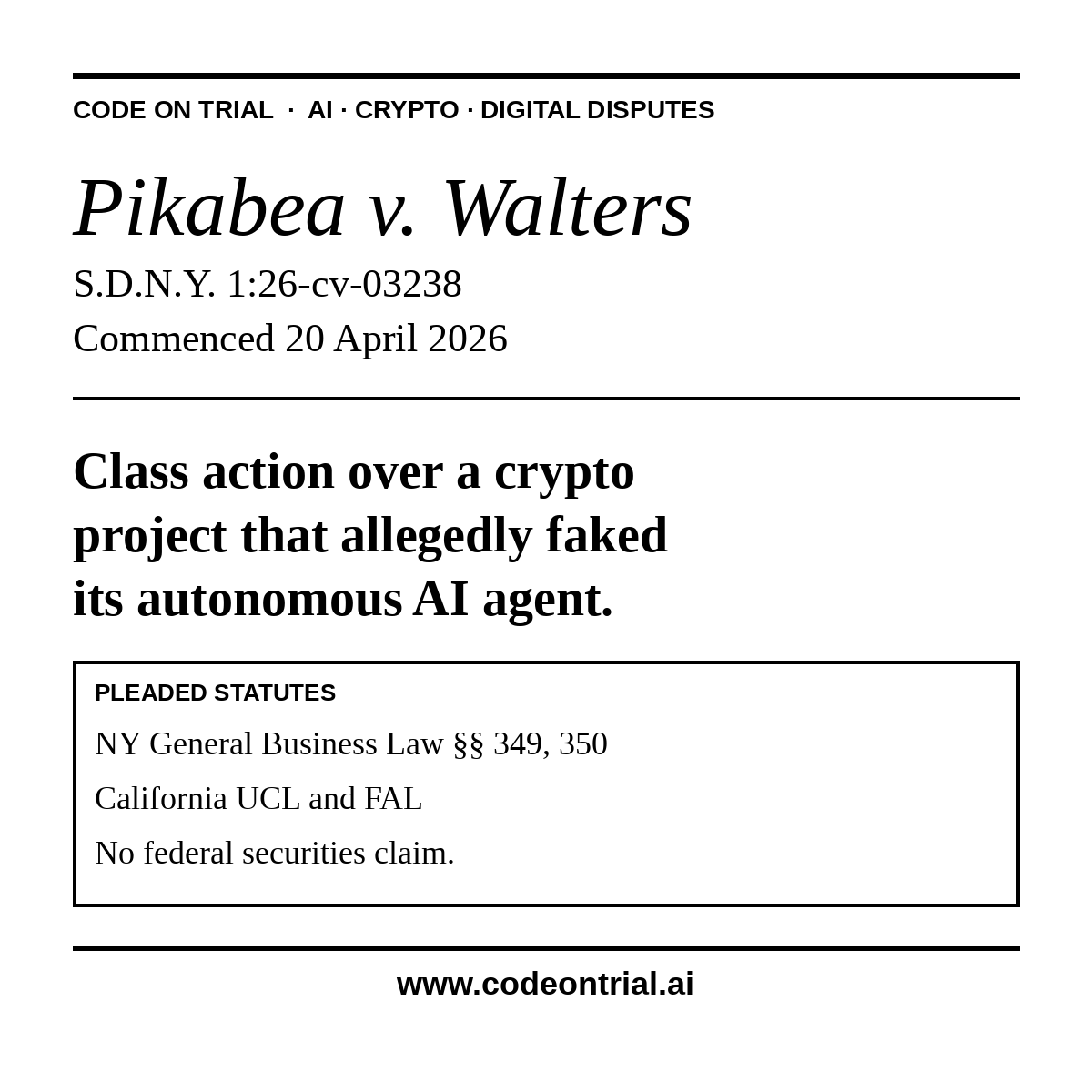
In Pikabea v. Walters (S.D.N.Y. 1:26-cv-03238, commenced 20 April 2026), a putative class of AI16Z / ELIZAOS purchasers sued Shaw Walters, Eliza Labs, AI16Z DAO and others. The complaint alleges that the project’s central claim, that an autonomous AI agent named “Marc AIndreessen” was managing on-chain investment decisions, was false. It alleges the agent was operated manually.¹ Secondary reporting refers to a class said to cover approximately 3,945 affected wallet addresses across a class period running from 24 October 2024 to 20 April 2026.²
The pleading further alleges that the project mimicked the “a16z” abbreviation of Andreessen Horowitz without authorisation. It alleges that a late-2025 token migration from $AI16Z to $ELIZAOS expanded supply tenfold from 1.1 billion to 11 billion. Of the expanded supply, 40 per cent is alleged to have been allocated to insiders and undisclosed private investors against a 60 per cent allocation to public holders.³ The token had reportedly reached a peak market capitalisation above USD 2.6 billion in early January 2025.
The complaint asserts six counts: sections 349 and 350 of the New York General Business Law (deceptive acts or practices and false advertising), the California Unfair Competition Law and False Advertising Law, negligent misrepresentation and unjust enrichment. There is no Securities Act or Exchange Act claim.
The action has been assigned to Hon. Jed S. Rakoff. At a status conference on 19 May 2026, the court declined to advance the matter because plaintiff had made only one service attempt on Walters in San Francisco; a written report on service is due by 10am on 5 June 2026. Sebastian Quinn-Watson is resident in Australia and will require Hague Convention service. AI16Z DAO’s amenability to suit is contested; DLA Piper, appearing for Walters and Eliza Labs, took the position at the same conference that “the DAO can’t be sued”.⁷ The forum is the same district and before the same judge as United States v. Heppner (S.D.N.Y., 17 February 2026), the AI-privilege ruling involving a criminal defendant’s self-directed use of Claude.
The state-law turn
The choice is consistent with two converging pressures. The first is the SEC’s reorientation. The joint SEC/CFTC interpretive release of 17 March 2026 sets out a taxonomy of crypto-assets and signals an approach centred on classification rather than the front-foot enforcement of the Gensler era. Chairman Atkins has signalled that AI-related misstatements will be addressed under existing anti-fraud frameworks rather than through a bespoke AI-washing rule.⁴
The second is the prior enforcement record. The SEC’s March 2024 settlements against Delphia (USA) Inc. and Global Predictions Inc. produced civil penalties of $225,000 and $175,000 respectively for misstatements about the use of AI in investment processes. The enforcement template exists. What is uncertain is whether it will be used in crypto-token AI-agent cases where classification remains contested.⁵
The Pikabea complaint shows how that gap may be filled. State consumer protection statutes do not depend on a “security” classification of the token. Section 349 of the New York General Business Law requires a deceptive act in the conduct of any business directed at consumers in New York. Section 350 requires false advertising. The California UCL and FAL provide analogous coverage. The pleader does not need to win the Howey debate to advance the state-law theory.
The English comparator
A claim of this character would be addressed differently in the United Kingdom. Under the Digital Markets, Competition and Consumers Act 2024, in force from 6 April 2025, the CMA may issue direct infringement decisions for misleading commercial practices and impose civil penalties of up to 10 per cent of a trader’s global turnover without first obtaining a court order.⁶ A token promotion that misrepresented the existence of an autonomous AI agent would be capable of attracting that jurisdiction. It would also fall within the FCA’s financial promotions regime for qualifying cryptoassets, in force since 8 October 2023, where breach of the section 21 financial-promotion restriction can amount to a criminal offence under section 25 of the Financial Services and Markets Act 2000.
The English direction is administrative and centralised. The American direction, at least for the moment, is private and state-based. The same misrepresented AI capability is policed through two different enforcement architectures.
Implications for practitioners
Three points follow. First, crypto issuers should treat any “autonomous AI agent” claim as capable of being characterised as a material representation under state consumer protection law and, in UK-facing promotion, as part of a financial promotion under FCA rules. Second, pleading strategy in US AI-washing cases may migrate towards state consumer statutes in federal forums where securities status is contested. Third, English counsel advising crypto issuers must stress-test promotional copy not against the Misrepresentation Act 1967 alone but against the DMCC Act enforcement regime, which imposes a far heavier penalty exposure.
Pikabea is the early-stage pleading. Whether the court certifies a class and whether the state-law theory survives a motion to dismiss will set the template for the next generation of AI-washing claims.
Footnotes
¹ Pikabea v. Walters et al, No. 1:26-cv-03238 (S.D.N.Y. commenced 20 April 2026; Rakoff, J.). Justia docket; Inner City Press court report of the 19 May 2026 status conference; Burwick Law statement of 20 April 2026. Operative complaint not independently reviewed at time of writing.
² Wallet-address figure (approximately 3,945) drawn from secondary reporting (Binance Square, claimdepot.com, 21 April 2026).
³ Allocation, supply and migration figures, market-capitalisation figure and chronology drawn from secondary reporting (claimdepot.com, 21 April 2026, citing the complaint paragraph-by-paragraph; crypto-economy.com; cryptorank.io). Independent verification against the operative complaint and the token contract remains recommended.
⁴ SEC interpretive release issued with CFTC interpretive guidance, 17 March 2026 (SEC Press Release 2026-30; SEC Release No. 33-11412).
⁵ In re Delphia (USA) Inc. and In re Global Predictions Inc., SEC settled orders of 18 March 2024 (penalties of $225,000 and $175,000). Wider AI-washing template includes the June 2024 charges against the founder of Joonko Diversity Inc. (SEC Press Release 2024-70).
⁶ Digital Markets, Competition and Consumers Act 2024, Parts 3 and 4 (consumer protection), in force 6 April 2025 (Commencement No. 2 Regulations 2025).
⁷ Inner City Press court report, “Crypto Lawsuit Over AI16Z Is Delayed By Lax Service of Process in SF As DAO Unrepresented” (19 May 2026), reporting the live SDNY status conference before Judge Rakoff on service of process and the DAO’s amenability to suit.