

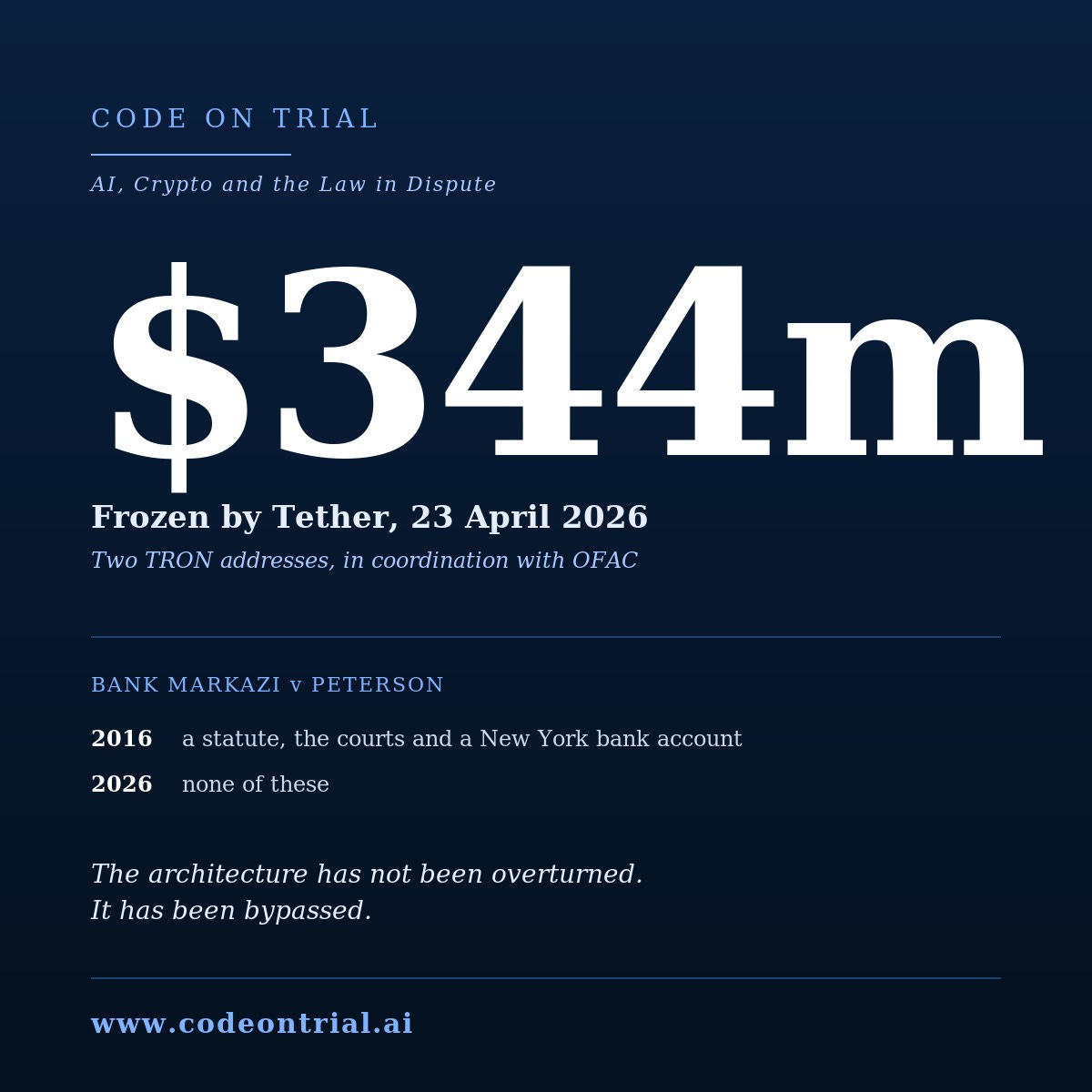
On 23 April 2026 Tether froze $344 million USD₮ across two TRON addresses in coordination with OFAC and US law enforcement.1 The following day OFAC updated Bank Markazi’s SDN List entry by adding two TRX digital currency addresses, with linkages to the IRGC-Qods Force and Hizballah.2 Treasury Secretary Scott Bessent framed the wider sanctions campaign as part of Economic Fury.3
From Citibank to TRON: the architectural shift
The $1.75 billion seizure underlying Bank Markazi v Peterson depended on assets held in a New York bank account, a statute, 22 U.S.C. section 8772, that identified the relevant enforcement proceeding and judicial enforcement under the Foreign Sovereign Immunities Act. The 2026 action depended on none of these. Tether International has redomiciled from the British Virgin Islands to El Salvador and now operates as Tether International, S.A. de C.V.; its token terms nevertheless continue to use BVI governing law.4 The frozen assets were USDT tokens on the TRON blockchain. The freeze occurred before judicial review, before OFAC’s public SDN List update the following day and before any constructive trust or judgment was imposed.
This is a different legal architecture from anything the US has previously deployed against Bank Markazi. In Peterson, Justice Ginsburg’s majority opinion (6-2, Roberts CJ and Sotomayor J dissenting) held that Congress had not invaded the judicial power by directing the disposition of specific assets in pending litigation.5 The dissent warned that the legislative branch had effectively decided a particular case. The 2026 mechanism does not even reach those waters. There is no statute directing courts. There is no judgment. There is a private issuer freezing tokens in coordination with OFAC and US law enforcement.
The GENIUS Act formalises the issuer-freeze model
The 10 April 2026 FinCEN-OFAC joint Notice of Proposed Rulemaking, issued under the GENIUS Act (S.1582, 119th Congress), would require every permitted payment stablecoin issuer to maintain technical capability to block, freeze and reject impermissible transactions, including transactions occurring on secondary markets via smart contracts.6 The proposed rule treats issuers as financial institutions under the Bank Secrecy Act, mandates risk assessments, internal controls, training and audit, and obliges issuers to comply with lawful orders. Comments close on 9 June 2026.
Once finalised, the rule will convert issuer-level freeze capability from a voluntary practice into a condition of operating as a US-permitted payment stablecoin issuer. Issuers of USDC, PYUSD and other payment stablecoins will be subject to that obligation where they operate through a PPSI structure.
The cross-jurisdictional gap
The UK and EU sanctions regimes already apply to cryptoassets. The cross-jurisdictional gap is more specific: neither the UK stablecoin regime nor MiCA yet appears to impose a GENIUS-style issuer-level obligation to maintain native technical capability to block, freeze and reject secondary-market stablecoin transactions through smart-contract control.
In the UK, FSMA 2023 and the developing FCA/Bank of England regimes focus principally on authorisation, backing assets, redemption, safeguarding, prudential requirements, operational resilience and systemic payment risk. UK sanctions law may still require cryptoassets to be frozen where they are funds or economic resources of a designated person, but that is not the same as requiring every stablecoin issuer to maintain smart-contract-level blocking infrastructure.7
In the EU, MiCA imposes authorisation, reserve, redemption, governance and disclosure obligations on asset-referenced tokens and e-money tokens. Sanctions enforcement continues to operate through EU asset-freeze regulations and Member State enforcement structures. There is no MiCA equivalent of the GENIUS Act’s PPSI-level technical freeze capability.8
The result is that, for a period, US regulation reaches more directly into the issuer-level technical architecture of stablecoin control than the equivalent UK or EU stablecoin regimes do. For Iranian, Russian and other sanctioned counterparties, the practical implication is that USDT and USDC are exposed to Treasury-driven issuer action in a way that GBP or EUR denominated stablecoins issued solely under UK or EU regimes may not be.
Forward implication
The Bank Markazi action will be cited and copied. It is a clean operational precedent for OFAC: identify wallets, coordinate with the issuer, freeze the tokens and then add the addresses publicly to the SDN entry. Practitioners advising sanctioned counterparties, or counterparties exposed to sanctions risk, should assume that stablecoin balances issued by entities with native freeze functionality and material US sanctions exposure may be frozen at issuer level before any judicial process. For US-permitted payment stablecoin issuers, the proposed GENIUS Act rule would turn that capability into a regulatory condition of issuance.
The Bank Markazi v Peterson architecture has not been overturned. It has been bypassed.
Tether press release, “Tether Supports Freeze of More Than $344 Million in USD₮ in Coordination with OFAC and U.S. Law Enforcement”, 23 April 2026.
OFAC, “Iran-related Designations; Counter Terrorism and Iran-related Designation Update; Issuance of Iran-related General License”, Recent Actions, 24 April 2026.
U.S. Department of the Treasury, “Economic Fury Targets Global Network Fueling Iran’s Oil Trade and Shadow Fleet”, 24 April 2026.
Tether, Legal Terms, noting that Tether International Limited has redomiciled from the British Virgin Islands to El Salvador and is now Tether International, S.A. de C.V.; Tether website terms, governing law clause.
Bank Markazi v Peterson, 578 U.S. 212 (2016), argued 13 January 2016, decided 20 April 2016.
FinCEN and OFAC, “Permitted Payment Stablecoin Issuer Anti-Money Laundering/Countering the Financing of Terrorism Program and Sanctions Compliance Program Requirements”, 91 Fed. Reg. 18582, 10 April 2026.
Office of Financial Sanctions Implementation, HM Treasury, “Financial Sanctions Guidance: Cryptoassets”, confirming that cryptoassets fall within the definitions of funds and economic resources for UK financial sanctions purposes.
Regulation (EU) 2023/1114 of the European Parliament and of the Council of 31 May 2023 on markets in crypto-assets (MiCA), OJ L 150/40, 9 June 2023; European Banking Authority, regulatory technical standards and guidelines on asset-referenced tokens and e-money tokens issued under MiCAR.
Do you think this strategy will be copied when the time will come against other entities?