

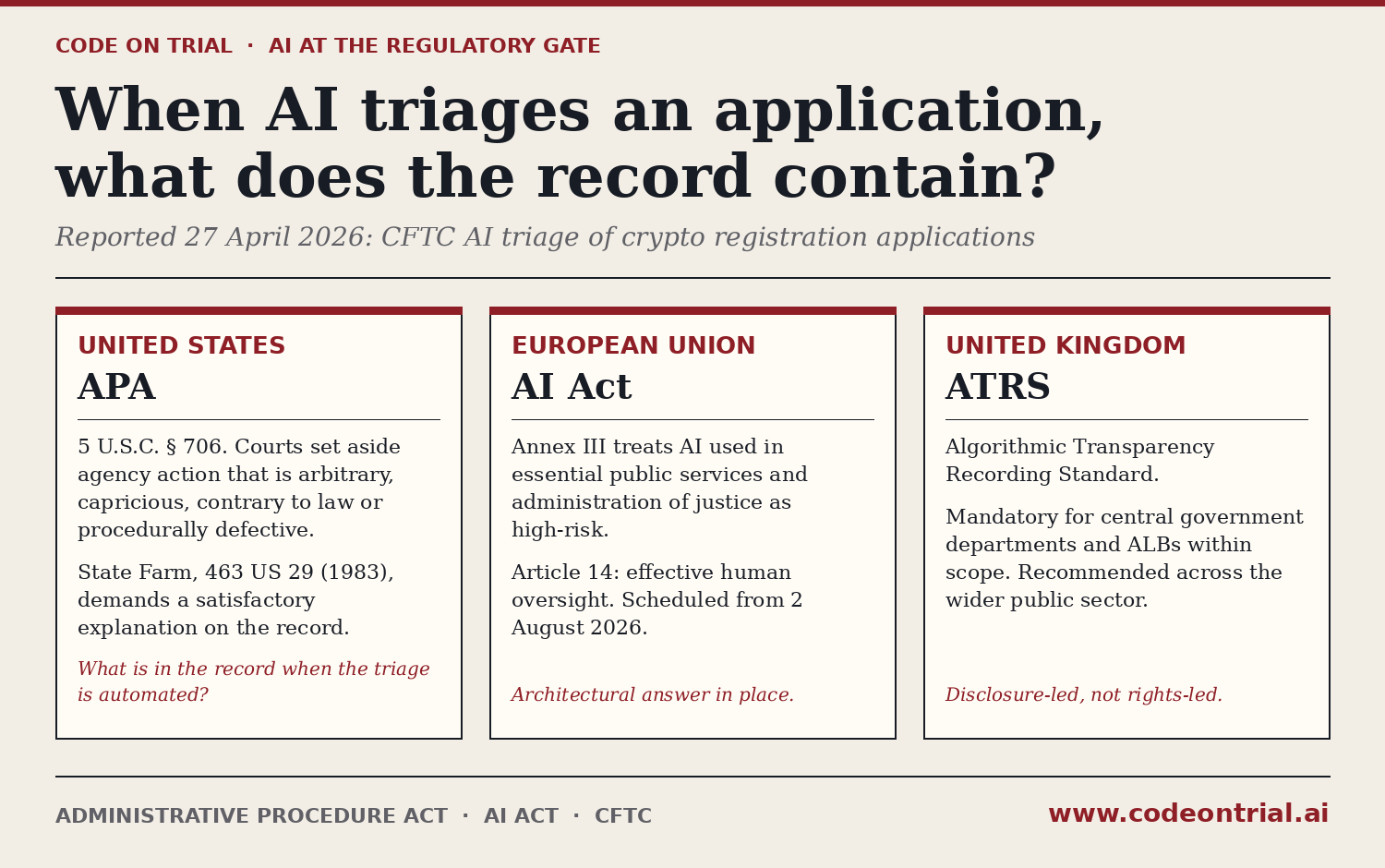
On 27 April 2026, CoinDesk reported that CFTC Chairman Michael Selig said the Commission is using, or building, artificial intelligence tools to assist with crypto registration applications.1 The reported use case is administrative triage: flagging incomplete filings, identifying clearly deficient submissions and helping prioritise the staff queue. The reporting also indicates that AI is being applied to trading data and to surveillance for fraud, market manipulation and insider trading. Reporting around Selig’s 16 April 2026 appearance before the House Agriculture Committee linked the deployment of AI tools to reduced staffing and to the agency’s need to supervise expanding crypto and prediction-market responsibilities.2
Triage at the regulatory gateway
Two structural facts give the disclosure analytical weight. The CFTC is the primary federal regulator for crypto derivatives. Following the SEC/CFTC joint interpretation of 17 March 2026, the Commission has committed to administering the Commodity Exchange Act consistently with the SEC’s interpretation of when a non-security crypto asset may become, or cease to be subject to, an investment contract.3 AI is therefore operating close to the gateway of regulatory classification, registration and market access, at the moment when the boundary between securities-law treatment and commodity-law treatment of crypto assets is the most active question in US crypto regulation.
The 1946 framework
Section 706 of the Administrative Procedure Act (APA), enacted in 1946, requires reviewing courts to set aside agency action found to be arbitrary, capricious, an abuse of discretion, contrary to law, procedurally defective or, in some cases, unsupported by substantial evidence, on the basis of the whole record.4 Motor Vehicle Manufacturers Association of US Inc v State Farm Mutual Automobile Insurance Co, 463 US 29 (1983), held that the agency must articulate a satisfactory explanation for its action including a rational connection between the facts found and the choice made. The administrative record fixes the basis of judicial review.
When the agency’s first-pass review is automated, the question is what the record contains. A flag triggered by an AI tool is not, on its own, an explanation. A rejection rationalised as “clearly deficient” without a human articulation of which fact controlled cannot satisfy State Farm in the form courts have applied since 1983. The Supreme Court’s abandonment of Chevron deference in Loper Bright Enterprises v Raimondo, 144 S Ct 2244 (2024), reinforces the point: reviewing courts are less likely to accept agency characterisation by default where the legal basis for action is contested.
Comparative jurisdiction
The EU has addressed comparable public-law risk through classification. Annex III of the AI Act covers certain public-sector AI uses, including those used by public authorities to assess eligibility for essential public services and to assist in the administration of justice. Such systems are high-risk. Article 14 requires that high-risk systems be designed and developed to enable effective human oversight during use, with the burden falling on providers and deployers.5 Registration triage of the kind the CFTC is now performing is not necessarily mapped one-for-one onto Annex III, but the architectural framework for classifying public-sector AI is in place.
The UK has adopted the Algorithmic Transparency Recording Standard. Current GOV.UK guidance treats it as mandatory for central government departments and certain arm’s-length bodies within scope, where tools significantly influence decision-making with public effect or directly interact with the public, and recommends it more broadly across the public sector. The United States has federal AI governance guidance, but no equivalent statutory high-risk classification regime and no APA-specific transparency framework for automated regulatory triage. The disclosure of CFTC AI use was made in a press interview rather than a notice-and-comment proceeding, which is itself a procedural data point.
Strategic implication
For practitioners advising crypto applicants, the immediate question is whether to plead the issue. A denied or stalled application that has been triaged by AI presents a State Farm record problem. Until the Commission publishes its protocols, denial letters should be treated as potentially actionable on APA grounds, not merely as procedural setbacks. Litigation pressure will drive disclosure of model documentation, training data and human review thresholds. That pressure is the most likely path to a US analogue of public-sector AI oversight, arrived at through judicial review rather than legislation.
1 CoinDesk, “CFTC’s AI Will Review U.S. Crypto Registration Applications, Chairman Tells CoinDesk” (27 April 2026).
2 CoinDesk, “U.S. CFTC’s Selig Says AI Has Helped Make Up for Staffing Cuts at Key Crypto Watchdog” (16 April 2026); House Agriculture Committee hearing transcript, oral evidence of Chairman Michael Selig, 16 April 2026.
3 SEC Press Release 2026-30, “SEC Clarifies the Application of Federal Securities Laws to Crypto Assets” (17 March 2026).
4 5 U.S.C. § 706.
5 Regulation (EU) 2024/1689 of 13 June 2024, Articles 6 and 14 and Annex III. High-risk obligations are currently scheduled to apply from 2 August 2026.