

The CFTC’s crypto rulemaking carries no Unified Agenda entry and no press release, so the OIRA queue is its only public trace. The classification there is Prerule, the stage before a notice of proposed rulemaking. No text yet exists for anyone to read. The question I am interested in comes earlier, being what the Commission could write at all on the authority the Commodity Exchange Act already gives it.
The filing
On 17 September 2026 the Commodity Futures Trading Commission sent a rulemaking to the Office of Information and Regulatory Affairs under the title Regulation Crypto Asset Transactions and Regulation Crypto Asset Markets. The entry carries RIN 3038-AF80 and records the stage as Prerule.1 It is the only Commission item in the OIRA queue. No entry for it appears in the Unified Agenda. The Commission has issued no press release about it, so the queue itself is the submission’s only public trace.2
The difference between a prerule and a proposed rule is not a formality. Executive Order 12866 gives OIRA ten working days to review a notice of inquiry, an advance notice of proposed rulemaking or any other preliminary regulatory action taken before a notice of proposed rulemaking. Proposed and final rules get ninety calendar days.3 The submission is preliminary and not a proposed rule. While it remains under OIRA review the public entry carries no text anyone can read or comment on.
Two days earlier, on Tuesday 15 September, the Senate declined to invoke cloture on the motion to proceed to the Digital Asset Market Clarity Act. The motion was rejected 49 to 50, against the sixty votes required.4 Chairman Michael Selig said in the same week that the Commission would proceed under its existing statutory authorities. The chairman of the Securities and Exchange Commission said much the same for his own agency.5
OIRA discloses the title, the receipt date and the classification. It does not disclose the text or the statutory basis, so what follows addresses the question the title raises rather than a rule anyone has read. The first thing to look for when a text appears is whether the Commission has confined itself to leveraged retail products or claimed a wider cash market perimeter. Either way it has to identify, somewhere in the Commodity Exchange Act, a cash market it is entitled to regulate.
What the Commodity Exchange Act gives
Three provisions frame the jurisdictional question. Section 2(c)(2)(D) supplies the direct route by which certain spot transactions become subject to exchange trading requirements, with the designated contract market provisions and Part 40 of the Commission’s regulations supplying the machinery that follows.
Section 2(a)(1)(A) gives the Commission exclusive jurisdiction over accounts, agreements and transactions involving swaps or contracts of sale of a commodity for future delivery.6 Futures and swaps, in other words. Nothing in it touches a cash sale.
Section 6(c)(1), codified at 7 U.S.C. section 9(1), makes it unlawful to use or employ any “manipulative or deceptive device or contrivance” in connection with a “contract of sale of any commodity in interstate commerce”, in contravention of such rules as the Commission promulgates.7 Those last quoted words are what carry the Commission into the spot market. The Ninth Circuit held in Commodity Futures Trading Commission v Monex Credit Company that the disjunction between manipulative and deceptive is a real one, so that the Commission may sue for fraudulent conduct without also pleading manipulation.8 District courts in New York and Massachusetts had already held that virtual currencies are commodities within the meaning of the Act.9 What those decisions confirm is an enforcement authority. It permits the Commission to sue a person who defrauded a buyer of bitcoin. It does not permit the Commission to tell a venue how to hold client assets, how to sequence a matching engine or what to file when it changes a rule.
Section 2(c)(2)(D), the retail commodity transaction provision, is the operative one. It applies to any agreement in any commodity that is entered into with or offered to a person who is not an eligible contract participant or an eligible commercial entity and that is entered into or offered on a leveraged or margined basis.10 Clause (iii) then applies 7 U.S.C. sections 6(a), 6(b) and 6b, which are sections 4(a), 4(b) and 4b of the Act, to such a transaction “as if” it “was a contract of sale of a commodity for future delivery”.11 Section 4(a) is the exchange-trading requirement, which is why a leveraged retail transaction in a commodity is deemed into the futures regime and has to be traded on a designated contract market.
That deeming carries everything the Commission has so far done in spot crypto. The listed spot trading initiative announced in August 2025 and the first leveraged retail spot crypto exchange, announced on 4 December 2025 for launch in the week of 8 December, both proceed on the footing that section 2(c)(2)(D) permits a registered contract market to list a spot digital asset product.12
The twenty-eight day problem
The deeming provision has a hole in it and the hole is where the cash market is.
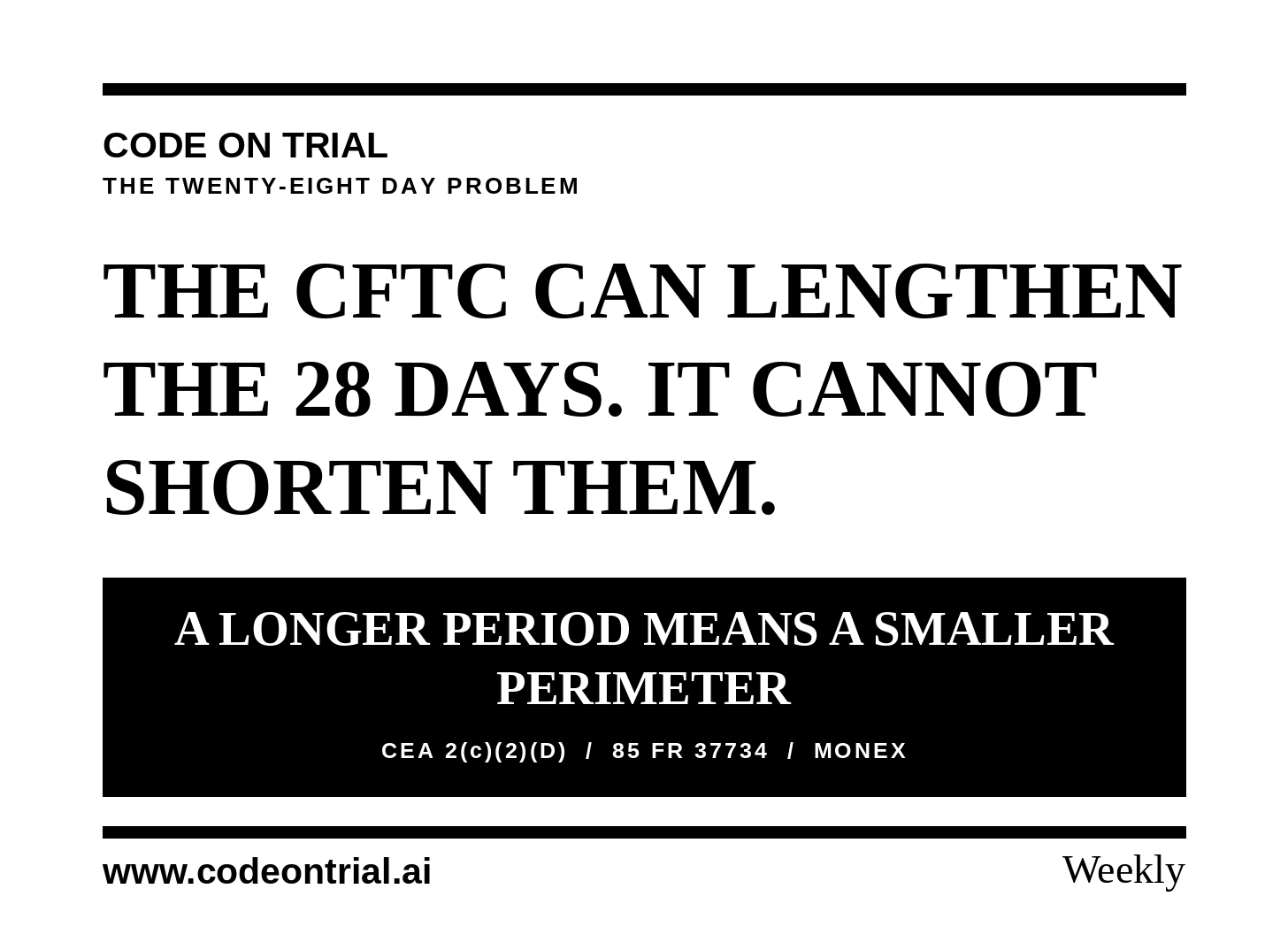
Clause (ii)(III)(aa) removes from the subparagraph any contract of sale that “results in actual delivery within 28 days or such other longer period as the Commission may determine by rule or regulation based upon the typical commercial practice in cash or spot markets for the commodity involved”.13 A retail transaction that delivers promptly is not deemed a future. It falls outside section 4(a) and therefore outside the requirement to trade on a designated contract market, together with the registration and core principle obligations that attach to trading there.
The reach of section 2(c)(2)(D) is therefore confined to retail leveraged or margined transactions that do not deliver within twenty-eight days. An eligible contract participant buying spot bitcoin falls outside it, because clause (i) applies only where the counterparty is neither an eligible contract participant nor an eligible commercial entity. A retail buyer who pays in full and takes delivery falls outside it too. So does a venue matching unleveraged spot trades between pre-funded accounts. Under the Act those transactions stay inside the Commission’s cash market antifraud and anti-manipulation perimeter and outside the exchange trading regime that section 2(c)(2)(D) creates. A rule called Regulation Crypto Asset Markets that rests on that subparagraph regulates a leveraged corner of the market and leaves the cash market where it found it.
The Commission cannot reach the rest of that market by adjusting the delivery period. The only adjustment clause (ii)(III)(aa) permits is a period longer than twenty-eight days, never a shorter one. Lengthening it would contract the Commission’s jurisdiction. A longer period would bring more transactions within the actual delivery exclusion, so fewer leveraged retail transactions would be deemed into the futures regime. Settlement practice in digital assets runs to days or less, which favours a shorter period. The Commission said as much in its 2020 interpretation on retail commodity transactions in virtual currency. It agreed there that the delivery period should correspond to the reality of a virtual currency spot transaction, while recording that it is limited in its ability to shorten the twenty-eight days the statute specifies.14 Congress set that floor and only Congress can lower it.
What has widened the perimeter is litigation rather than rulemaking. In Monex the Ninth Circuit read actual delivery to require “at least some meaningful degree of possession or control by the customer”. It rejected an arrangement under which metals stayed in the broker’s chosen depository, never changed hands and remained subject to the broker’s exclusive control.15 That construction does not condemn custody as such. The Commission’s 2020 interpretation accepts actual delivery through a depository, on conditions. A customer must secure possession and control of the entire quantity with the ability to use it freely in commerce. Once the twenty-eight days expire neither the offeror nor the counterparty seller may retain any interest, legal right or control over the asset.16 Where a platform retains control or the customer cannot transfer or use the asset freely, delivery is not made out and the transaction stays inside the deeming provision without the Commission writing anything at all. What follows may be a wider perimeter over leveraged retail transactions and no corresponding authority over the unleveraged cash market.
What CLARITY would have supplied
That gap does not have to be inferred. The House Financial Services Committee’s section-by-section analysis of its own bill describes section 401 as giving the Commission “exclusive regulatory jurisdiction over digital commodity cash or spot markets that occur on or with new entities required to be registered”. It states that this authority “complements the CFTC’s existing anti-fraud and anti-manipulation authority over all cash or spot market commodity transactions”.17 Sections 404 and 406 would have created three registration categories to carry that jurisdiction, covering the digital commodity exchange, the digital commodity broker and the digital commodity dealer.18
That is the bill’s own sponsors, writing in support of it, describing what the Commission presently holds over cash and spot commodity transactions as anti-fraud and anti-manipulation authority. They were explaining what the bill would add. Whoever drafts the preamble to the Commission’s rule will now have to explain why the position before the bill was something more than the bill’s promoters said it was.
Section 22 and the limits of provision-specific deeming
For litigants the more immediate consequence is narrower and easier to miss. The deeming in clause (iii) is provision-specific. It applies sections 4(a), 4(b) and 4b of the Act to a leveraged retail transaction as if that transaction were a contract of sale for future delivery. It does not deem the transaction to be a future for the purposes of the Act at large.
Section 22(a)(1)(B), at 7 U.S.C. section 25(a)(1)(B), gives a private right of action to a person who made through the defendant “any contract of sale of any commodity for future delivery”.19 A customer who loses money on a listed leveraged spot product therefore faces a threshold question. Did he make a contract for future delivery within the meaning of section 22 or a spot contract that section 2(c)(2)(D) deems to be a future for three enumerated provisions and no others? Clause (iii) names 7 U.S.C. sections 6(a), 6(b) and 6b and stops there, so the text does not answer the question.
The private remedy does not end there. Section 22(b)(1) gives a separate action against a registered entity. It is available to a person who engaged in any transaction on or subject to that entity’s rules, for actual losses caused by the entity’s failure to enforce a rule it is required to enforce or by its enforcement of one.20 Section 22(b)(4) requires the claimant to establish bad faith.21 A customer of a designated contract market listing spot digital asset products may therefore have a route against the exchange whether or not the underlying contract counts as a future under section 22(a).
The gap, such as it is, is claim-specific. A rulemaking cannot enlarge the causes of action Congress enacted. Within a validly regulated perimeter the Commission can impose registration, custody and rule-filing requirements without touching them. Nor does the narrow drafting of clause (iii) disturb the registered entity liability that section 22(b) supplies independently. A market structure rule could supply obligations relevant to such a claim, without displacing the separate requirements of bad faith, causation and actual loss that section 22(b) imposes.
Loper Bright and the shape of a challenge
It is tempting to reach for Loper Bright Enterprises v Raimondo and stop there. The decision did less than that. It removed the obligation on a court to defer to an agency’s reading of an ambiguous statute.22 It left arbitrary and capricious review untouched, that being a separate inquiry under the Administrative Procedure Act into whether the agency explained itself against the standard the statute sets. It has nothing at all to say about how many commissioners an agency has. Keeping those three apart is the difference between an argument and a slogan.
On the statutory question, the issue is not whether the Commission may regulate retail leveraged commodity transactions, which section 2(c)(2)(D) expressly permits, nor whether it may set a delivery period longer than twenty-eight days, which the same clause expressly permits. The issue is whether a registration and market-conduct regime for crypto asset markets generally fits the transactions the statute actually deems into the futures regime and whether the Commission has explained why it does. A rule confined to leveraged retail products listed on designated contract markets is comfortably inside the grant. The general rulemaking power at section 8a(5) is available to fill in the detail.23 A rule that reaches custody, settlement or trading in the cash market, on the footing that the deemed futures character of one class of transaction licenses the Commission to govern the venue at large, is a different proposition. A reviewing court will now resolve that question for itself without deferring to the Commission’s reading of the Act.
On the reasoning question the prerule posture is the Commission’s friend. An advance notice that asks the right questions and builds a comment file is the orthodox way to produce the explanation that arbitrary and capricious review demands. The exposure grows if the Commission proceeds to a proposed rule without using the preliminary stage to expose and test its jurisdictional premise.
Commission composition is a separate question again. The Commission’s own website currently lists one commissioner, Chairman Selig.24 It has continued to act with him as its sole serving member, approving a final rule on whistleblower awards on 11 September.25 The consequence is one of durability, since a framework resting on a short statutory foundation can be revisited without much difficulty by the three or four commissioners who follow him.
The comparator
Four weeks earlier the Securities and Exchange Commission proposed Regulation Crypto Assets, on a firmer statutory footing than the Commodity Futures Trading Commission has available to it.26 Its offering exemptions rest on the Commission’s exemptive authority. Section 18(b)(3) expressly allows it to define qualified purchaser differently for different categories of securities.
The Commission’s position under the Commodity Exchange Act is the reverse of that. Its expansive provision, section 6(c)(1), supports enforcement and not registration, while the provision that does support registration, section 2(c)(2)(D), reaches only a slice of the market. A rulemaking that produces a market structure regime for crypto assets generally has to do something that neither provision does on its own, which is the difficulty the preamble will have to meet.
What to watch
Watch the stage at which the text emerges. An advance notice carrying questions means the Commission is building a record and the framework is a 2027 proposition at the earliest. A proposed rule appearing within weeks means the prerule filing was a formality and the text already exists.
Then read the authority section. A release citing section 2(c)(2)(D) and section 8a(5), confined to leveraged retail products on registered exchanges, is defensible on its face. A release reaching into cash market conduct on the strength of section 6(c)(1) invites the challenge set out above and invites it from a direction the industry may not expect. The firms building venues want the rules. The challenge is more likely to come from a firm left outside the perimeter, from a state regulator displaced by it or from a defendant in an enforcement action taking the point collaterally.
Watch also for any proposal touching the delivery period. Lengthening it would narrow the Commission’s own perimeter, so a proposal to do so would need an explanation. The standard against which it would be measured is typical commercial practice in the cash or spot market for the commodity involved.
The Senate’s refusal to act left the Commission with an antifraud provision that reaches the whole cash market, a deeming provision that reaches a corner of it and no power to enlarge that corner by shortening the statutory delivery period. A framework can be written on that foundation. How much of the market it reaches is a question for a court reading section 2(c)(2)(D).
Notes
1. Office of Information and Regulatory Affairs, Executive Order Submissions Under Review, entry for Commodity Futures Trading Commission, RIN 3038-AF80, Regulation Crypto Asset Transactions and Regulation Crypto Asset Markets, stage Prerule, received 17 September 2026, status Pending Review. Consulted 23 September 2026 at reginfo.gov.
2. A search of the Unified Agenda for RIN 3038-AF80 at reginfo.gov returns the single line “This rule has not been published in a Unified Agenda”. The most recent Commission press release is 9302-26 of 22 September 2026, a staff advisory on mention markets. No release announces the submission. Both consulted 23 September 2026.
3. Executive Order 12866, section 6(b)(2)(A) and (B). Ten working days for a notice of inquiry, advance notice of proposed rulemaking or other preliminary regulatory action taken before a notice of proposed rulemaking. Ninety calendar days for all other regulatory actions, reduced to forty-five where OIRA has previously reviewed the information and there has been no material change, extendable once by up to thirty days with the written approval of the Director of the Office of Management and Budget or at the request of the agency head.
4. United States Senate, Cloture Motions, 119th Congress, recording a cloture motion on the motion to proceed to H.R. 3633, the Digital Asset Market Clarity Act, filed 8 August 2026 and rejected on 15 September 2026 by 49 votes to 50 against the sixty required.
5. Reported by The Block, 16 September 2026, quoting Chairman Selig as saying the Commission is “locked in and ready to ship its rules for the new frontier of finance” and Chairman Atkins as saying that “with or without legislation, we will act decisively within the SEC’s statutory authority to deliver certainty”. Both quotations are taken from posts on X and are reproduced as reported.
6. Commodity Exchange Act section 2(a)(1)(A), 7 U.S.C. section 2(a)(1)(A).
7. 7 U.S.C. section 9(1).
8. United States Commodity Futures Trading Commission v Monex Credit Company, 931 F.3d 966 (9th Cir. 2019), No. 18-55815, decided 25 July 2019.
9. Commodity Futures Trading Commission v McDonnell, 287 F. Supp. 3d 213 (E.D.N.Y. 2018). Commodity Futures Trading Commission v My Big Coin Pay, Inc., 334 F. Supp. 3d 492 (D. Mass. 2018).
10. 7 U.S.C. section 2(c)(2)(D)(i).
11. 7 U.S.C. section 2(c)(2)(D)(iii), which applies 7 U.S.C. sections 6(a), 6(b) and 6b, being sections 4(a), 4(b) and 4b of the Commodity Exchange Act. Section 6 of title 7 is headed Regulation of futures trading and foreign transactions and carries at subsection (a) the requirement that a futures transaction be made on or subject to the rules of a designated contract market.
12. CFTC Press Release 9105-25, Acting Chairman Pham Launches Listed Spot Crypto Trading Initiative, 4 August 2025, which invites comment on listing spot crypto asset contracts on a designated contract market “including section 2(c)(2)(D) of the Commodity Exchange Act, Part 40 of CFTC regulations”. CFTC Press Release 9145-25, 4 December 2025, states that listed spot cryptocurrency products “will begin trading for the first time in U.S. federally regulated markets on CFTC registered futures exchanges” and names no exchange or date. Bitnomial’s own announcement of the same date puts the launch in the week of 8 December 2025.
13. 7 U.S.C. section 2(c)(2)(D)(ii)(III)(aa).
14. Retail Commodity Transactions Involving Certain Digital Assets, 85 Fed. Reg. 37734 (24 June 2020). The Commission agrees that the actual delivery period should correspond to the reality of a virtual currency spot transaction and records that it is limited in its ability to shorten the twenty-eight days specified in section 2(c)(2)(D).
15. Ibid., on the conditions for actual delivery. The customer must secure “possession and control of the entire quantity of the commodity” and “the ability to use the entire quantity of the commodity freely in commerce” within twenty-eight days. The offeror and counterparty seller must retain no interest, legal right or control over the commodity at the expiration of that period.
16. Monex, above, on the construction of actual delivery.
17. Committee on Financial Services, United States House of Representatives, Section-by-Section, Digital Asset Market Clarity (CLARITY) Act of 2025, 10 July 2025, section 401.
18. Ibid., sections 404 and 406.
19. 7 U.S.C. section 25(a)(1)(B).
20. 7 U.S.C. section 25(b)(1), which makes a registered entity that fails to enforce a rule it is required to enforce liable for actual damages sustained by a person who engaged in any transaction on or subject to the rules of that entity.
21. 7 U.S.C. section 25(b)(4), requiring a person seeking to enforce liability under the section to establish that the registered entity acted in bad faith and that the failure or action caused the loss.
22. Loper Bright Enterprises v Raimondo (2024).
23. Commodity Exchange Act section 8a(5), 7 U.S.C. section 12a(5), empowering the Commission to make such rules and regulations as in its judgment are “reasonably necessary to effectuate any of the provisions or to accomplish any of the purposes of this chapter”.
24. Commodity Futures Trading Commission, Chairman and Commissioners, consulted 23 September 2026, listing Michael S. Selig alone, as Chairman.
25. CFTC Press Release 9297-26, CFTC Approves Final Rule Concerning Whistleblower Awards, 11 September 2026.
26. Securities and Exchange Commission, Regulation Crypto Assets, Release Nos. 33-11434 and 34-106150, File No. S7-2026-27, issued 18 August 2026, published in the Federal Register on 21 August 2026 with comments due by 20 October 2026.