

Update, 20 August 2026. The Commission issued Regulation Crypto Assets as a proposed rule on 18 August, later the same day this piece was published, and without rescheduling the cancelled meeting. Three statements below were overtaken by that issuance. The substantive content of the proposal is no longer known only from Chair Atkins’s preview. The proposing release described below as never published has been issued as Release Nos. 33-11434 and 34-106150, File No. S7-2026-27. The $5 million and $75 million figures are no longer illustrative. The analysis of Section 11 and of administrative durability is unaffected by the issuance. I have set out the released text, including the state pre-emption provision in Subpart E, in “Issued Without a Meeting”. The text below is left as published on 18 August.
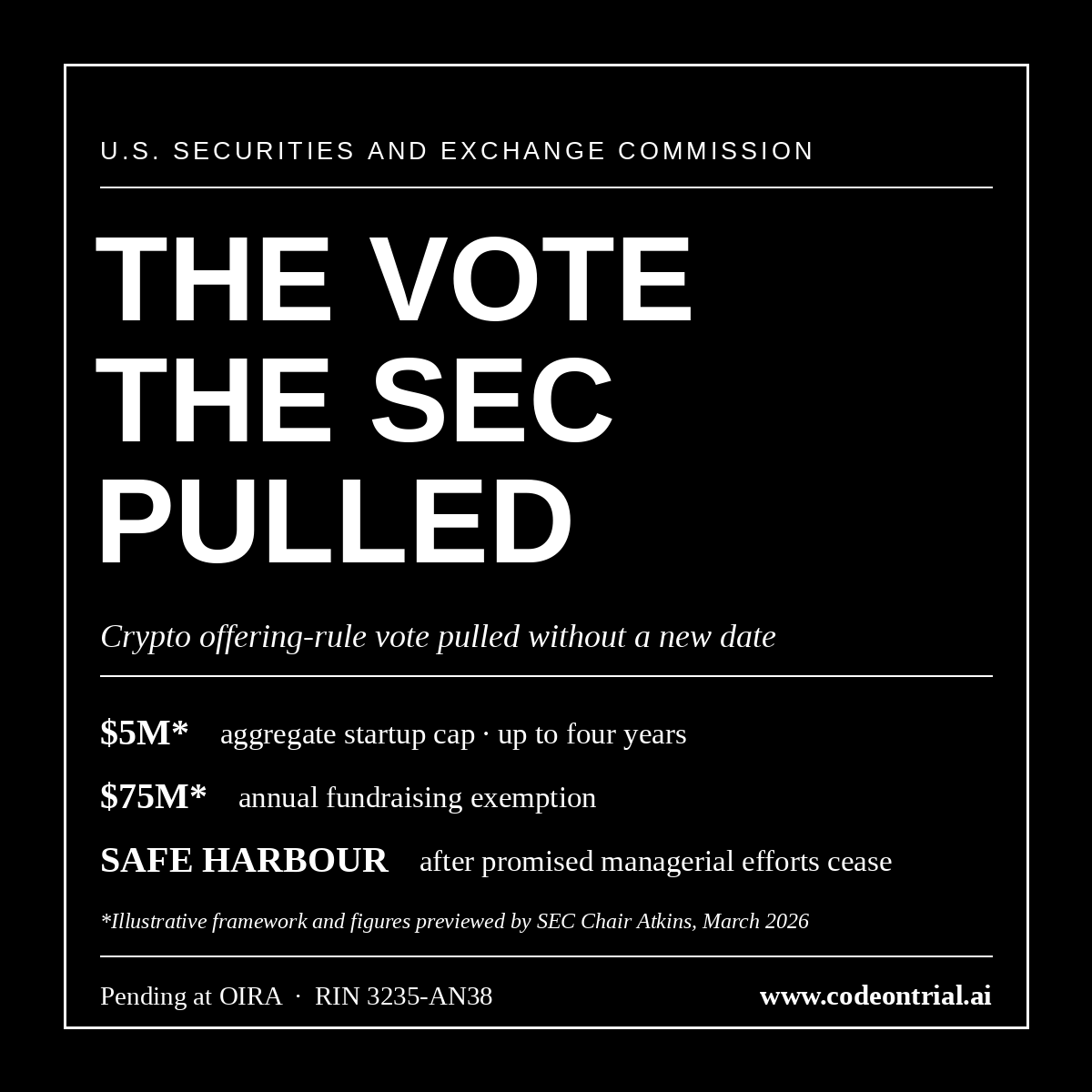
On 13 August, the SEC cancelled the open meeting scheduled for the following morning, at which its three commissioners were to decide whether to publish proposed rules creating a tailored offering regime for certain investment contracts involving crypto assets.1 The formal notice gave no reason and no replacement date. What disappeared was not a final rule, but the vote needed to expose a proposal to public scrutiny. Everything known about the proposal’s substantive content comes from what Chair Paul Atkins has previewed, not from a published release, and I keep that distinction in view throughout.
A framework with six-year roots
The framework traces to the Token Safe Harbor Proposal that Commissioner Hester Peirce first floated in 2020 and revised in 2021, which would have given a token network a grace period to decentralise before securities rules applied.2 Peirce now chairs the SEC’s Crypto Task Force. Atkins’s preview develops her earlier idea. It rests on the interpretation the SEC and CFTC issued on 17 March 2026, which set out a five-part crypto-asset taxonomy and explained that four categories ordinarily comprise non-security crypto assets, while separately addressing digital securities and investment contracts.3 The rulemaking remains under review at the White House Office of Information and Regulatory Affairs as RIN 3235-AN38. Its continued appearance there as a pending proposed rule suggests postponement rather than withdrawal, although the SEC has announced no new date.
The framework previewed by Atkins contemplated three possible routes. A startup exemption would last up to four years, with an illustrative $5 million aggregate cap and whitepaper-style disclosure in place of a registration statement. A fundraising exemption would carry an illustrative $75 million cap in any 12-month period, supported by principles-based disclosure, a discussion of financial condition and financial statements. An investment-contract safe harbour could apply once the issuer had completed or permanently ceased the essential managerial efforts represented or promised under the investment contract. The figures are illustrative because Atkins offered them as examples. The proposing release that would fix them was never published.
Where the remedy stops
The routes carry a cost that the caps obscure. Section 11 of the Securities Act gives a person acquiring a security issued under a registration statement an express claim for a material misstatement or omission in that statement, without requiring proof of scienter.4 An exempt offering carries no such claim. Federal antifraud provisions continue to apply, and other federal or state-law remedies might remain available depending on the facts, but none replicates the no-fault registration-statement claim that anchors investor protection in the registered market. Senators Warren and Van Hollen warned in April that the SEC’s direction risked exemptions that undermine decades of protection. Separately, former SEC Chief Accountant Lynn Turner described the CLARITY Act’s parallel statutory exemption framework as “severely deficient”.5 While the vote remains postponed, token issuers have the March interpretation but no tailored offering regime, leaving investors with neither the protections contemplated in Atkins’s preview nor a comprehensive statutory framework.
The European contrast
Europe addressed the same subject through legislation. MiCA, Regulation (EU) 2023/1114, has applied in full since 30 December 2024 and requires many offerors of crypto-assets, and persons seeking their admission to trading, to publish a crypto-asset white paper whose defective content can found civil liability under Article 15.6 That liability is not the equivalent of Section 11. A holder must establish that the information was not complete, fair or clear, or was misleading; that reliance affected the decision to acquire, sell or exchange the asset; and that loss resulted. Even so, the obligation sits in binding EU legislation. Changing it would require further legislative action. The US is trying to reach a comparable destination by rulemaking because Congress has not passed a statute, and that route is exposed in two ways. Peirce is due to leave in November for Regent University, which would reduce the Commission to two serving members unless another appointment is made.7 Any eventual rule would also face a post-Loper Bright court applying its own judgment to disputed questions of statutory authority, without Chevron deference. Neither point prevents rulemaking. Both show how much of the framework rests on administrative rather than legislative durability, since a later Commission could amend or rescind it through further rulemaking.
The near-term calendar
The weeks ahead will show which way the executive branch leans. The CFTC convenes its first Innovation Advisory Committee on 20 August, under the banner “Crypto’s Regulatory Evolution: From Uncertainty to Clarity”, a commodities regulator occupying ground a securities regulator has just stepped back from.8 The Digital Asset Market Clarity Act, meanwhile, is reported to face a cloture test on 15 September. Senator Lummis has warned that failure this year could push comprehensive federal legislation into the next Congress.9 For issuers and compliance teams the planning assumption should shift. Do not assume publication on the original timetable, watch the status of RIN 3235-AN38 on Reginfo.gov for the first firm signal and price in a securities framework that, if it arrives, can be revised by a later Commission. A statute-shaped problem is being met with an administrative instrument, and that mismatch is where the exposure lies.
Notes
1. SEC, notice of cancellation of the open meeting of 14 August 2026 (sec.gov); scheduling explanation reported by Reuters, 13 August 2026.
2. SEC Commissioner Hester M. Peirce, Token Safe Harbor Proposal (2020); revised proposal (2021).
3. SEC Press Release 2026-30, “SEC Clarifies the Application of Federal Securities Laws to Crypto Assets”, 17 March 2026 (joint SEC and CFTC interpretation).
4. Securities Act of 1933, s.11 (15 U.S.C. s.77k).
5. Senators Elizabeth Warren and Chris Van Hollen, letter to SEC Chair Paul Atkins, 27 April 2026 (US Senate Committee on Banking, Housing, and Urban Affairs, minority), written response requested by 8 May 2026. Lynn Turner, former SEC Chief Accountant, letter to the Senate Banking and Agriculture Committees, 13 January 2026, describing the CLARITY Act framework as “severely deficient”.
6. Regulation (EU) 2023/1114 (MiCA), Articles 4–15; applicable in full from 30 December 2024.
7. Regent University School of Law faculty announcement (Peirce to join November 2026); Bloomberg, 21 May 2026.
8. CFTC Press Release 9279-26; Federal Register notice 2026-16328 (11 August 2026).
9. Majority Leader John Thune filed cloture on the motion to proceed to the Digital Asset Market Clarity Act (H.R. 3633), first procedural vote set for 15 September 2026 (The Block; American Banker, 8 August 2026). Senator Lummis’s timing warning as reported (Tech Times, August 2026).