

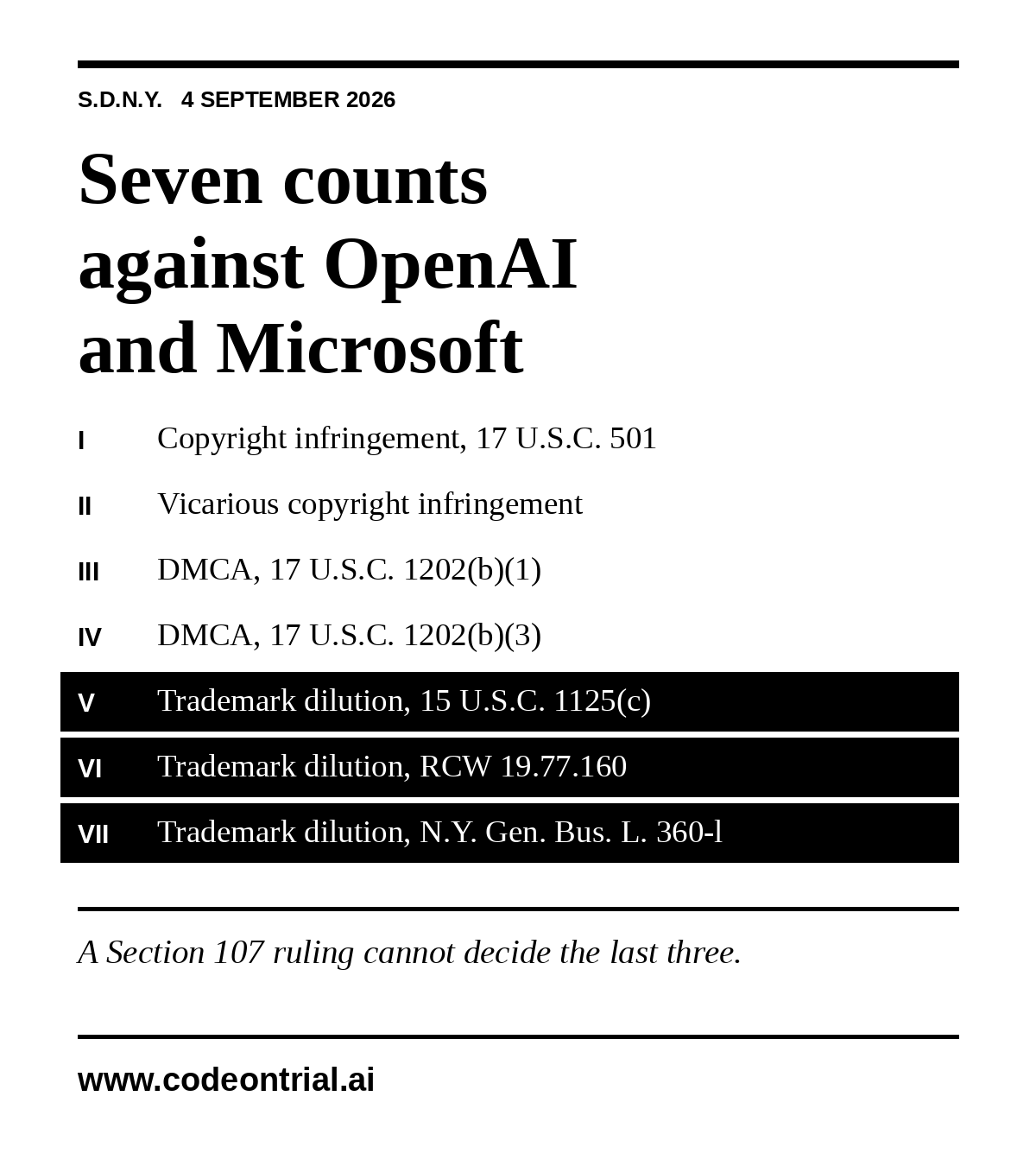
The Seattle Times and Newsday sued OpenAI and Microsoft in the Southern District of New York on 4 September.1 Seven counts, of which three are trademark dilution. Those three make the pleading worth reading closely because a ruling on Copyright Act fair use would not decide them.
What the rulings so far have decided
The action arrives against a body of rulings from Judge Sidney Stein in the consolidated Times, Daily News and Center for Investigative Reporting actions. On 4 April 2025 he gave judgment on the motions to dismiss in all three.2 He dismissed the section 1202(b)(3) claims against every defendant in all three actions. He dismissed the section 1202(b)(1) claims against Microsoft in all three. Each was dismissed without prejudice. Section 1202(b)(1) claims against OpenAI survived in the Daily News and CIR actions but not in the Times action. Section 1202(b) carries what the court described as a double scienter requirement. Those pleadings failed on the second limb, knowledge that the conduct would induce, enable, facilitate or conceal infringement.
On the trademark side he went the other way. He denied the motions to dismiss the federal and New York state dilution claims in the Daily News action. The federal claim survived because the diluted marks were plausibly alleged to be famous. The New York claim survived a different attack. Microsoft’s challenge to section 360-l was brought under the dormant Commerce Clause rather than on the merits of dilution. At section VIII.B of the opinion the court held that the New York statute does not offend the Clause.
Counts III and IV of the new complaint are pleaded against the defendants without limitation. Counts V, VI and VII are dilution counts. The DMCA counts repeat theories that the April opinion rejected. The dilution counts follow theories it allowed to proceed. As at the 4 September docket update, no judge was shown and the action had not been tagged into the multidistrict litigation. Whether these issues will come before Judge Stein remains to be seen.
The untested exclusions
Section 1125(c)(3) excludes three categories of conduct from federal dilution liability. The first is fair use, other than as a designation of source for the defendant’s own goods or services, including nominative or descriptive use and certain parody, criticism or commentary. The other two are all forms of news reporting and news commentary, together with any noncommercial use of a mark. None of the three is addressed in the complaint, which is ordinary at the pleading stage but leaves the whole of Count V contingent on how a court reads statutory language drafted with a human speaker in mind.
The federal count presents a different threshold question. Section 1125(c)(1) concerns a defendant’s use of a mark or trade name in commerce that is likely to cause dilution. Here the alleged use is a masthead appearing in generated output rather than a mark adopted to identify the defendants’ own services. Whether that output satisfies the statutory requirements remains unresolved in these cases, as does whether the reporting or noncommercial exclusions apply.
The defendants could invoke the news-reporting exclusion where an output uses a masthead while summarising a news event. Harder is whether the statutory description attaches to the particular output or whether the court should examine the commercial service through which the output was produced. On that sequencing question the text is silent. In Jack Daniel’s Properties, Inc. v. VIP Products LLC the Supreme Court held that the noncommercial use exclusion did not shield parody or commentary where the challenged mark was being used to designate the source of the defendant’s own goods.3 The Court described its decision as narrow and did not determine the wider reach of the noncommercial use exclusion.
Paragraph 120 pleads dilution by tarnishment under section 1125(c)(2)(C) on the footing that the products hallucinate content and misattribute it to the plaintiffs. Tarnishment doctrine developed around unsavoury association, typically a famous mark placed alongside sexual or illicit material. Applied here it becomes a claim about model error, which is a claim about a defect in the product rather than about what the defendant chose to associate with the mark.
The state counts and why they were pleaded separately
The state counts offer alternative routes around the federal fame threshold.
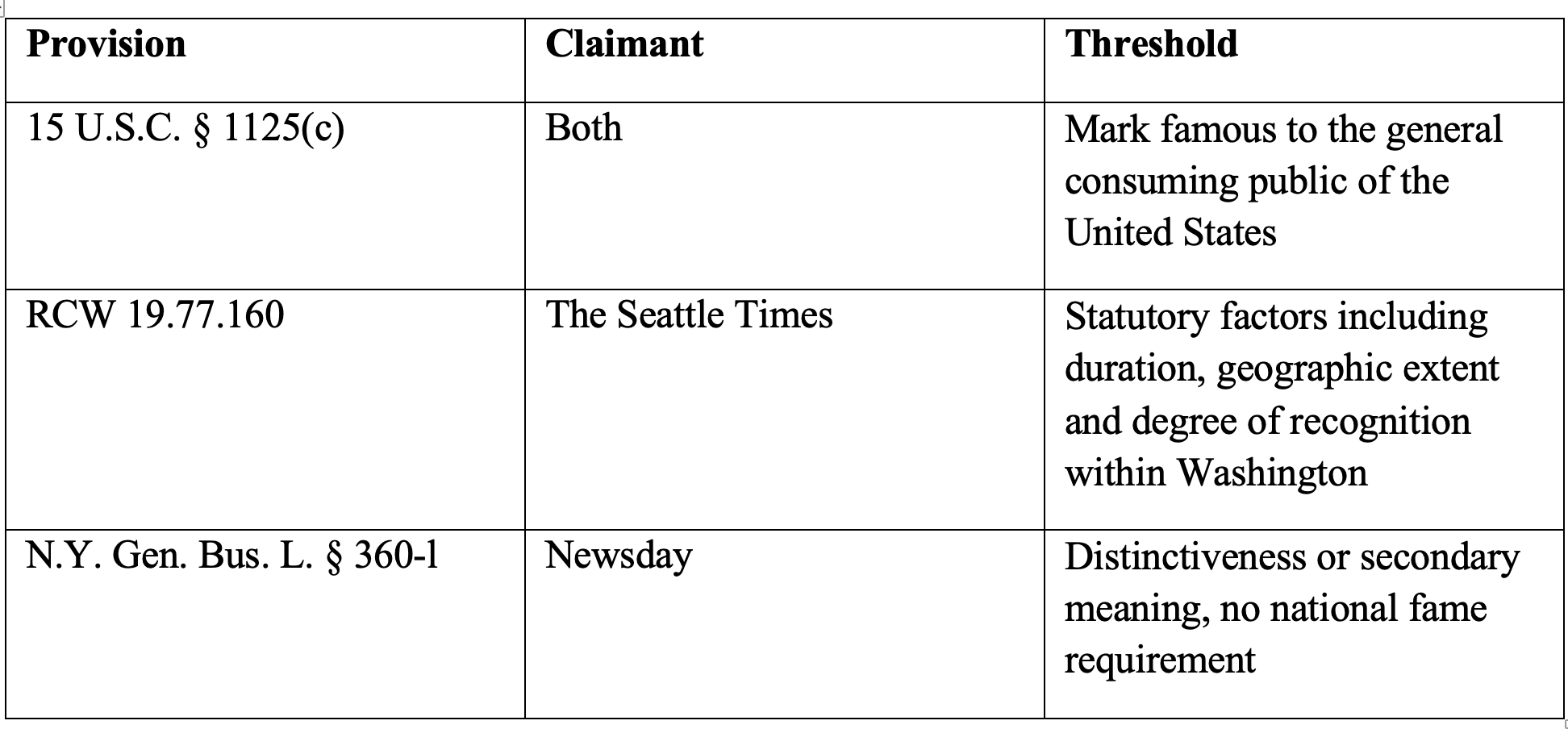
The Washington count avoids the federal nationwide fame standard, but it does not avoid every federal difficulty. RCW 19.77.160 contains its own exclusions for specified fair use, noncommercial use and all forms of reporting and news commentary.
The complaint pleads the RCW 19.77.160 factors in terms at paragraphs 126 to 129. Continuous and prominent use since at least 1896, an audience of over one million readers monthly, eleven Pulitzer Prizes and registration on the Principal Register. That is a regional publisher pleading fame within Washington, an alternative unavailable under the federal nationwide fame standard. Section 360-l expressly provides injunctive relief. Its value here is the distinctiveness threshold it applies rather than a federal requirement of fame among the general consuming public.
The sequencing problem
If the action is transferred into MDL 3143 and stayed with the other newly tagged cases, none of this is likely to be decided soon. Judge Stein has issued a run of orders in that multidistrict litigation requiring newly tagged plaintiffs to show cause why their actions should not be stayed pending resolution of summary judgment in the other active cases. The pattern is visible at ECF 1556 on 18 May 2026, ECF 1599 on 29 June 2026 and ECF 1679 entered on 31 August 2026.4 The Department of Justice filed a statement of interest in the same multidistrict litigation on 1 September supporting the position that training is fair use under the Copyright Act.
The stays are being ordered by reference to summary judgment on infringement. Section 107 is a defence to copyright infringement. It does not decide claims under section 1125(c), RCW 19.77.160 or section 360-l. The federal and Washington provisions contain their own express exclusions. The New York provision does not. A ruling that training on news content is fair use under section 107 would leave Counts V, VI and VII intact. A ruling the other way would not decide them either, since neither outcome speaks to whether a masthead reproduced in generated output is a use in commerce.
For practitioners advising publishers, the drafting point is clear enough. Copyright and dilution claims do not rise or fall on the same legal question. If this action is transferred into MDL 3143 and stayed, the trademark counts may wait behind the copyright bellwethers even though a ruling on section 107 would not decide them. The state counts also avoid the federal nationwide fame threshold, although the Washington statute contains parallel exclusions and the New York provision is directed principally to injunctive relief.
1 Complaint, The Seattle Times Company and Newsday LLC v. OpenAI, Inc., OpenAI GP, LLC, OpenAI, LLC, OpenAI OpCo, LLC, OpenAI Global LLC, OAI Corporation, OpenAI Holdings, LLC, OpenAI Foundation, OpenAI Group PBC and Microsoft Corporation, No. 1:26-cv-07644 (S.D.N.Y., filed 4 September 2026), ECF No. 1. Thirty-eight pages. Counsel Klaris Law PLLC. Jury demanded.
2 Opinion, The New York Times Company v. Microsoft Corporation, No. 1:23-cv-11195-SHS-OTW (S.D.N.Y.), ECF No. 514 (signed 4 April 2025), filed in associated cases 1:24-cv-03285-SHS-OTW and 1:24-cv-04872-SHS-OTW. The famousness holding is at section VII.B. The New York ruling is at section VIII.B and rejects a dormant Commerce Clause challenge.
3 Jack Daniel’s Properties, Inc. v. VIP Products LLC, 599 U.S. 140 (2023).
4 In re: OpenAI, Inc., Copyright Infringement Litigation, No. 1:25-md-03143-SHS-OTW (S.D.N.Y.). ECF No. 1679 was signed on 28 August 2026 and entered on 31 August 2026, with a show cause response due 11 September 2026, in associated case 1:26-cv-07171-SHS.