

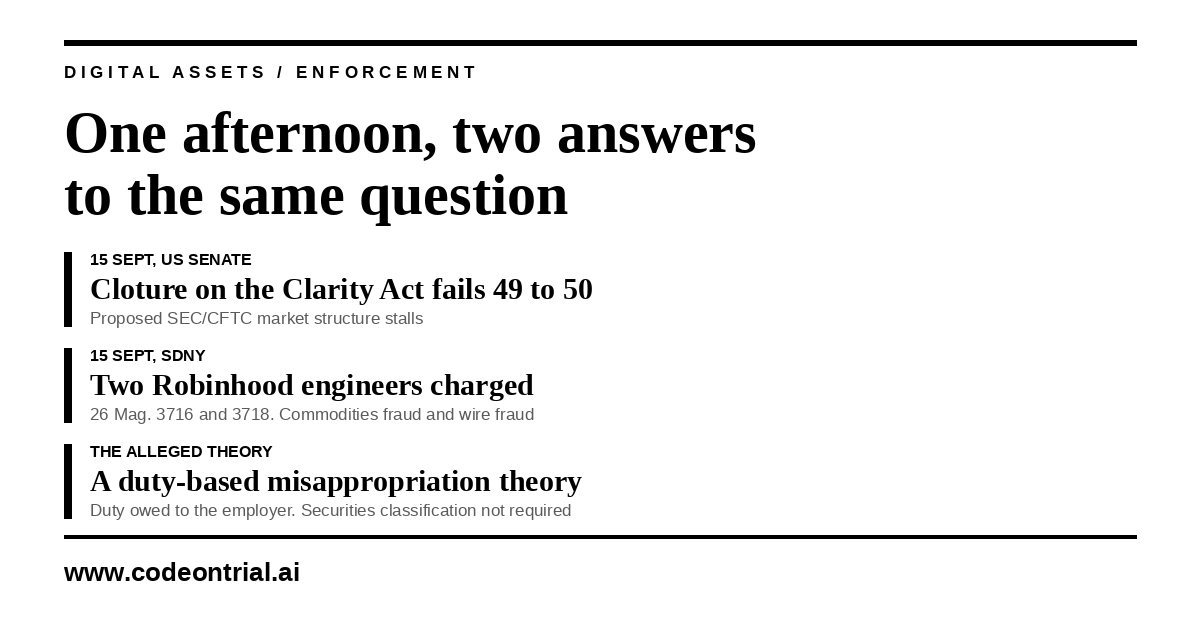
Complaints unsealed in Manhattan federal court on 15 September charge two Robinhood engineers with commodities fraud and wire fraud over perpetual futures traded on Hyperliquid ahead of Robinhood Crypto’s token listing announcements.1
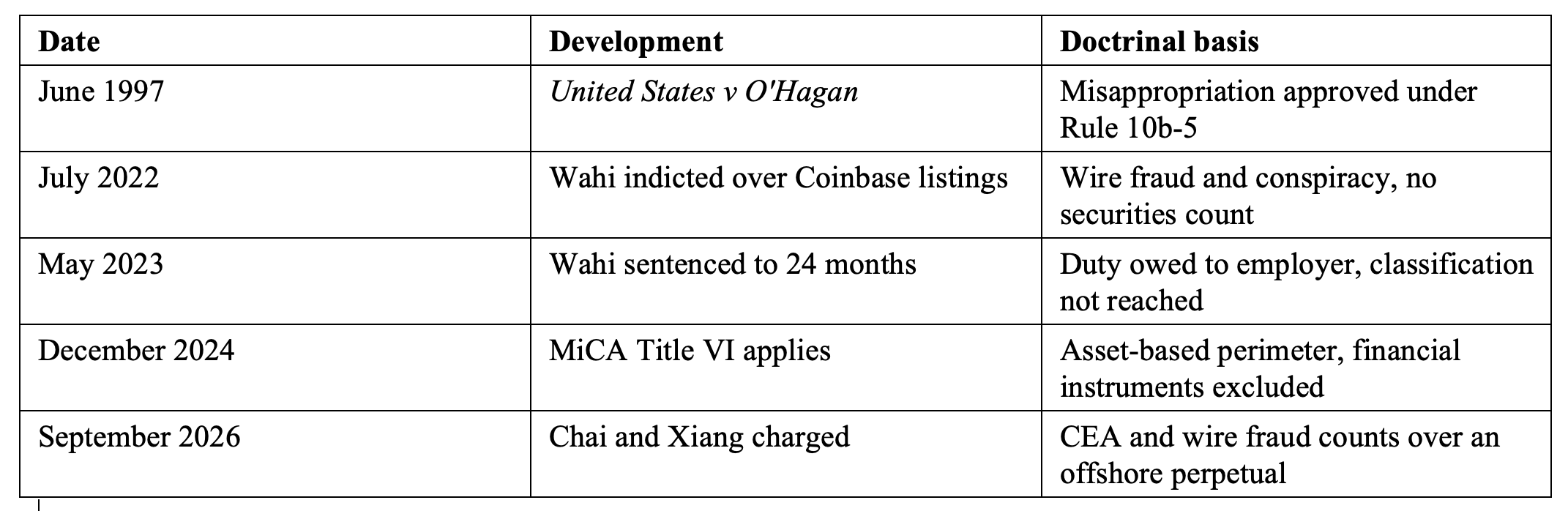
Prosecutors did not have to establish that the underlying tokens were securities. Count One pleads that each defendant, “knowing that he had obtained material nonpublic information in breach of a duty, used that information to trade perpetual futures on a decentralized derivatives exchange for personal gain”.2 That resembles the misappropriation theory approved in O’Hagan, placing the alleged deception in the employee’s misuse of entrusted information rather than in the classification of the underlying token. The same facts produce a different result in Europe and England.
The American route avoids token classification
Two features of the alleged conduct matter. The defendants are said to have traded derivatives referencing the tokens without acquiring the tokens themselves, and to have done so on a protocol that the complaints plead holds no CFTC approval to operate a futures contracts market and geofences United States IP addresses.3
The complaints plead both features without first classifying the underlying tokens as securities. Count One is brought under section 6(c)(1) of the Commodity Exchange Act and Rule 180.1, and tracks the statutory language reaching conduct “in connection with a swap, a contract of sale of a commodity in interstate commerce, and for future delivery on and subject to the rules of a registered entity”.4 Count Two avoids the classification question differently, by requiring a scheme to obtain money or property by fraud and the use of interstate or foreign wires. The complaints allege both, identifying the listing information as valuable confidential business information and the trading profits as money obtained from counterparties.5
The Office made the same move in 2022. The indictment against Ishan Wahi over Coinbase listings charged two counts of wire fraud conspiracy and two of wire fraud, and pleaded no securities count, while the Commission alleged in parallel civil proceedings that several of the tokens were securities.6 The classification question was not adjudicated in the criminal case, which did not require it to be.
Where Europe actually draws the line
The intuitive European answer is that a decentralised venue defeats the regime. It does not.
Title VI of the Markets in Crypto-Assets Regulation, Articles 86 to 92, has prohibited insider dealing, unlawful disclosure and market manipulation in crypto-assets since 30 December 2024, with Article 89 carrying the insider dealing prohibition.7 Its scope is fixed by the asset, not the venue. Where a crypto-asset is admitted to trading or admission has been requested, the prohibitions bite on conduct wherever it occurs, including dealing on a fully decentralised exchange running as a smart contract.8 Hyperliquid would not save anyone.
The obstacle is the classification of the instrument traded. Article 2(4)(a) excludes financial instruments from MiCA, and ESMA’s guidelines indicate that a derivative referencing a crypto-asset will fall within MiFID II where it satisfies the relevant derivative criteria.9 A cash-settled perpetual of the kind alleged here is therefore likely to be treated as a financial instrument rather than a crypto-asset governed by MiCA. The underlying token may remain a crypto-asset. The perpetual itself routes instead to MAR, which ordinarily requires the financial instrument to be admitted to trading, traded on an MTF or OTF, or otherwise connected through Article 2(1)(d) to an instrument within that perimeter.10 On the facts presently alleged, there is no identified Union venue or covered instrument supplying that connection.
The resulting gap begins with the classification of the perpetual and continues through MAR’s trading perimeter. It is also a live European argument, since derivatives sit outside MiCA while carrying most of the trading volume, which licensed exchanges have begun calling reverse discrimination.11
England is narrower again. The criminal insider dealing offence in Part V of the Criminal Justice Act 1993 applies only to securities within Schedule 2 and is subject to its own market and territorial conditions.12 A perpetual on a token traded through an offshore decentralised protocol is not an obvious fit. Section 4 of the Fraud Act 2006 provides a possible alternative, where an employee dishonestly abuses a position in which he is expected to safeguard, or not act against, his employer’s financial interests, intending thereby to make a gain or cause a loss.13 That resembles O’Hagan in locating the alleged wrong in an abuse of position, but its application to these facts would still have to satisfy the English offence’s full elements and territorial rules.
The employer documents the duty
A duty-based theory needs proof of the duty and the defendant’s knowledge of it. In both American cases, the employers’ internal arrangements supplied unusually clear evidence. The 2022 indictment records that Ishan Wahi belonged to a private Coinbase messaging channel reserved for employees involved in asset listings.6 The Robinhood complaints plead that listing information was restricted to “Coin Aware Individuals” with access to a confidential Slack channel. Robinhood’s policy also prohibited those employees from trading on any platform before a listing announcement and during the following 24 hours.14
The compliance point is practical. A dealing policy confined to particular instrument categories or to the firm’s own venue may leave avoidable uncertainty over the scope of the employee’s obligation. The policy does not create criminal liability or replace the statute. It can, however, provide powerful evidence that the information was confidential, that the employee knew it, and that off-platform trading breached an identified duty.
None of this turned on the Clarity Act cloture motion failing the same afternoon. Legislation dividing digital assets between the Commission and the Commodity Futures Trading Commission would establish a clearer framework for registration, disclosure and civil liability. It would not displace the theory pleaded in these complaints. The complaints are allegations, both defendants are presumed innocent, and the theory has not yet been tested on a motion to dismiss, at trial or on appeal.
Notes
1 United States v Chai, 26 Mag. 3716, and United States v Xiang, 26 Mag. 3718 (S.D.N.Y.), sealed complaints sworn before Willis USMJ and unsealed 15 September 2026. Both plead violations of 7 U.S.C. §§ 9(1) and 13(a)(5), 17 C.F.R. § 180.1 and 18 U.S.C. §§ 1343 and 2. Hefu Chai, 36, of Menlo Park, California; Huaisong Xiang, also known as “Jerry Xiang”, 30, of Jersey City, New Jersey. See also USAO SDNY press release 26-260.
2 Chai complaint, Count One; Xiang complaint, Count One. See United States v O’Hagan, 521 U.S. 642 (1997).
3 Chai complaint ¶ 5(a); Xiang complaint ¶ 5(a). The complaints add that the geofencing may be bypassed using a virtual private network.
4 Chai complaint, Count One; 7 U.S.C. § 9(1); 17 C.F.R. § 180.1.
5 Chai complaint, Count Two; Xiang complaint, Count Two; 18 U.S.C. §§ 1343 and 2.
6 USAO SDNY press release 22-232, 21 July 2022, announcing the unsealing of an indictment. Ishan Wahi was sentenced by Preska J to 24 months in May 2023.
7 Regulation (EU) 2023/1114, Title VI, Articles 86 to 92.
8 This reading of Title VI scope follows the analysis in Crypto-Asset Market Abuse Under EU MiCA, European Journal of Risk Regulation. It is interpretative rather than settled.
9 Regulation (EU) 2023/1114, Article 2(4)(a); ESMA Final Report on the conditions and criteria for the qualification of crypto-assets as financial instruments, ESMA75-453128700-1323. The guidelines apply the MiFID II criteria and do not establish that every product labelled a perpetual future qualifies.
10 Regulation (EU) No 596/2014, Articles 2(1) and 14.
11 The volume estimate and the reverse discrimination characterisation come from industry commentary on the derivatives exclusion, not from an official source.
12 Criminal Justice Act 1993, Part V and Schedule 2, as amended by the Insider Dealing (Securities and Regulated Markets) Order 2023, SI 2023/582.
13 Fraud Act 2006, s 4.
14 Chai complaint ¶¶ 4(e) to (h); Xiang complaint ¶¶ 4(e) to (h).