

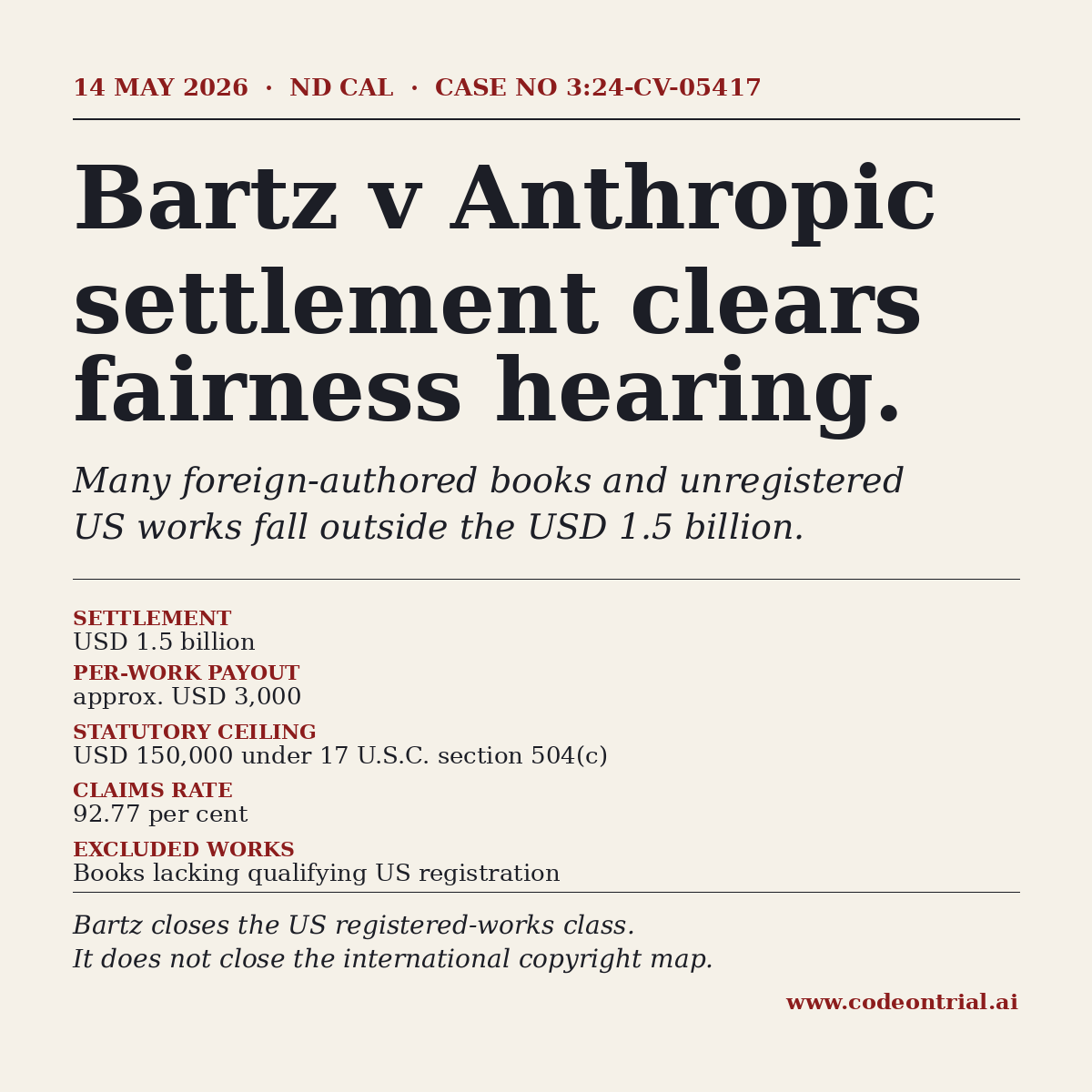
The Bartz v Anthropic fairness hearing on 14 May 2026 saw little resistance to the headline number. But the class definition reaches the registered US works problem. It does not reach the global corpus problem.
The Hearing
On 14 May 2026 the Northern District of California held the final fairness hearing in Bartz et al v Anthropic PBC, Case No. 3:24-cv-05417, the USD 1.5 billion proposed class settlement covering eligible registered works Anthropic allegedly downloaded from pirate libraries. Judge Araceli Martínez-Olguín took the matter under submission. She inherited the docket from Judge William Alsup, who retired at the end of 2025, after the June 2025 summary judgment that held training on lawfully acquired books to be fair use while leaving the pirated central-library theory exposed for trial.1
By the date of the hearing 447,576 of approximately 482,460 eligible works had been claimed, a rate of 92.77 percent. Class counsel from Lieff Cabraser characterised the opt-out and objection rates as minimal. The judge’s questioning concentrated on attorneys’ fees and the settlement’s cost structure rather than the substantive deal terms.2
The Registration Trap
The most consequential objection came from author George Tombs, whose works were excluded because they lacked a US copyright registration. The class definition restricts membership to works that satisfy the settlement’s eligibility criteria, including qualifying US registration. The predictable consequence is that many foreign-authored books, and many unregistered US works, fall outside the settlement entirely.
The exclusion is statutory. Section 411(a) requires registration as a precondition for bringing a US infringement action in respect of a United States work. Section 412 restricts statutory damages and attorneys’ fees where registration was not timely made, and that remedy restriction applies to foreign and domestic works alike.3 Neither provision extinguishes the underlying copyright, which subsists automatically in any work qualifying under Article 5(2) of the Berne Convention.4 Foreign authors whose works lack qualifying US registration, and other unregistered rightsholders, retain whatever underlying copyright they have but sit outside the USD 1.5 billion settlement structure.
The Comparative Position
The German position has begun to be clarified by the OLG Hamburg judgment in Kneschke v LAION, 5 U 104/24, 10 December 2025.5 The court held that section 44b UrhG, which implements Article 4 of Directive (EU) 2019/790, can permit text-and-data mining for AI-training datasets where no valid machine-readable opt-out has been declared. It also held that LAION, as a non-commercial research organisation, could rely separately on section 60d UrhG.6 The judgment matters for foreign authors with respect to Anthropic because Anthropic is a commercial enterprise. Section 60d is unlikely to assist it, and section 44b is available only where rightsholders have failed to opt out in a machine-readable form. If the relevant copying occurred before machine-readable opt-out mechanisms were standardised or widely implemented, the German exposure will turn on how courts treat that timing problem.
In the United Kingdom, the Government’s March 2026 copyright and AI report confirmed that a broad text-and-data-mining exception with opt-out is no longer its preferred way forward.7 The section 29A research exception remains narrow. Where the relevant copying occurs within the UK, unauthorised commercial training may be actionable as primary infringement under section 16 of the Copyright, Designs and Patents Act 1988, subject to proof of copying, territorial nexus and any applicable exception.8 Getty Images v Stability AI is the principal English authority to date, but it left the training-stage question only partly answered because the primary copyright claim was narrowed by jurisdictional and evidential issues. UK collective management organisations and author groups are obvious potential claim-coordination vehicles, but the procedural route remains unsettled.
In France, the infringement baseline rests on article L122-4 of the Code de la propriété intellectuelle. The text-and-data-mining exceptions sit in articles L122-5 and L122-5-3, following implementation of the CDSM Directive by Ordonnance n° 2021-1518.9 The opt-out architecture is materially similar to Germany’s. France is an obvious forum for coordinated rights-holder action, but the procedural route remains to be seen.
The Strategic Implication
The unresolved question is whether the US per-work figure of approximately USD 3,000 sets a reference point for parallel European proceedings. There is no doctrinal reason it should. Damages in European jurisdictions are typically calculated by reference to a notional licence fee or to an account of profits, not to settlement values reached in unrelated US class actions. The reference may still operate informally. Anthropic’s commercial incentive will be to characterise the US settlement as substantial compensation already provided. The counter is that excluded European authors and unregistered rightsholders received nothing under that settlement and their underlying rights remain unimpaired.
If approved, Bartz will close the US registered-works class. It will not close the international copyright map. European proceedings may determine whether the global cost of the allegedly pirated training corpus remains a US-class-settlement number or becomes a materially larger cross-border exposure.
Footnotes
1 Bartz et al v Anthropic PBC, Case No. 3:24-cv-05417 (ND Cal); Order on Motion for Summary Judgment, 23 June 2025 (Alsup, J.).
2 Authors Alliance, “Bartz v. Anthropic Fairness Hearing: Observations and Takeaways”, 14 May 2026; Publishing Perspectives, “Anthropic Settlement Appears to Cruise Through Its Final Fairness Hearing”, 15 May 2026.
3 17 U.S.C. sections 411(a), 412, 504(c).
4 Berne Convention for the Protection of Literary and Artistic Works, Article 5(2).
5 OLG Hamburg, Kneschke v LAION, Case No 5 U 104/24, 10 December 2025.
6 Directive (EU) 2019/790, Article 4; Urheberrechtsgesetz, sections 44b and 60d.
7 UK Government, Report and Impact Assessment on Copyright and Artificial Intelligence, March 2026.
8 Copyright, Designs and Patents Act 1988, sections 16 and 29A.
9 Code de la propriété intellectuelle, articles L122-4, L122-5 and L122-5-3; Ordonnance n° 2021-1518.